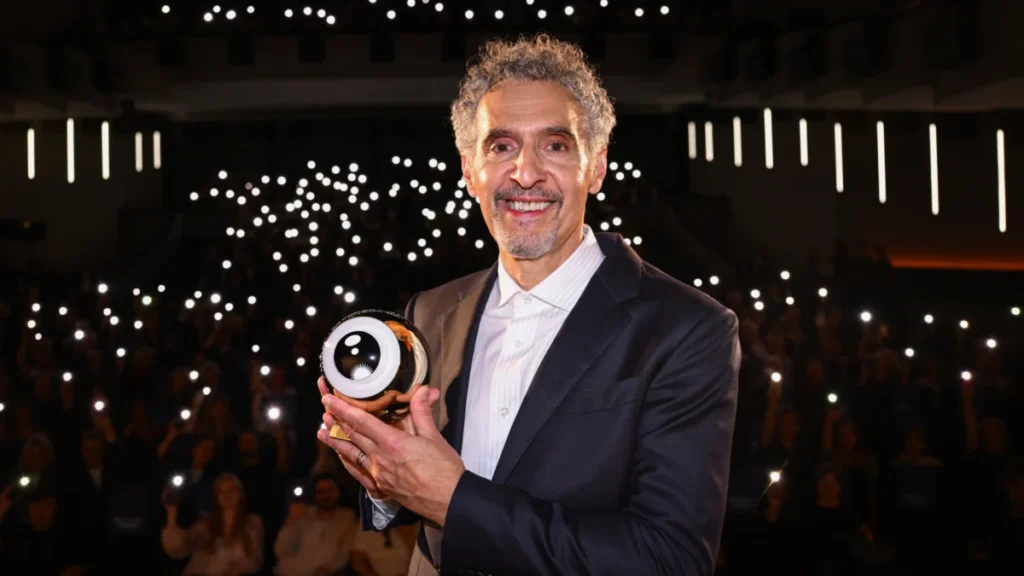

Fresh off receiving the prestigious Golden Eye award at the 22nd annual Zurich Film Festival, veteran American actor and filmmaker John Turturro captivated audiences once again during an expansive masterclass held on Sunday. The Emmy-winning star, recognized internationally for his chameleonic performances across independent cinema, blockbusters, and prestige television, used the platform to reflect on a remarkable four-decade career. Seated opposite Deadline journalist Melanie Goodfellow with his gleaming Golden Eye trophy resting between them, Turturro delivered a masterclass that balanced sharp industry insights with deeply personal reflections on art, aging, and the collaborative nature of storytelling.
The Zurich appearance comes amid a wave of renewed critical acclaim for Turturro, driven by his tour-de-force leading performance in Noah Segan’s The Only Living Pickpocket in New York. The indie feature, which first generated major waves during its successful debut on the Sundance Film Festival circuit, has thrust the formidable character actor firmly into the conversation for this year’s best actor awards race—a territory Turturro has historically navigated with characteristic reluctance.
Main Facts and the Sundance Success
In The Only Living Pickpocket in New York, Turturro stars as Harry, an aging, seasoned pickpocket whose meticulously structured daily existence spirals out of control after a single job goes disastrously wrong. The high-stakes narrative unfolds in a tense, claustrophobic 36-hour window, testing the physical and emotional limits of the protagonist. While the film has quickly become a darling of the festival circuit and a focal point for early Oscar buzz, Turturro confessed that the relentless campaign trail is not something he has traditionally pursued.
"I never really have gone the whole hog with it," Turturro told the Zurich audience when asked about transitioning into a frontrunner for the upcoming awards season. "But now I’m the lead in the film, so I’m going to support the film because I love the film."
He acknowledged, however, that navigating the modern awards apparatus serves a practical purpose in sustaining a career of longevity and creative autonomy. "Is it nice to be acknowledged? Great, but that’s not why you do it… Just because a film is really popular doesn’t mean it will have staying power, but it’s nice to be in the conversation. I don’t look upon myself as being a competitive person. I’m competitive with myself. I want to get the most out of what I can do, but it’s not sports!"
Reflecting on the unexpected critical avalanche that followed the film’s Sundance premiere, Turturro admitted to a profound sense of validation. "Finally, I’m in something that people will see," he recalled thinking. He noted that the accumulation of life experience has fundamentally shifted his artistic toolkit. Unlike athletic pursuits, where physical prowess diminishes with time, Turturro believes acting thrives on the accumulation of life’s complex emotional milestones. "Now I’ve experienced life, death, loss, being a parent, being married—what it is to really love someone versus falling in love. That’s a huge difference," he said with a laugh.
Chronology and Career Evolution: From Brooklyn Roots to Global Auteurs
Turturro’s journey to becoming one of modern cinema’s most reliable and respected actors is rooted in his upbringing in a working-class Italian-American immigrant household in Queens and Brooklyn. Over the past forty years, his resume has grown to read as a masterclass in American auteur cinema. His trajectory was forged through landmark collaborations with Spike Lee in the late 1980s and early 1990s, cementing his status in socio-politically charged masterpieces such as Do the Right Thing and Jungle Fever.
Simultaneously, Turturro became an indispensable player in the cinematic universe of Joel and Ethan Coen. His indelible performances in Miller’s Crossing, Barton Fink, O Brother, Where Art Thou?, and The Big Lebowski—in which he immortalized the eccentric, bowling-obsessed villain Jesus Quintana—showcased an astonishing range. For his searing, psychologically fractured portrayal of a beleaguered playwright in Barton Fink, Turturro claimed the Best Actor prize at the 1991 Cannes Film Festival, a pivotal milestone he revisited during his masterclass reflections.
Beyond his work with Lee and the Coen brothers, Turturro’s filmography spans collaborations with an elite roster of international and domestic directors, including Martin Scorsese, Robert Redford, Robert De Niro, Nanni Moretti, and Pedro Almodóvar. Yet, despite his monumental output, the actor remains remarkably grounded, noting that he frequently finds more nuanced, grounded roles in European cinema than he is often offered by major Hollywood studios. He revealed that he has repeatedly rejected scripts that rely on gratuitous violence, particularly narratives featuring characters exhibiting violence toward women.
Television Triumphs: Severance and The Night Of
While Turturro’s cinematic footprint is vast, his recent contributions to television have introduced him to entirely new generations of viewers. During the Zurich conversation, the actor treated fans to behind-the-scenes glimpses of his work on HBO’s critically acclaimed crime miniseries The Night Of and Apple TV+’s mind-bending workplace thriller Severance.
Addressing the eagerly anticipated third season of Severance, Turturro offered a coy confirmation regarding the return of his character, Irving Bailiff, alongside co-star Adam Scott. "Yeah," he conceded after a brief pause. "As long as they give me interesting things to do, then I’m interested."
The conversation naturally pivoted to his on-screen romance with longtime friend and collaborator Christopher Walken, whose character, Burt Goodman, shared a poignant, tender storyline with Irving in the show’s first season. Turturro shared how he actively advocated for Walken to take the role.
"Who’s going to be my love interest?" Turturro remembered asking producers when he initially signed onto the series. When they suggested various younger actors, Turturro pushed back. "Well no, I’ve worked with Chris Walken, and I said, ‘I want Chris, because I love Chris.’ And I don’t have to act that I love him because I love him."
Despite Walken famously confessing that he "didn’t understand a lot of the show," Turturro served as a reassuring anchor for his veteran peer. "I said, ‘Don’t worry about it. You just look at me,’" Turturro recalled. Praising Walken’s vast theatrical background, Turturro emphasized that his colleague possesses a rare, sensitive range that extends far beyond the eccentric personas he is frequently hired to play. "He has a childlike joy in his work, and when that happens, anything is possible."
Turning to The Night Of, the 2016 HBO legal drama created by Steven Zaillian and Richard Price, Turturro expressed enduring pride in his portrayal of John Stone, the weary, eczema-afflicted defense attorney. The series, which earned five Emmy Awards and a Best Supporting Actor nomination for Turturro, was originally adapted from the British television series Criminal Justice. Turturro revealed a deliberate choice made during production: "It was originally a BBC thing, which I actually never watched because I didn’t want to be influenced." He also confirmed that conversations had taken place regarding a potential second season, though the project ultimately stalled due to creative differences over the narrative direction. "They couldn’t agree on what the story would be," he noted. "But I loved doing it. It was one of those great experiences in my life."
Broader Impact, Implications, and the Zurich Honor
The Zurich Film Festival’s decision to honor Turturro with the Golden Eye award places him in stellar company for the 2026 edition of the festival, running from September 24 to October 4. He joins fellow high-profile honorees Julianne Moore, who received the Golden Icon Award, and Tom Hiddleston.
Accepting the award on Saturday night, Turturro bridged his storied past with an outlook of perpetual artistic reinvention. Referencing Italian novelist Cesare Pavese during his acceptance speech, the actor encapsulated his enduring philosophy: "He once said that the only great thing in life is to begin. I still consider myself a beginner in many ways."
Industry analysts and cultural commentators view Turturro’s late-career renaissance—spurred by prestige television and critically lauded independent films like The Only Living Pickpocket in New York—as a testament to the enduring viability of character-driven storytelling in an era increasingly dominated by intellectual property and franchise filmmaking. By refusing to rest on the laurels of his iconic 1990s output, Turturro continues to redefine what a mature acting career looks like in contemporary cinema.
"I’m very fortunate," Turturro reflected to the Zurich audience, his remarks met with warm applause. "I wanted to make a living doing something that interested me and to do interesting work—to share that with an audience, [and that] wouldn’t diminish their intelligence at the same time. I consider this an encouragement to continue."