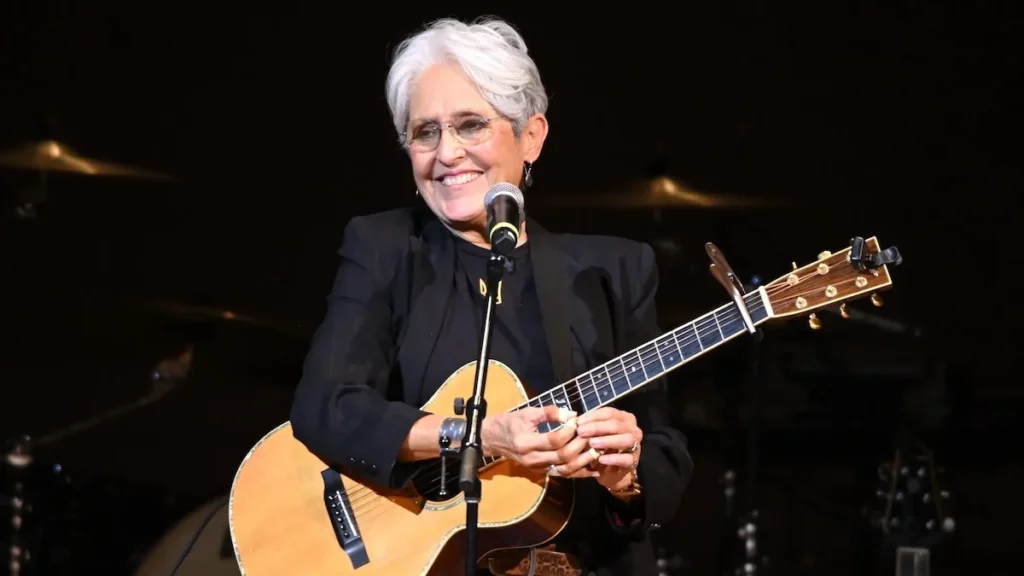

In a recent appearance on the podcast Wiser Than Me With Julia Louis-Dreyfus, legendary folk singer and activist Joan Baez delivered a pointed critique aimed at contemporary pop stars, challenging their perceived silence on significant socio-political issues. Baez, whose career has been synonymous with social justice for over six decades, expressed a nuanced understanding of the pressures faced by younger artists but ultimately questioned their reluctance to use their immense platforms for advocacy, particularly given their considerable wealth and influence. Her message was clear: a call for even a "little step" towards engagement from those who fill stadiums worldwide.
A Direct Challenge to Modern Pop’s Silence
Baez’s comments emerged from a broader discussion about the current state of artistic engagement, specifically prompted by inquiries regarding younger artists’ responses, or lack thereof, to abuses under the Trump Administration and other recent socio-political events. While initially displaying a degree of empathy, acknowledging that "some are writing amazing stuff" and "a few are willing to speak out," her tone shifted to one of candid bewilderment.
"I sort of cock my head at these stadiums filled with brilliant young women songwriters, and why can’t they just take that little step," Baez articulated, her words carrying the weight of a lifetime spent on the front lines of activism. She further underscored her point by noting, "Because they’re already richer than God, you know, most of them. So, that little step." This observation highlights a core tenet of her philosophy: that immense privilege and financial security should, if anything, empower artists to speak out, rather than deter them. Her critique was not aimed at the musical quality of these artists, nor did she name specific individuals, but rather at a collective hesitancy she perceives within the mainstream pop music industry.
Acknowledging the Engaged: Brandi Carlile and Maggie Rogers
Amidst her broader critique, Baez was quick to highlight exceptions, commending artists like Brandi Carlile and Maggie Rogers for their visible commitment to social causes. She specifically lauded Rogers for her prominent role "front and center on the stage at a rally against ICE" in April, and also recalled a joint appearance with Rogers at an AOC/Bernie Sanders rally in April 2025. These examples serve to illustrate that the path of activism, while perhaps challenging, is not insurmountable for contemporary artists. Carlile, a Grammy-winning singer-songwriter, has been a vocal advocate for LGBTQ+ rights, women’s rights, and other humanitarian causes, often integrating her activism into her public persona and performances. Rogers, an emerging indie-pop sensation, has similarly utilized her growing platform to support various social justice movements, demonstrating that engagement is possible even for those earlier in their careers.
The Enduring Legacy of Joan Baez: A Blueprint for Activism
To fully grasp the significance of Baez’s words, one must understand the bedrock of her own career—a career inextricably linked with social and political activism. Born in 1941, Baez rose to prominence in the early 1960s as a central figure in the American folk revival, using her crystalline soprano voice not just to entertain but to galvanize. Her participation in the Civil Rights Movement was profound. She famously performed "We Shall Overcome" at the 1963 March on Washington for Jobs and Freedom, standing alongside Martin Luther King Jr. and cementing her place in history as a musical voice of the movement. She also joined King in the Selma to Montgomery marches in 1965, facing segregation and violence firsthand.
Her activism extended globally. During the Vietnam War, Baez became a staunch opponent, refusing to pay a portion of her income taxes as a protest against military spending. This act of civil disobedience led to her arrest and imprisonment. She founded the Institute for the Study of Nonviolence in 1965 and later Humanitas International, an organization dedicated to monitoring human rights abuses. She toured extensively in war zones, bringing comfort to civilians and shedding light on atrocities. In the 1970s, she actively campaigned against the Chilean dictatorship of Augusto Pinochet, lending her voice to human rights efforts across Latin America. Her commitment to various causes, including LGTBQ+ rights, environmental protection, and death penalty reform, has remained unwavering throughout her career.
In October, Baez continued this tradition by releasing a poem titled "Little Green Worm," a cutting commentary on Donald Trump’s perceived lack of empathy and his political rhetoric. This recent artistic expression demonstrates that her dedication to speaking truth to power has not diminished with age, offering a contemporary example of how artists can engage with political discourse beyond music alone. Her entire career serves as a powerful testament to the idea that art and activism are not mutually exclusive but can, in fact, amplify each other to foster meaningful change.
The Evolving Landscape of Artist Activism: Then vs. Now
The era in which Baez began her career offered a different landscape for artist activism. The folk music movement of the 1960s was inherently political, born out of social unrest and a desire for change. Artists like Woody Guthrie, Pete Seeger, Bob Dylan, Harry Belafonte, and Nina Simone were not just performers; they were chroniclers of their times, catalysts for social movements, and moral voices. Their music often directly addressed issues of poverty, inequality, war, and civil rights, and their physical presence at protests and rallies was expected and celebrated by their audiences. The risks, while present, were often understood as part of the artist’s role in society.
Today’s music industry, particularly the pop sector, operates under vastly different commercial pressures and media scrutiny. The global reach of social media means that any political statement can be amplified instantly, but also scrutinized, criticized, and weaponized by various factions. The commercial stakes are immense, with pop stars often signing multi-million dollar endorsement deals and having carefully curated brand images that might be perceived as vulnerable to political controversy. A single misstep can lead to fan backlash, boycotts, and significant financial repercussions. This environment creates a powerful disincentive for many artists to venture into politically charged territory.
Furthermore, the nature of fan engagement has shifted. While 1960s folk audiences often sought out artists who mirrored their social conscience, modern pop fandom can be more diverse and less politically monolithic. An artist speaking out on a divisive issue risks alienating a significant portion of their fanbase, potentially impacting ticket sales, streaming numbers, and merchandise revenue. This commercial calculus, Baez suggests, seems to overshadow the moral imperative for many.
The Modern Pop Dilemma: Risks and Rewards of Engagement
Baez’s call for pop stars to "take that little step" implicitly asks them to weigh the potential risks against the profound rewards of social engagement. The risks are undeniable: alienating a segment of their audience, facing intense online harassment, potentially jeopardizing lucrative endorsement deals, and even facing personal attacks. In a hyper-polarized political climate, simply expressing a view can lead to being labeled and targeted.
However, the rewards, from Baez’s perspective, are equally significant. Artists, particularly those filling stadiums, possess an unparalleled ability to influence public discourse, inspire their millions of fans, and draw attention to critical issues. Their voices can shape conversations, mobilize younger generations, and contribute to a more informed and engaged citizenry. When an artist with a massive platform speaks out, it can legitimize a cause, encourage donations, or even shift public opinion. The impact of someone like Taylor Swift, for instance, encouraging voter registration has demonstrated the immense power these artists wield, even if their direct political endorsements are often selective or cautiously delivered.
Baez’s challenge is not necessarily for pop stars to become full-time activists in the mold of the 1960s folk singers, but to simply take a "little step." This could mean a statement on social media, a brief comment during a concert, a donation to a relevant charity, or a public appearance at a rally. It suggests that even a small act of solidarity or advocacy, when multiplied by the scale of their influence, can have a cumulative and significant impact.
Broader Implications and the Call to Action
The implications of Baez’s critique extend beyond the music industry. It raises broader questions about the responsibility of all influential public figures—athletes, actors, social media personalities—to leverage their platforms for societal good. In an age where information overload and political apathy are widespread, the voices of trusted and admired figures can cut through the noise.
Baez’s enduring message is a reminder that silence, particularly from those with power and privilege, can be a form of complicity. Her challenge to contemporary pop stars is not born of a desire to criticize for criticism’s sake, but from a deep-seated belief in the transformative power of art and conscience. For over 60 years, she has embodied the principle that one’s voice, however singular, can contribute to making the world "even one degree better every single day."
As the world grapples with complex global challenges—from climate change and human rights abuses to political polarization and economic inequality—the question of whether those with the largest megaphones will choose to speak out remains profoundly relevant. Joan Baez, the "Queen of Folk" and a tireless advocate, continues to pose this question, inviting everyone, pop stars included, to reflect on their own capacity for impact and, in her own resonant words, "take that little step." The full episode of her interview offers further insight into her perspective, reminding us of the rich history of artist activism and its potential to shape a more just future.