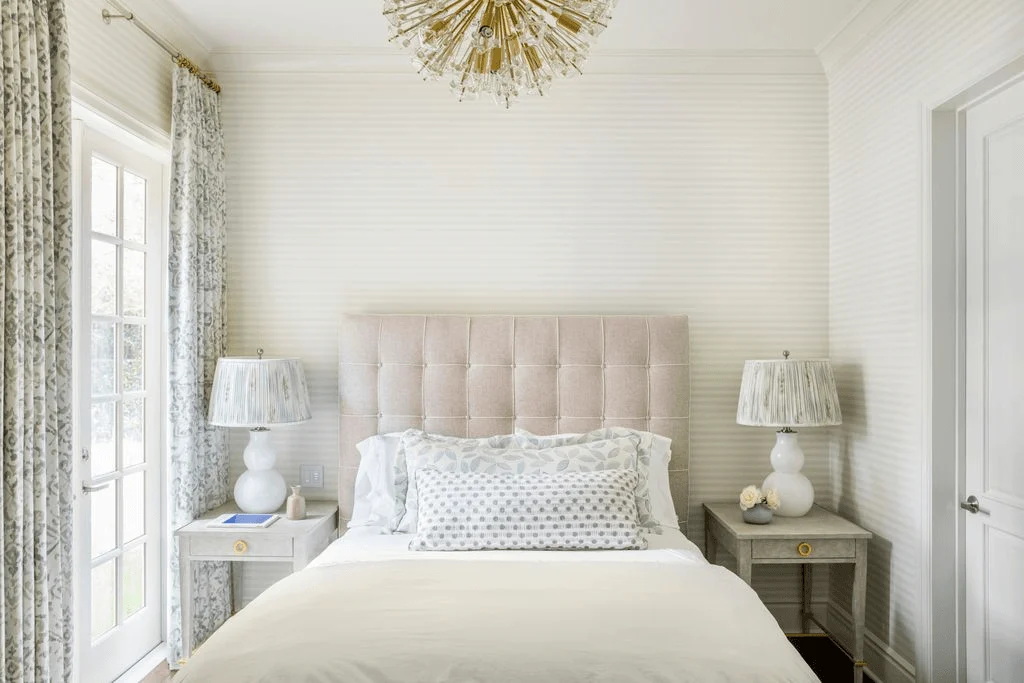

The modern residential landscape is increasingly defined by the challenge of limited square footage, particularly in dense urban centers where the demand for housing has outpaced the availability of expansive floor plans. While the desire for a spacious, airy bedroom remains a universal priority for homeowners, the reality of contemporary architecture often necessitates working within "petite" or "compact" dimensions. However, leading figures in the interior design industry contend that the perceived size of a room is not merely a product of its physical measurements, but a result of psychological perception and strategic design intervention. By employing sophisticated techniques in furniture scaling, color theory, and architectural millwork, designers are proving that small bedrooms can be transformed into expansive sanctuaries.

The Evolution of the Compact Bedroom: Context and Trends
The shift toward smaller living spaces is supported by significant demographic and economic data. According to recent urban planning reports, the average size of new apartments in major metropolitan hubs like New York, London, and San Francisco has decreased by nearly 10% over the last decade. This trend, driven by rising real estate costs and a shift toward "micro-living," has forced a revolution in interior design. Historically, bedrooms were often treated as secondary spaces with bulky, freestanding wardrobes and heavy furniture. Today, the design community has pivoted toward "spatial optimization," where every square inch is treated as a premium asset.
This evolution has been accelerated by the post-pandemic realization that the home must serve multiple functions. The bedroom is no longer just a place for sleep; for many, it must also function as a retreat from the digital world or a quiet corner for reflection. Consequently, the "illusion of space" has moved from a luxury aesthetic to a functional necessity.

Strategic Layouts and the Psychology of Scale
The foundational step in expanding a small room’s visual footprint begins with the furniture layout. Jennifer Jones, the principal designer of San Francisco-based Niche Interiors, emphasizes that a "thoughtfully edited" approach is the most efficient way to achieve immediate results. The core of this strategy lies in the concept of scale.
"Pay close attention to the scale of pieces to ensure that none of the furniture items feel too large for the space," Jones notes. In professional practice, this often involves selecting "leggy" furniture—pieces that sit high off the floor—allowing the eye to see the continuous floor line, which trick the brain into perceiving more area. Furthermore, Jones advocates for a minimal number of pieces. Instead of a traditional suite consisting of a bed, two nightstands, a dresser, and a vanity, designers are increasingly opting for multi-functional pieces that reduce "visual clutter."

Color Theory: The Science of the Monochromatic Envelope
While aesthetic preferences for color vary, there is a consensus among interior architects regarding the impact of palette on spatial perception. Light-reflective values (LRV) play a critical role in how a room feels. Lighter colors, particularly those in the off-white, cream, and pale gray families, reflect more natural and artificial light, pushing the walls outward.
Natasha Willauer, a designer known for her work on high-end boutique projects like Greydon House in Nantucket, suggests a technique known as "color drenching" for rooms with complex architecture, such as sloped or peaked ceilings. "Use a single color across all surfaces," Willauer advises. This approach eliminates the "visual breaks" or hard lines between the wall and the ceiling. When the eye does not encounter a sharp contrast where the wall ends and the ceiling begins, it perceives the space as a continuous, soft-edged envelope, making the room feel significantly taller and more open.

Supporting this is the strategic use of blue. Blue is psychologically associated with the "infinite" nature of the sky and the sea. Designers like Lillian Byers of Platt Interiors often utilize blue hues to create a sense of limitlessness. By pulling tones from grasscloth wall coverings onto the ceiling, a "glowy" atmosphere is created that mimics the horizon, further blurring the physical boundaries of the room.
Architectural Integration vs. Freestanding Furniture
One of the most significant shifts in high-end small-space design is the move away from floating furniture in favor of integrated millwork. Toronto-based designer Dvira Ovadia argues that built-ins are the key to resolving the "cluttered" feel of small bedrooms.
.jpg)
"Built-ins allow us to eliminate bulky, floating pieces and instead create a seamless, integrated envelope that reads as architecture rather than furniture," Ovadia explains. This method "stretches the perception of space" by treating storage as part of the wall itself. From a property valuation perspective, custom millwork also adds long-term value, as it optimizes the specific floor plan of the home in a way that generic furniture cannot.
Similarly, Stephanie Kraus of Stephanie Kraus Designs utilizes custom cabinetry to "trick the eye." By designing cabinetry that flanks windows to look like extended architectural shutters, she subtly widens the perceived footprint of the wall. Vertical lines in the millwork draw the gaze upward, emphasizing the height of the room rather than its narrow width.

The Role of Reflective Surfaces and Light Manipulation
Mirrors have long been a staple of the designer’s toolkit for small spaces, but modern applications have become more sophisticated. Julien Legeard, founder of Legeard Studio in New York, views mirrors not as decorative accessories but as "spatial tools" and "instruments of light."
Rather than hanging a single mirror on a wall, Legeard integrates reflective surfaces directly into the architectural millwork, such as closet doors or alcoves. This technique "dissolves boundaries" and doubles the visual depth of the room. When placed opposite a window, these mirrors also bounce natural light into the darkest corners of the room, further enhancing the airy quality that is essential for a feeling of spaciousness.

Pattern Play and the Maximalist Distraction
While the minimalist, monochromatic approach is a proven method for expansion, a secondary, equally effective strategy involves the use of "intentional maximalism." Houston-based designer Meg Lonergan suggests that layering patterns and textures can distract the eye from a room’s small dimensions.
"Layered patterns, textures, and colors are visually arresting and create the feeling that a room is spacious enough to accommodate them all," Lonergan states. This "pattern-on-pattern" approach works by giving the eye a multitude of focal points, preventing it from settling on the physical limits of the walls. This is often achieved through high-contrast bedding, ruffled textures, and the juxtaposition of geometric prints like gingham with organic florals.

In more historic properties, such as the 1920s-era Lilly Pulitzer suite at Casa Marina Key West, designer Amanda Reynal utilized bold, vertical foliage prints. By having patterns "grow" up the walls and onto the ceiling, the design forces the occupant to "look up," a classic architectural trick to emphasize vertical volume when horizontal space is lacking.
Impact on Well-being and Real Estate
The implications of these design strategies extend beyond mere aesthetics. Environmental psychology studies have consistently shown that living in spaces perceived as "cramped" or "cluttered" can lead to increased cortisol levels and higher stress. Conversely, rooms that feel open and organized contribute to better sleep quality and mental clarity.

From a market perspective, the ability to make a small bedroom feel "deceptively spacious" is a critical selling point. Real estate experts note that "staged" homes utilizing these professional design tricks often sell faster and at higher price points than those with traditional, bulky furniture arrangements.
Summary of Professional Recommendations
To summarize the current professional standard for small bedroom optimization, homeowners and developers should consider the following data-driven strategies:

- Monochromatic Continuity: Reducing contrast between walls and ceilings to soften edges.
- Vertical Emphasis: Using full-height curtains and vertical millwork to draw the eye upward.
- Architectural Anchoring: Utilizing low-profile or canopy beds to define "zones" without blocking sightlines.
- Reflective Integration: Incorporating mirrors into the actual structure of the room to amplify light.
- Scale Restraint: Prioritizing fewer, well-scaled pieces over a high volume of small items.
As urban density continues to increase, the expertise of designers in manipulating spatial perception will remain a vital component of residential architecture. By treating the small bedroom as a "pretty gem" rather than a limitation, the design industry is proving that luxury and comfort are not dependent on square footage, but on the intelligence of the design itself.