
In the heart of the Swedish capital, design is far more than a superficial aesthetic; it is a fundamental cultural pillar, often described as a birthright for those residing within the city’s archipelago. Stockholm serves as a living museum of refined minimalism, where the architectural narrative transitions seamlessly from the medieval cobblestones of Gamla Stan to the industrial-chic corridors of Södermalm. This pervasive commitment to form and function is rooted in a heritage defined by legendary figures such as Josef Frank, whose vibrant patterns redefined Swedish Modernism; Hilma af Klint, whose abstract visions predated global movements; and Carl Larsson, whose depictions of domestic life solidified the "Swedish idyll." Today, this legacy is further democratized by IKEA, yet it finds its most sophisticated expression in the city’s high-end short-term residential market.
For the modern traveler, the selection of an Airbnb in Stockholm has evolved into an exercise in curated living. As the global travel industry shifts toward "experiential tourism," visitors are increasingly eschewing traditional luxury hotels in favor of residences that offer an authentic immersion into the "Scandi-chic" lifestyle. This trend is particularly evident in neighborhoods like Östermalm and the tranquil island of Stora Essingen, where the intersection of historical preservation and contemporary innovation creates a unique hospitality value proposition.
The Chronology of Swedish Design and Urban Development
To understand the significance of Stockholm’s premier rental properties, one must examine the chronological development of the city’s aesthetic identity. The late 19th and early 20th centuries marked a pivotal era for Swedish architecture. During this period, the "National Romantic" style emerged, blending traditional craftsmanship with the burgeoning needs of a modernizing society. This era produced the iconic "kakelugn" (traditional tiled fireplace) and the expansive ceiling moldings that characterize many of the city’s most sought-after historic apartments.
By the mid-20th century, the concept of "Folkhemmet" (The People’s Home) began to influence design, emphasizing that well-designed, functional items should be accessible to everyone. This philosophy laid the groundwork for the clean lines and organic textures—such as blonde woods and natural stone—that remain the hallmark of Scandinavian interiors today. In the 21st century, Stockholm has reinforced its position as a global design hub, utilizing its unique geography—a city built on 14 islands—to integrate natural light and water views into the very fabric of its residential architecture.
Premier Residential Profiles: A Study in Curated Minimalism
The current landscape of high-end short-term rentals in Stockholm reflects a meticulous attention to detail, where professional architects and designers often lead the renovation of historic spaces. These properties are not merely places to stay; they are case studies in the effective use of space and light.
The Refined Elegance of Östermalm
In the affluent district of Östermalm, residential design often bridges the gap between 19th-century grandeur and ultra-modern utility. One paradigmatic one-bedroom apartment in this neighborhood exemplifies the "IKEA-catalogue-as-art" aesthetic. While the comparison to the retail giant is frequent, in the context of Östermalm, it refers to a high-concept minimalism.
The residence features blonde wood dining tables and neutral textiles that contrast with a clean marble kitchen, accented by subtle, purposeful strokes of color. The preservation of oak flooring and decorative ceiling moldings serves as a reminder of the building’s historic bones, while contemporary additions like heated bathroom floors and high-speed connectivity cater to the modern executive traveler. Located near the city’s most prestigious boutiques and restaurants, such properties command rates starting at $352 per night, reflecting the premium placed on both location and design pedigree.
Architectural Integration on Stora Essingen
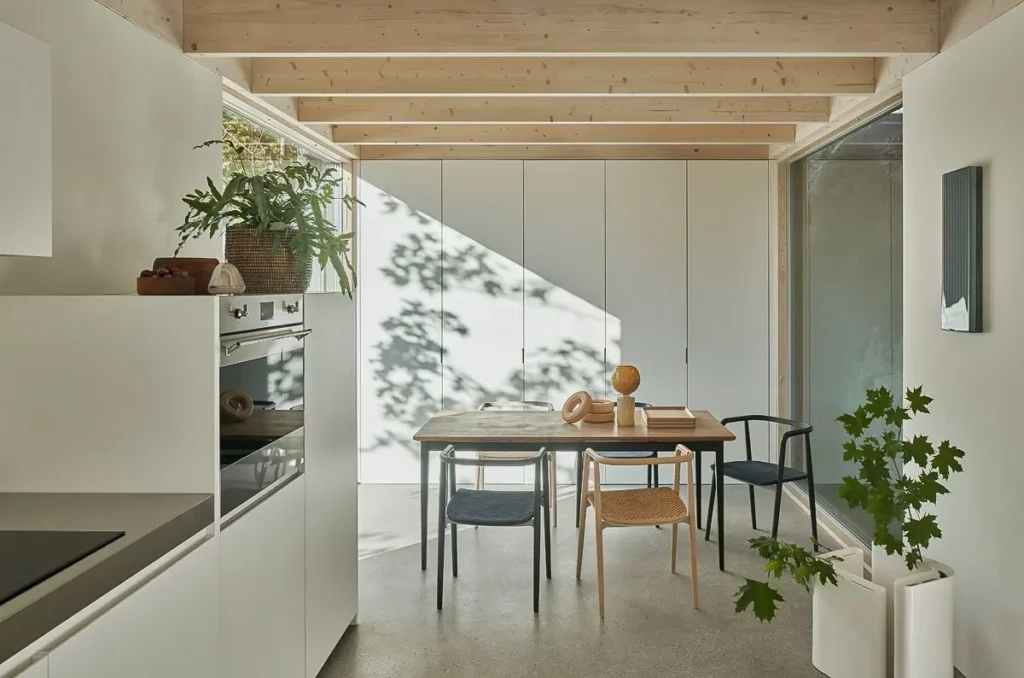
Further afield, the island of Stora Essingen offers a different perspective on Stockholm’s design philosophy: the integration of the built environment with the natural landscape. Here, a two-bedroom retreat designed by a professional architect demonstrates the use of bleached and waxed fir and textured granite to mirror the surrounding wooded groves.
The property utilizes oversized picture windows to frame views of Lake Essingesundet, effectively turning the exterior environment into a living element of the interior decor. This emphasis on "friluftsliv" (open-air living), even within an urban context, is a critical component of the Swedish psyche. With private outdoor patios and modern amenities like in-unit laundry, these waterfront homes represent a growing segment of the market focused on wellness and seclusion, with price points averaging $475 per night.
Historical Preservation in Gamla Stan and Södermalm
In Gamla Stan (the Old Town), the design challenge lies in modernizing structures that date back several centuries without compromising their historical integrity. Two distinct approaches are currently prevalent in the market. The first is a whimsical, "New Nordic" style that utilizes punchy textiles, polkadot lampshades, and watercolor paintings to create a vibrant, cheerful atmosphere. These spaces often incorporate soundproofing technology to protect the sanctuary of the home from the bustling tourist activity of the medieval streets outside.
The second approach is one of "Atmospheric Preservation," where thick stone walls, low-slung timber beams, and original arched doorways are kept as the focal points. In these residences, modern luxury is introduced through private saunas and high-end Smeg kitchen appliances, blending the 17th century with the 21st. In Södermalm, larger 19th-century apartments—some dating back to 1885—cater to families, offering four-bedroom layouts that preserve the "striped back" wood floors and crown moldings of the era. These properties, ranging from $500 to nearly $700 per night, highlight the value of "space-as-luxury" in a densely populated European capital.
Supporting Data: The Economic Impact of Design Tourism
The demand for these high-design short-term rentals is supported by robust tourism data. According to reports from Visit Stockholm, the city has seen a consistent increase in international visitors who cite "architecture and design" as a primary motivator for their trip. The short-term rental market in Stockholm has adapted to this by offering properties that function as showrooms for Swedish brands.
Statistical trends indicate that travelers are willing to pay a 25% to 40% premium for rentals that feature "authentic Scandinavian design elements" over standard, non-descript apartments. Furthermore, the rise of the "work-from-anywhere" culture has extended the average stay in these designer apartments from three days to nearly ten, as guests seek environments that inspire creativity and provide the comforts of a high-functioning home office.
Market Implications and Regulatory Context
The proliferation of high-end Airbnbs in Stockholm does not come without its complexities. The Swedish housing market is known for its "Bostadsrättsförening" (BRF) system, where apartment owners belong to a cooperative association. These associations often have strict rules regarding short-term subletting, which makes the availability of high-quality, legal Airbnbs in central Stockholm relatively limited compared to other European capitals.
This scarcity has a two-fold effect: it ensures that the properties available are of a significantly higher standard, as they are often the primary or secondary residences of design professionals, but it also drives up the price point. Industry analysts suggest that this regulatory environment actually protects the "premium" nature of the Stockholm rental market, preventing the "over-tourism" seen in cities like Barcelona or Venice while maintaining a high level of residential quality.
Official Responses and Broader Impact
While the Swedish government and local municipalities have moved to regulate the short-term rental market to protect the long-term housing supply, there is a general recognition of the value these properties bring to the city’s global brand. Representatives from the tourism sector have noted that "living like a local" in a meticulously designed apartment reinforces Stockholm’s image as a sophisticated, forward-thinking metropolis.
The broader impact of this trend is the "democratization of inspiration." Guests who stay in a turn-of-the-century gem in Midsommarkransen or a minimalist studio in Gamla Stan often return home with a redefined understanding of how their own living spaces can be optimized for light, comfort, and functionality.
Conclusion: The Future of the Stockholm Stay
As Stockholm continues to evolve, the synergy between its historic architecture and its future-facing design industry will remain its greatest asset. The city’s Airbnbs have become more than just lodging; they are curated experiences that offer a window into the Swedish soul. Whether it is through the warmth of a kakelugn on a winter evening or the stark beauty of a granite-clad waterfront home in the summer, these residences prove that in Stockholm, impeccable design is indeed a birthright—one that is now being shared with the world, one stay at a time. The continued success of this sector will likely depend on maintaining the delicate balance between modern luxury and the "lagom" (just right) philosophy that defines the Swedish way of life.