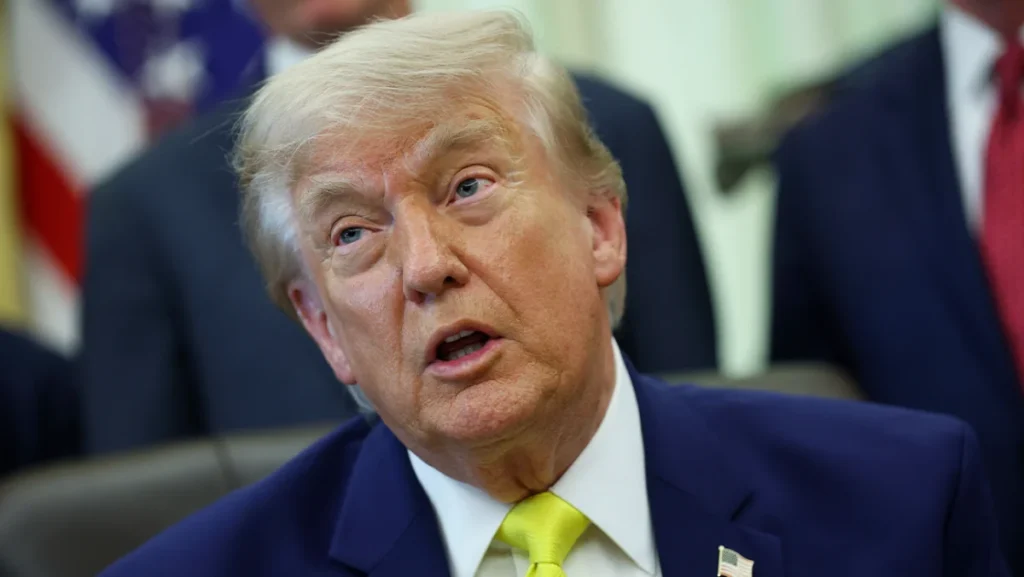

The recent primetime address delivered by former President Donald Trump on a Thursday night served as a stark illustration not of the unsubstantiated claims he presented regarding the 2020 election – alleging hacks by foreign entities like China or Venezuela into America’s voting machines – but rather of the evolving landscape of media access for high-profile political figures. The event underscored a significant shift in how major broadcast networks approach presidential or former presidential addresses, particularly when those addresses are perceived to be overtly political or lacking in immediate national emergency relevance.
The most notable aspect of the evening was the split decision among the "Big Four" broadcast networks. While some opted to carry the address live, others notably declined, choosing instead to stick with their regularly scheduled entertainment programming. This divergence reignited discussions surrounding network gatekeeping, editorial independence, and the delicate balance between public interest and commercial considerations in an increasingly fragmented media environment.
The Broadcast Divide: A Closer Look at Network Decisions
On the evening of the address, two of the prominent broadcast networks, NBC and ABC, made the decision not to interrupt their scheduled programming for the former president’s speech. This move, which Trump himself later denounced during his address as part of a "plot," signaled a departure from historical norms where presidential addresses were almost sacrosanct in their ability to command airtime.
NBC opted to air a rerun of its nature documentary series, The Americas, a decision that prioritized established content over a live political broadcast. Meanwhile, ABC aired a new episode of the popular game show Press Your Luck, hosted by Elizabeth Banks. In a striking visual metaphor, contestants on the show were seen hitting a giant button, hoping to avoid the cartoon "Whammy" that could strip them of their winnings, while the former President was simultaneously attempting to convey what he termed "really big news" to the nation. The contrast was stark: a game of chance and light entertainment against a somber address making serious, albeit unverified, claims about national electoral integrity.
Conversely, the former President found a more receptive platform on other networks. Fox carried the majority of the speech live, providing an uninterrupted platform for his message. CBS, another major player, preempted a rerun of Georgie and Mandy’s First Marriage, a spinoff from Young Sheldon, to air a special report anchored by Tony Dokoupil. This report provided coverage of the address, indicating a middle-ground approach of acknowledging the event’s significance while potentially framing or contextualizing its content.
The decision by CBS is particularly noteworthy given recent shifts in its corporate structure. The network is now controlled by David Ellison, son of Larry Ellison, a prominent figure and known ally of Donald Trump. Furthermore, Bari Weiss, a journalist known for her critical stance on certain progressive viewpoints, serves as editor-in-chief of CBS News. These executive alignments raise questions, or at least invite speculation, about potential influences on editorial decisions, even if such decisions are formally made by news division leadership based on journalistic merit.
A Historical Lens on Presidential Addresses and Network Access
Traditionally, primetime presidential addresses have been treated with a high degree of deference by broadcast networks. These occasions were viewed as sacred summons, moments when the leader of the free world directly addressed the American public on matters of profound national importance. Historical examples abound:
- Ronald Reagan’s address after the Challenger disaster (1986): A somber, unifying speech delivered in the wake of a national tragedy, universally carried by networks.
- George H.W. Bush’s addresses at the outset of the Gulf War (1990-1991): Critical communications to prepare the nation for conflict and update citizens on military action, also widely broadcast.
- Jimmy Carter’s "Crisis of Confidence" speech (1979): A candid and introspective address to the nation grappling with economic woes and a perceived malaise, which networks readily cleared their schedules for.
In these instances, the networks consistently "parted the airwaves" to ensure these Oval Office orations reached televisions from coast to coast, recognizing their inherent news value and their role in informing the public during moments of national significance. The expectation was that a presidential request for airtime, especially in primetime, would be almost automatically granted.
Evolving Media Landscape and Editorial Discretion
However, in more recent years, this automatic deference has waned. Broadcasters have become more "finicky" and less predictable about when they will agree to preempt regularly scheduled programming for presidential addresses. This shift reflects several factors:
- Audience Fragmentation: The rise of cable news, the internet, and streaming services has dramatically fragmented the television audience. Broadcast networks no longer hold the singular power to reach the masses they once did.
- Increased Partisanship: The political landscape has become more polarized, and presidential addresses, even those ostensibly on policy, are often perceived as highly partisan. Networks face pressure from audiences and internal critics regarding whether an address constitutes genuine news or merely political campaigning.
- Commercial Imperatives: Preempting popular primetime shows means losing advertising revenue. With declining linear TV viewership, networks are more reluctant to sacrifice profitable programming unless the news value is overwhelmingly clear and broadly appealing.
- Editorial Judgment: News organizations increasingly exercise more stringent editorial judgment regarding the content of an address. If a speech is anticipated to contain unverified claims, highly partisan rhetoric, or simply rehash previously stated positions without significant new information, networks may deem it not worthy of immediate, uninterrupted primetime coverage across all channels.
This evolving discretion was evident in previous administrations. In 2014, for instance, all four major networks (ABC, CBS, NBC, Fox) declined to air President Barack Obama’s address on immigration reform. At the time, they largely deemed it too political to justify bumping popular shows like Grey’s Anatomy and The Biggest Loser. Yet, just five years later, in 2019, those very same networks unanimously carried President Trump’s border-wall address, despite its equally political nature and the contentious debate surrounding the issue. This inconsistent application of criteria highlights the subjective nature of these decisions and the constant negotiation between journalistic principles and external pressures.
The Unconventional Request and Network Response
Adding another layer of complexity to the recent event was the apparent lack of a customary, formal request from the White House for network airtime. Traditionally, the White House would contact the networks well in advance, detailing the subject matter and requesting a specific time slot, allowing networks to assess the request against their editorial standards and programming schedules. In this instance, it appears Trump simply declared his intention to announce "really big news" and seemingly assumed that the networks would automatically rearrange their lineups to accommodate him.
This informal approach likely played a significant role in the networks’ decisions. Without a formal request, and potentially without sufficient prior information about the content of the "big news," networks were left to make quick judgments based on public statements and past experiences, potentially contributing to the split in coverage. It reinforces the idea that access to the public airwaves, even for a former president, is no longer an automatic entitlement but rather a matter of editorial negotiation and demonstrated public interest.
The Cable News Echo Chamber
In stark contrast to the varied approach of broadcast television, cable news coverage of the former President’s address was predictably aligned with their established editorial leanings and viewer demographics.
- CNN opted for a common cable news format: Kaitlan Collins assembled a panel of pundits and analysts who discussed and dissected the speech as it played off-screen. This approach allows the network to control the narrative, provide real-time fact-checking or commentary, and cater to an audience that often prefers analysis alongside raw footage.
- MSNBC aired the initial 17 minutes of the speech before cutting away for what was described as "outraged discussion." This move suggests that the network’s editorial team quickly determined that the content veered into areas requiring immediate challenge or strong counter-commentary, rather than uninterrupted broadcast. It caters to a viewership generally critical of Trump’s rhetoric and supportive of immediate pushback.
- Fox News, consistent with its historically supportive coverage of the former President, stayed with Trump’s address until "the bitter end," carrying the full speech live and in "livid color." This decision provided an unmediated platform for Trump’s message, appealing directly to his base and reinforcing Fox News’s position as a primary source of information for his supporters.
This divergence across cable news further illustrates the fragmented media landscape, where audiences self-select into ideological bubbles, receiving information often filtered through a particular lens.
Underlying Narratives: The 2020 Election Claims
The context of Trump’s address—his continued assertion that China or Venezuela hacked voting machines during the 2020 election—is crucial to understanding the networks’ decisions. These claims have been widely debunked by election officials, cybersecurity experts, and numerous court rulings. The Department of Homeland Security’s Cybersecurity and Infrastructure Security Agency (CISA) notably declared the 2020 election "the most secure in American history," and former Attorney General William Barr stated that the Justice Department found no evidence of widespread fraud that would have altered the election outcome.
Broadcasters, especially those committed to factual reporting, faced a dilemma: provide a platform for unverified claims that could further erode public trust in democratic institutions, or exercise editorial judgment to contextualize, fact-check, or even decline to carry the address live. The split in coverage reflects differing approaches to this challenge, with some networks seemingly prioritizing the live dissemination of information from a prominent political figure, while others prioritized preventing the unchallenged spread of disinformation.
Implications for Media Gatekeeping and Public Discourse
The varied network response to Trump’s address carries significant implications for media gatekeeping and the future of public discourse:
- Erosion of "Must-Carry" Status: The event further diminishes the expectation that any address by a former president, or even a sitting president, will automatically receive universal broadcast coverage. This shifts more power to network executives and news directors to determine what constitutes genuinely newsworthy content deserving of national airtime.
- Challenges to Shared Reality: When major networks diverge significantly in their coverage of a high-profile political event, it contributes to a fractured media landscape where different segments of the population receive fundamentally different information, or different framings of the same information. This exacerbates the challenge of maintaining a shared national understanding of facts and events.
- The "Plot" Narrative: Trump’s immediate accusation of a "plot" against him for not receiving full network coverage plays directly into a narrative of media bias and censorship, further entrenching skepticism about mainstream media among his supporters. This makes it harder for traditional news outlets to effectively communicate with a significant portion of the electorate.
- Commercial vs. Public Interest: The decisions highlight the ongoing tension between a broadcast network’s public service mandate and its commercial imperative. Choosing to air entertainment over a political address can be seen as a commercial decision, but also as an editorial one if the address is deemed not to serve the public interest in an objective, factual manner.
The event underscores that in the current media climate, "access" is no longer guaranteed, even for the most powerful political voices. It is subject to editorial scrutiny, commercial pressures, and the ever-present question of what truly serves the public interest in an age of abundant information and pervasive disinformation. The Thursday night address, therefore, became less about the content of Trump’s claims and more about the evolving power dynamics between political figures and the traditional gatekeepers of information.