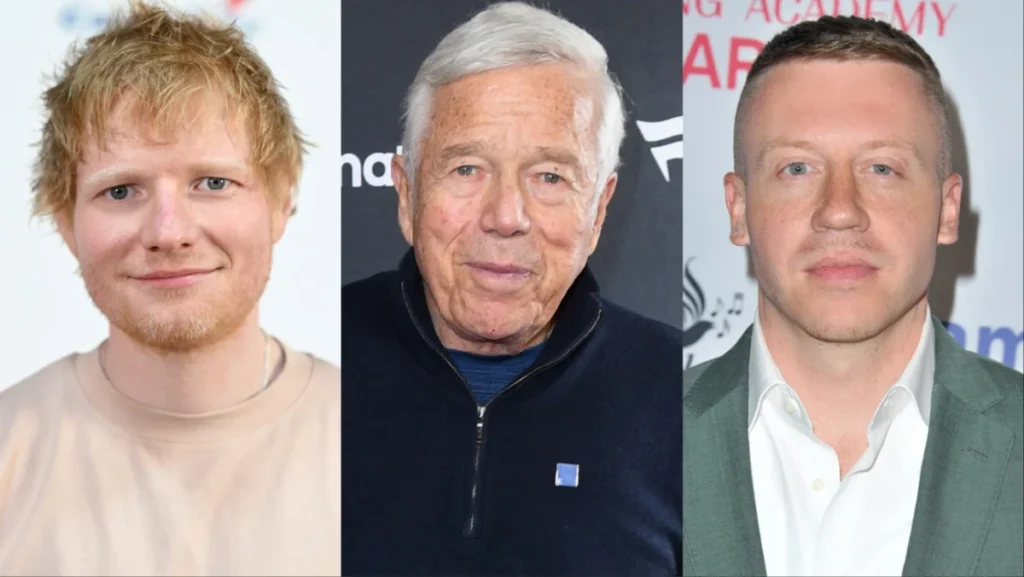

The controversy surrounding rapper Macklemore’s dismissal from Ed Sheeran’s U.S. Loop Tour continues to unravel, with new reporting shedding light on the tense behind-the-scenes negotiations, high-stakes phone calls between headliners and powerful NFL stadium owners, and the broader collision of geopolitics, live entertainment, and corporate venue management. New details published by The Wall Street Journal have illuminated the frantic efforts made by tour promoters and artists to salvage the multi-date stadium run before it ultimately collapsed under the weight of political friction, leading to cancellations, solidarity boycotts, and substantial charitable donations.
The core of the dispute centers on Macklemore’s outspoken advocacy for Palestine during his brief tenure as the opening act for Ed Sheeran’s high-profile stadium tour across the United States. What began as a standard supporting slot quickly escalated into a national flashpoint, pitting high-profile artists against influential sports franchise owners, advocacy groups, and venue operators who control some of the largest entertainment spaces in North America.
Chronology of the Controversy
The sequence of events that led to Macklemore’s removal from the tour unfolded rapidly over a tumultuous two-week period in September. Initially slated to appear as a supporting act on ten dates of the Loop Tour, the Grammy-winning rapper used his platform on September 4 at MetLife Stadium in East Rutherford, New Jersey, to voice his political views. Before performing his pro-Palestinian song "Hind’s Hall"—a track written in tribute to student protesters and named after a six-year-old Palestinian girl killed in Gaza—Macklemore declared "Free Palestine" to the packed stadium audience.
The reaction was immediate. The following day, on September 5, during the second of the two MetLife Stadium concerts, the artist doubled down on his remarks. Addressing the crowd directly, he stated that one of the reasons he wanted to perform on stadiums across America was to express support for Palestine. He explicitly addressed his Jewish audience members, asserting that criticism of Israel, opposition to apartheid, and condemnation of genocide should not be misconstrued as criticism of Jewish people as a whole.
These remarks quickly drew intense public scrutiny and organized pushback. The Israeli-American Council petitioned Ed Sheeran to remove Macklemore from the tour. Concurrently, prominent pressure groups, including StopAntisemitism and the Combat Antisemitism Movement, condemned the rapper’s statements. Pop star Pink also publicly called for his removal, adding further momentum to the mounting pressure on the tour’s organizers.
Negotiations, Assurances, and Venue Resistance
Behind the scenes, the situation was rapidly deteriorating. According to The Wall Street Journal, representatives for several powerful NFL stadium owners—including New England Patriots owner Robert Kraft, Carolina Panthers owner David Tepper, Atlanta Falcons owner Arthur Blank, and Philadelphia Eagles owner Jeffrey Lurie—contacted the Messina Touring Group, the promoters of the Loop Tour, to express deep concern over Macklemore’s overtly political remarks.
Reports indicate that during these initial discussions, tour representatives provided assurances to stadium stakeholders that Macklemore would refrain from bringing up the issue of Palestine during subsequent performances. However, because those assurances were disregarded during the September 5 concert, stadium operators grew increasingly alarmed over potential disruptions, security concerns, and the political liability of hosting the tour.
The tension culminated in a direct, 40-minute phone call between Patriots owner Robert Kraft and headliner Ed Sheeran. According to sources cited by the Journal, Kraft expressed sympathy for the Palestinian people but argued that Macklemore’s stage comments crossed the line into hate speech rather than protected free speech. With multiple NFL venues threatening to pull out of their hosting agreements if Macklemore remained on the lineup, the economic and logistical viability of the entire tour was brought into question.
The Decision to Drop Macklemore
Facing the prospect of sweeping venue cancellations that could impact hundreds of thousands of ticket-holders, the Messina Touring Group made the decisive move to drop Macklemore from the remaining eight U.S. tour dates. On September 14, Messina released an official statement explaining the necessity of the decision:
"As the concert promoter for Ed Sheeran’s U.S. Loop Tour, we have been notified by venues on the upcoming U.S. tour dates that they will not allow a concert to take place with Macklemore on the lineup, which would result in the cancellation of the tour and impact hundreds of thousands of fans. After discussions with stakeholders, Macklemore will not be performing on the remaining support dates."
The announcement triggered a wave of public statements from the principal figures involved. Macklemore took to Instagram to address his removal, emphasizing that he did not view himself as a victim.
"Before I get into it, I want to say something that should be obvious. In this moment I think it matters. I am not a victim," Macklemore wrote. "Ed Sheeran is not a victim. Pink is not a victim. We have careers, money, opportunities, safety and audiences around the world. Whatever consequences any of us face for what we say, we get to go home to our families. The victims are the Palestinian people."
Ed Sheeran also released a detailed statement clarifying his position and attempting to contextualize his role in the crisis. He emphasized that the decision to remove the rapper rested entirely with the promoters and venue owners, not with him personally.
"After Macklemore’s performances at my New Jersey shows, venues on my upcoming tour dates communicated that they would pull the shows if he was still supporting," Sheeran stated. "I was informed that this stance was based on how Macklemore conveyed part of his message during his performance, rather than on everything that was said. I spoke with the venues at length all week to try and build a bridge. One of those people was Robert Kraft. I was also involved in direct talks with promoters along with activists on both sides to try and find a mutual resolution for all, but the venue’s and promoter’s decision was final."
Sheeran reiterated, "Macklemore coming off tour was the promoter’s decision, it was not mine. Macklemore’s contract for the tour was with the promoter, not me."
Broader Industry Fallout and Solidarity Boycotts
The fallout from Macklemore’s removal extended far beyond the immediate business arrangements of the Loop Tour, sparking a broader conversation about artistic freedom, political expression in live music, and the power dynamics governing major entertainment venues.
In a notable display of solidarity with the ousted rapper, several other supporting acts and members of Sheeran’s touring entourage chose to exit the tour. Artists including Finneas, Lukas Graham, Aaron Rowe, and members of Sheeran’s backing band, Beoga, announced their departure from the remaining tour dates, citing principled objections to the silencing of political speech and the cancellation of artists based on their ideological expressions.
The controversy took a philanthropic turn shortly thereafter. On September 16, Macklemore announced that he would donate his entire earnings from the Loop Tour—estimated at approximately $1 million—to six charitable organizations dedicated to supporting Palestinian communities and humanitarian relief efforts. Concurrently, the rapper issued a public challenge to Robert Kraft, calling on the billionaire stadium owner to match his donation. Kraft responded by committing $2 million to philanthropic causes, closing a turbulent chapter of public accusation and counter-statement.
Broader Implications for Live Entertainment and Free Expression
The clash between Macklemore and NFL stadium owners highlights an increasingly complex challenge for the contemporary music industry: the intersection of commercial live entertainment and deeply polarizing geopolitical conflicts. As major concert tours increasingly rely on massive, multi-purpose corporate venues—frequently owned by sports conglomerates and billionaires with distinct corporate and civic interests—the boundaries governing on-stage political speech are facing unprecedented scrutiny.
Industry analysts note that while artists have long used large stages to voice political convictions, the consolidation of venue management and the sensitivity of corporate stakeholders to political controversies create a precarious environment for outspoken performers. The incident serves as a significant case study in how modern tours can be destabilized when artistic expression directly conflicts with the risk-management policies of corporate venue operators.
As the live music sector moves forward, the events surrounding the Loop Tour are likely to influence how promoters, venues, and artists navigate political commentary in public spaces, raising lingering questions about where the line is drawn between contractual obligations, venue autonomy, and the fundamental right to free expression on the global stage.