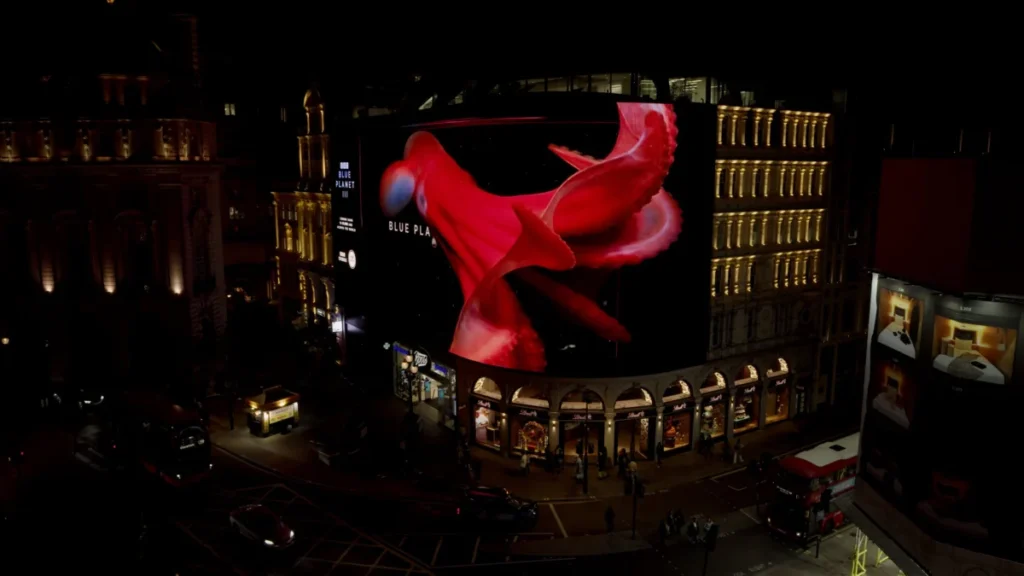

The BBC Studios Natural History Unit has officially signaled the return of its landmark underwater documentary franchise, unveiling a breathtaking first-look trailer for Blue Planet III. The upcoming six-part series, scheduled to premiere later this year across BBC One, iPlayer, and BBC America, marks a monumental milestone for the globally celebrated franchise. To celebrate the announcement, the heart of London was temporarily transformed into a mesmerizing aquatic ecosystem, merging cutting-edge digital spectacle with environmental advocacy.
The launch event, framed as a "global premiere," took over the iconic Piccadilly Circus via the massive Piccadilly Lights screens. Breaking away from traditional Hollywood traditions, attendees walked a striking blue carpet instead of a red one. The evening featured an immersive fusion of high-definition marine visuals—including a digital whale breaching and plunging back into the digital sea—special guests, and live musical elements. Hosted by BBC Radio 1 personality Greg James, the event served as a high-profile showcase for what is arguably the most anticipated natural history television event of the decade.
A Quarter-Century Legacy of Ocean Exploration
The journey of the franchise began twenty-five years ago with the groundbreaking broadcast of the original Blue Planet series. That inaugural production fundamentally shifted global perspectives on marine biology, opening a window into pelagic environments, deep-sea trenches, and coastal ecosystems that had previously remained largely mysterious to mainstream audiences.
When the follow-up, Blue Planet II, aired, it achieved unprecedented cultural impact. Beyond its critical acclaim and Emmy-winning cinematography, the second installment played a pivotal role in shifting international public policy and consumer behavior regarding single-use plastics—a phenomenon often referred to by environmental scientists as "the Blue Planet effect."
Now, after four and a half years of painstaking production by the BBC Studios Natural History Unit in Bristol, Blue Planet III arrives at a critical juncture for the planet’s oceans. Facing unprecedented challenges from climate change, ocean acidification, overfishing, and habitat degradation, the new series aims to document not only the breathtaking resilience and sophisticated adaptations of marine life but also the urgent necessity of conservation.
Sir David Attenborough Reflects on a Historic Milestone
At the center of the global premiere event was a specially recorded video message from legendary broadcaster and naturalist Sir David Attenborough. Attenborough, who celebrated his 100th birthday earlier this year, offered poignant reflections on his enduring career and his ongoing association with the franchise.
"Twenty-five years ago, when I narrated the first Blue Planet, it didn’t occur to me that I would be narrating a third season in my centennial year," Attenborough told the gathered audience. "The ocean is an endlessly fascinating place. In these new programs, we uncover a further wonderful array of underwater life, which is more surprising, more sophisticated, and even more important than we ever realized. I am proud and delighted to be associated with Blue Planet III."
Attenborough’s continued involvement adds a profound layer of historical continuity to the project. As a central figure in natural history broadcasting for over half a century, his voice remains an authoritative and trusted anchor for audiences navigating complex ecological realities.
An A-List Collaboration: Hans Zimmer and Jade Thirlwall
Beyond its stunning cinematography, Blue Planet III boasts a powerhouse musical collaboration. Academy Award-winning composer Hans Zimmer has teamed up with singer-songwriter Jade Thirlwall—formerly of the chart-topping pop group Little Mix—to craft an original song and overarching musical framework for the series.
Zimmer, whose legendary film scoring credits range from The Lion King and Inception to upcoming tentpoles, described the project as a defining moment in his storied career.

"Blue Planet III is the most important work I’ve ever done," Zimmer remarked during the launch campaign. "I’ve worked on a lot of films throughout my career, but nothing affects humanity, our world, and our planet as much as the work being done by the Natural History Unit in Bristol. I think everybody who comes to Blue Planet comes to it with the knowledge that it is something that changes the world by making you fall in love with the world."
Zimmer emphasized that the documentary deliberately avoids heavy-handed lecturing, opting instead for an aesthetic of profound appreciation. "It’s not something where you’re being lectured or cajoled about things, but it’s something that just shows you how spectacular and beautiful our world truly is, and how we need to preserve it and how we need to love it, and how whatever we love we need to treat with great kindness and great respect."
The inclusion of Jade Thirlwall adds a contemporary pop-culture dimension to the production, bridging generational divides and ensuring that the crucial conservation message resonates with younger audiences across digital platforms.
Executive Perspectives on British Creativity and Global Reach
The immense scale of the production and its marketing campaign reflects the BBC’s continued dominance in natural history programming. Zai Bennett, CEO and chief creative officer of BBC Studios global content, underscored the cultural and technological significance of the launch during the Piccadilly Lights takeover.
"For a quarter of a century, our landmark Blue Planet series has helped people around the world view our oceans through fresh eyes," Bennett stated. "Blue Planet III is the next chapter in that extraordinary story. Created by the unparalleled talent of our incredible Natural History Unit and guided once again by Sir David Attenborough’s astonishing storytelling, this new series reveals wonders few of us could ever imagine and deepens our understanding of the world we share."
Bennett added that the Piccadilly Lights event was designed to celebrate the unmatched impact of public service broadcasting and British creative excellence. "Tonight’s premiere at Piccadilly Lights celebrates the power of world-class British creativity to stop people in their tracks, spark collective awe, and connect audiences across generations—and across the globe."
Broader Implications for Marine Conservation
While Blue Planet III is fundamentally an entertainment and educational product, its release carries significant real-world implications. In an era marked by climate fatigue and polarized environmental debates, natural history blockbusters produced by the BBC have historically proven uniquely capable of cutting through political noise. By focusing on emotional resonance, aesthetic beauty, and scientific discovery, the series leverages mass media to foster grassroots ecological awareness.
Marine biologists and environmental NGOs frequently report spikes in public engagement, research funding, and policy pressure following the broadcast of such high-profile natural history events. As industrial pressures on deep-sea environments—such as deep-sea mining and commercial trawling—intensify, the timing of Blue Planet III could not be more critical.
Production Timeline and Distribution Details
The release of the first-look trailer and the Piccadilly Circus takeover initiate the final countdown to the series’ official debut. Produced entirely over a rigorous four-and-a-half-year schedule, the production utilized advanced underwater filming technologies, specialized submersibles, and low-light camera systems to capture behaviors of deep-sea and coastal species never before documented on film.
The six-hour-long episodes will roll out later this year. In the United Kingdom, the series will air on BBC One and stream on BBC iPlayer, while North American audiences will be able to watch via BBC America. As the broadcast date approaches, the BBC is expected to release further details regarding regional television schedules, accompanying educational resources, and immersive digital companion pieces designed to expand the reach of the franchise into virtual reality and interactive formats.
For now, the release of the trailer and the dazzling illumination of Piccadilly Circus serve as a powerful reminder of humanity’s deep, enduring connection to the oceans—and the urgent responsibility to protect them for future generations.