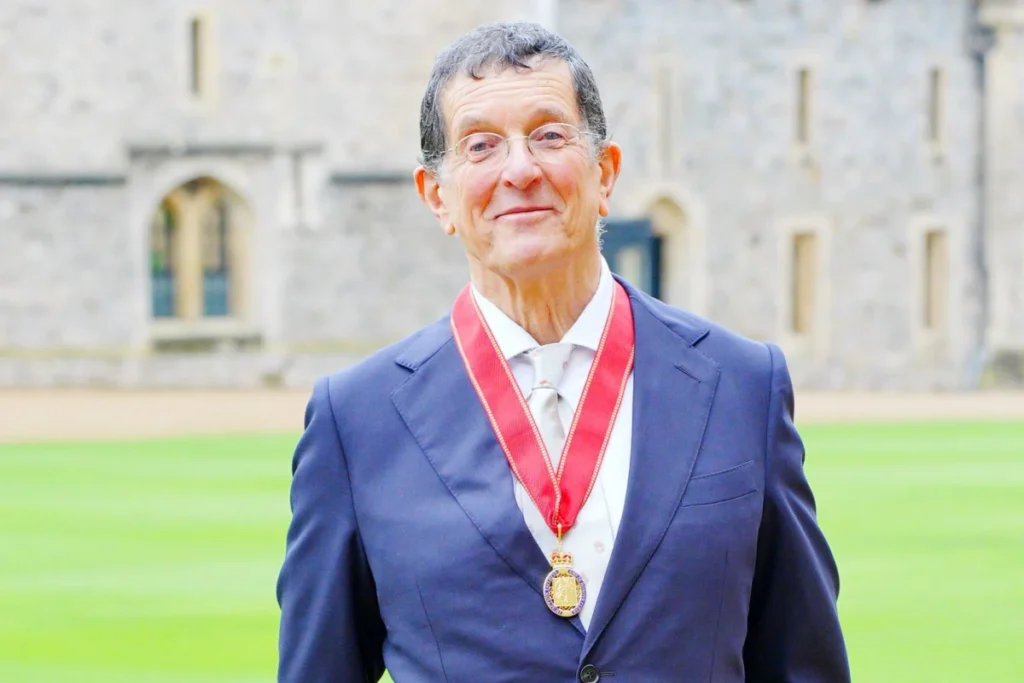

Renowned sculptor Sir Antony Gormley, the visionary behind the iconic Angel of the North, has issued a profound declaration, asserting that art is an "essential tool in our survival." His powerful statement, made during an appearance on the Roundhouse podcast Making Space, underscores his long-standing advocacy for the arts within the educational curriculum, a sector he believes is tragically undervalued in favour of skills geared purely towards "gainful employment." Gormley’s critique resonates deeply within ongoing national debates regarding the prioritization of subjects in schools and the holistic development of young people.
The Turner Prize-winning artist, celebrated globally for his monumental public installations that often explore the human form and its relationship with space, articulated his concerns about an education system increasingly defined by measurable outcomes. "Our education has been formulated by teaching to test," Sir Antony observed, describing this as a "total diminishment of what it means to be human, if we only value things that can be measured." He lamented what he termed "the tragedy of the myopia of education that is only seen as providing the tools for gainful employment." For Gormley, the true measure of education’s success lies in its ability to connect individuals with "the thing that makes us feel alive, that makes us feel happy, that makes us feel purposeful and fulfilled." He firmly believes that "art has been a fundamental tool in our survival, in our knowing, in a way ourselves and the world."
The Enduring Legacy of the Angel of the North
Sir Antony Gormley’s words carry significant weight, not only due to his stature in the art world but also because of the indelible mark he has left on the British landscape. His most widely recognized creation, the 20-metre-tall steel sculpture known as the Angel of the North, has stood as a majestic sentinel overlooking the A1 motorway in Gateshead, Tyne and Wear, for over 28 years. This monumental work, with its imposing 54-metre wingspan, equivalent to that of a Boeing 747 jumbo jet, has become a potent symbol of the North East, embodying both its rich industrial past and its aspirations for the future.
The journey of the Angel of the North from concept to cultural icon is a testament to Gormley’s artistic vision and the region’s courage to embrace ambitious public art. Commissioned by Gateshead Council in 1990 and designed in 1994, the project faced considerable public debate and logistical challenges before its installation in February 1998. Constructed from 200 tonnes of weathering steel, primarily salvaged ship plate, the sculpture draws a direct lineage to the region’s proud shipbuilding heritage and coal mining industry. Its material choice allows it to gradually develop a rusted patina, further cementing its connection to the landscape and the passage of time. The Angel’s foundations alone descend 20 metres into the ground, anchoring it firmly on the site of a former colliery, the lower Team Colliery, underscoring Gormley’s intention for the work to be deeply rooted in the specific history and geology of its location.

Gormley elaborated on this profound connection, explaining, "I think it was very much about recognising that a site, a place for a work, is not a geographical location findable on a map, (it is) the history and living truth of the population that lives there, which is not just human, but also all of the birds and the animals." He continued, "The reason that it works is that it is literally, but also kind of imaginatively, rooted in that place, which is a mixture of where it is on the lower Team Colliery just over the hill from Tyne, but then also where it is in history in terms of human experience." This holistic understanding of place imbues the Angel with a layered meaning that resonates with both local residents and millions of visitors annually, making it one of the most viewed artworks in the UK.
The Crisis in Arts Education: A National Dialogue
Sir Antony’s impassioned plea for the arts is not an isolated voice but part of a wider chorus of concern from educators, artists, and cultural institutions across the United Kingdom. The debate surrounding the role and value of arts education has intensified over the last decade, largely influenced by government policies aimed at strengthening "core" academic subjects.
One of the most significant policy shifts has been the introduction of the English Baccalaureate (EBacc) in England in 2010. While not mandatory for students, the EBacc measures the percentage of pupils in a school who achieve passes at GCSE in English, mathematics, two sciences, a humanities subject (history or geography), and a modern or ancient foreign language. The explicit exclusion of arts subjects from this key performance measure has been widely criticized by the arts sector, which argues it has inadvertently devalued subjects like art and design, drama, music, and dance within the curriculum.
Data from organizations such as the Cultural Learning Alliance and the Education Policy Institute consistently highlight a worrying trend. Since the introduction of the EBacc, there has been a notable decline in the number of students taking arts subjects at GCSE level. For instance, reports indicate a significant drop in entries for subjects like Design & Technology, Art & Design, and Music. This decline is not merely statistical; it translates into fewer specialist arts teachers, reduced curriculum time for creative subjects, and a narrowing of educational opportunities for young people.
Critics of the EBacc policy, including Sir Antony Gormley, contend that this focus on a narrow set of academic subjects neglects the broader skills and attributes essential for personal development and future success in a rapidly changing world. They argue that an overemphasis on "teaching to test" stifles creativity, critical thinking, problem-solving, and emotional intelligence – qualities that are inherently nurtured through engagement with the arts.

Beyond Measurable Outcomes: The Intrinsic Value of Creative Making
Sir Antony Gormley’s insights extend beyond a simple call for more arts funding or curriculum hours. He offers a nuanced perspective on how art should be integrated into education. While campaigning to keep the arts in the school curriculum, he paradoxically stated that art is something that "can’t really be taught." This seemingly contradictory stance is clarified by his belief that what is required is not didactic instruction but rather an environment conducive to creative exploration.
"Opening the gates of creative making can be provided," he explained, emphasizing that what children truly need is "the space, time and materials" to experiment, alongside "the attention and the encouragement" from educators. This philosophy champions a facilitative approach, where teachers act as guides and mentors, fostering an atmosphere where students feel safe to explore, make mistakes, and discover their own creative voices. Gormley vividly recalled the profound impact of his own formative experiences, stating, "I wouldn’t be sitting here today if I hadn’t had wonderful art teachers at school." This personal anecdote underscores the transformative power of dedicated educators who champion creative expression.
The implications of Gormley’s argument are profound. It suggests that merely including art on the timetable is insufficient if the pedagogical approach remains focused on rigid testing and measurable outcomes. True arts education, in his view, is about cultivating an internal landscape of curiosity, self-expression, and imaginative engagement with the world. It is about empowering individuals to "feel alive" and find "purposeful and fulfilled" lives, rather than merely equipping them for economic utility.
The Broader Impact: Creativity, Well-being, and the Creative Industries
The benefits of a robust arts education extend far beyond individual enrichment. Research consistently demonstrates the positive correlation between arts engagement and improved academic performance in other subjects, enhanced cognitive development, and better mental well-being. Creative subjects foster resilience, collaboration, and communication skills, which are increasingly sought after by employers in diverse fields, not just the creative industries.

Moreover, the creative industries themselves represent a significant economic force in the UK. Sectors such as film, television, music, design, fashion, architecture, and the visual and performing arts contribute billions to the national economy and provide millions of jobs. A vibrant pipeline of talent, nurtured through comprehensive arts education, is crucial for maintaining the UK’s global leadership in these fields. By devaluing arts subjects in schools, critics argue, the nation risks undermining its future economic competitiveness and cultural standing.
Organisations like Arts Council England actively campaign for the intrinsic and instrumental value of the arts, advocating for policies that support creativity in education. Their reports frequently highlight how creative subjects develop essential skills for the 21st century workforce, fostering innovation and adaptability – qualities that cannot be easily quantified by standardized tests.
Looking Ahead: Reclaiming the Human Dimension of Education
Sir Antony Gormley’s latest intervention serves as a powerful reminder of the fundamental role art plays in human experience and societal progress. His call to action urges a re-evaluation of educational priorities, moving beyond a narrow focus on "gainful employment" towards a more holistic understanding of human flourishing.
As societies grapple with complex challenges, from technological disruption to climate change and mental health crises, the capacity for creative problem-solving, empathetic understanding, and imaginative vision becomes ever more critical. These are precisely the faculties that art education cultivates. By providing "space, time, and materials" for creative making, accompanied by encouragement and attention, educational institutions have the potential to unlock not just economic potential, but the deeper human potential for meaning, connection, and survival.
The full Making Space podcast episode, featuring Sir Antony Gormley’s compelling arguments, became available on April 22, offering a timely opportunity for reflection on these crucial issues. His voice joins a growing movement advocating for a re-centring of human values and creative expression at the heart of our educational system, ensuring that future generations are equipped not just with skills for jobs, but with the fundamental tools for a truly meaningful existence.