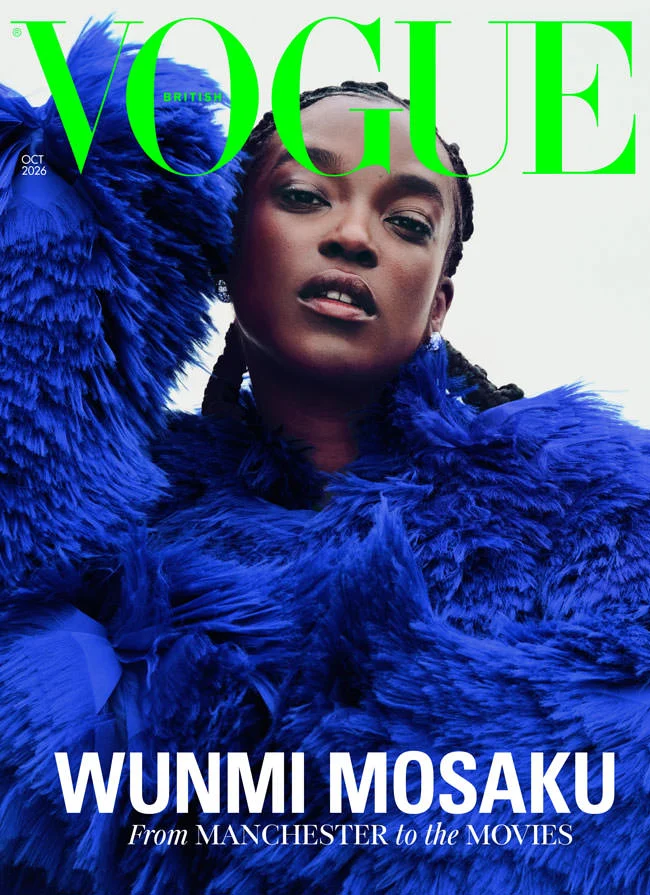

The landscape of contemporary cinema and television is continually shaped by performers who manage to transcend screen roles, translating their artistic weight into vital cultural conversations. Wunmi Mosaku, the acclaimed Mancunian actor whose breakout performances have captivated international audiences, officially anchors the fashion world’s most anticipated autumn publication as the cover star of British Vogue’s October 2026 issue. Photographed by Dan Jackson and styled by Julia Sarr-Jamois, Mosaku’s appearance on the prestigious cover arrives at a pivotal juncture in her career. Following a celebrated red-carpet run and her unforgettable work in projects like Sinners, the versatile actor is preparing to lead the upcoming high-profile drama The Social Reckoning, alongside expanding her portfolio into executive production and independent storytelling.
The accompanying interview, conducted by acclaimed author Oyinkan Braithwaite, traverses a broad spectrum of personal and professional milestones. From navigating the complexities of motherhood and pregnancy during awards season to confronting deeply entrenched industry biases surrounding beauty, heritage, and labor standards on set, Mosaku uses her platform to articulate a clear vision for an equitable entertainment industry. Her reflections offer a rare, unvarnished look at the realities faced by dark-skinned women navigating global stardom, while signaling a newfound insistence on structural reform both in front of and behind the camera.
A Breakthrough Trajectory and Upcoming Projects
Mosaku’s rise to prominence has been marked by critical acclaim and a steady accumulation of demanding, multi-layered roles. Having first established her formidable range on British stages and television before capturing global attention, the actor cemented her elite status with a BAFTA win that signaled her arrival as a powerhouse talent. However, it was her work in the cinematic project Sinners that truly expanded her international footprint, introducing her distinct presence to wider audiences and establishing her as a magnetic leading lady capable of anchoring complex narratives.
Looking forward, Mosaku’s momentum shows no sign of slowing. Her upcoming leading role in The Social Reckoning places her at the center of a timely and high-stakes narrative exploring the modern intersections of technology, corporate crisis, and public accountability. In the production, Mosaku portrays Raya, a crisis public relations advisor for Facebook tasked with managing the catastrophic fallout from the historic 2021 platform leaks. The role requires Mosaku to examine the machinery of modern communication and the psychological toll exacted by pervasive digital connectivity—themes that deeply resonate with the actor’s own worldview.
Critiquing the Digital Age and Social Media Regulation
Transitioning from her character’s corporate navigation of digital disaster to her personal philosophy, Mosaku does not mince words regarding the societal impact of social media. In her interview with British Vogue, the actor voices support for sweeping legislative measures, including the UK government’s planned ban on social media access for children under the age of sixteen.

"I am all for people using it less," Mosaku states, emphasizing the urgency of protecting developing minds. "Adults and children, but children for sure. I think the world felt a little safer, in many ways, before social media."
Going further than mere personal abstinence, Mosaku calls for systemic accountability from the technology sector. She advocates for rigorous platform regulations, enhanced fact-checking protocols, and aggressive measures to dismantle radicalization and ideological echo chambers. Yet, she remains acutely aware of the economic and political hurdles standing in the way of such reform. Pointing directly to the architects of the digital landscape, she notes the fundamental conflict of interest inherent in current platforms: "That doesn’t benefit the people doing the manipulating, and those are the guys in charge."
Confronting Industry Beauty Standards and Personal Identity
Beyond her commentary on technology, Mosaku turns a critical lens toward the entertainment industry and the historical exclusion of dark-skinned women from mainstream definitions of beauty. Reflecting on her formative years in Manchester, the actor shares the candid reality of growing up within a culture that rarely validated her physical appearance.
"I know that that’s the trope that we have been sold—and we have come to accept that the world does not see us as lovable," Mosaku explains. She recalls a childhood where external validation was virtually nonexistent outside of her immediate family. "I don’t think anyone called me pretty once growing up [besides my parents]. Like, not once. Except my uncle Hubert. I was 12 when he died, and I remember saying to my mum, ‘Who will call me pretty now?’"
This early realization informed her broader understanding of how systemic forces—specifically the intersections of patriarchy and capitalism—dictate human worth. Articulating her personal mantra, "Love yourself or hurt yourself," Mosaku unpacks the exhausting physical and psychological compromises demanded of women in the public eye.
"I understand that people feel like they have to change because the patriarchy, capitalism too, says, ‘You’re worthy if you look like this; you’re worthy if you do this; you’re worthy if you have this in your account… you’re worthy if you’re thin or sculpted,’" she says. For Mosaku, maintaining authenticity means acknowledging the profound gap between herself and conventional Hollywood beauty ideals. She notes that attempting to bridge that gap would require self-inflicted harm: "I just feel like I’ve always been so far away from it [the ideal] that in order to try and achieve it I would really have to hurt myself to get there."

Red-Carpet Inclusivity and the Reality of Styling
Amid these structural critiques, Mosaku’s recent experiences during awards season offered a glimpse into potential progress, particularly regarding fashion and bodily autonomy. Having navigated the circuit while pregnant, the actor experienced a rare moment of genuine industry accommodation.
"Designers happily embraced my growing bump with no pushback or compromise," she notes, praising the flexibility shown by couture houses during a high-profile period of her life.
However, this inclusion has also sparked anxiety about the future. Mosaku remains cautious about whether the fashion industry’s temporary embrace of pregnancy will translate into permanent size inclusivity for regular, non-pregnant curves. Expressing a common frustration shared by many women outside standard sample sizes, she articulates her concerns moving forward: "I really hope designers remain equally excited about dressing regular curves, not just pregnancy bumps. I’m nervous about what comes next. I am hoping not to go back to sample sizes being sent and forking out for tailoring out of pocket. Long may it continue where designers actually dress me and my body as I am!"
Exploring Complex Characters and Behind-the-Scenes Power
Mosaku’s commitment to challenging narratives extends directly into her artistic choices. In discussing her role as Bola—a Nigerian woman who has systematically detached herself from her heritage and history in pursuit of familial comfort and elevated lifestyle—Mosaku admits to confronting uncomfortable personal truths through the character.
"I felt like I was answering a lot of questions that I was too scared to ever ask myself," she reflects. "What are the parts that you didn’t like about yourself? What are the parts that you haven’t accepted about yourself?"
To exercise greater control over the narratives brought to the screen, Mosaku has increasingly stepped behind the camera, taking on executive producer credits for ambitious new projects. These include a National Geographic documentary and Mango, a body horror short film centering on a woman battling fibroids while attempting to secure her dream employment. For Mosaku, securing these titles is not merely about prestige, but about wielding substantive authority.

"You start to see how the cake is made, because you’re closer now, because you’re a little bit higher on the sheet," Mosaku explains. She highlights the strategic advice she received from industry veterans: "Make sure you get an executive producer credit because it’s not just credit; it means that you have a say. You have a voice… If you don’t have representation, you can miss out on things that are really important and vital for other people."
Eradicating Workplace Toxicity and Taking a Stand
Perhaps the most resonant note of Mosaku’s British Vogue interview is her declaration of zero tolerance for workplace misconduct. Admitting that the grueling demands of the industry had previously left her feeling jaded in the wake of Sinners, the actor has reached a definitive turning point regarding her boundaries on set. No longer willing to acquiesce to toxic environments for the sake of professional diplomacy, Mosaku vows to actively intervene against bullying.
"There need not be one bad spirit, one bad energy on the set," she asserts. "If I see one bully on set, I am going to stand up. I mean it. No more quiet. I’m going to stand up and say something. I don’t care who it is. It could be a dame or a sir, I don’t care who it is. I will have the courage to stand up to bad behaviour."
As the October 2026 issue of British Vogue hits stands, Wunmi Mosaku stands not only as a defining actor of her generation, but as a cultural architect reshaping the standards of her profession. Through her unflinching honesty, her demand for systemic accountability in both technology and film, and her refusal to compromise her integrity, Mosaku continues to chart a course defined entirely on her own terms.