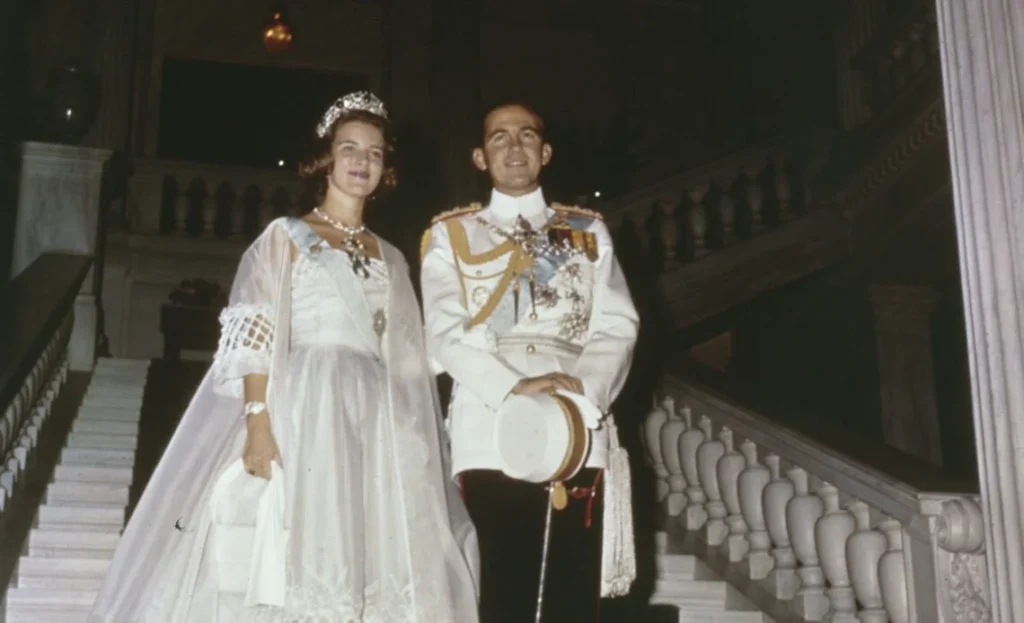

Sixty years ago, on September 18, 1964, the eyes of the European continent and the global press turned toward Athens for a historic royal wedding. The ceremony united twenty-four-year-old King Constantine II of Greece, who had unexpectedly ascended the throne just months prior, with Princess Anne-Marie of Denmark, who had turned eighteen only weeks earlier. Held at the Metropolitan Cathedral of the Annunciation, the nuptials were celebrated with traditional Orthodox grandeur, drawing a guest list of reigning monarchs, princes, and dignitaries from across the globe. Yet, behind the glittering facade of tiaras, horse-drawn carriages, and international pageantry lay a romance that would soon face severe political turmoil, ultimately defining an era of profound transformation for the Greek monarchy.
Main Facts and the Historic Setting
The wedding ceremony in Athens was one of the largest gatherings of European royalty in the twentieth century. Approximately 1,200 distinguished guests filled the Metropolitan Cathedral of the Annunciation to witness the union. Among the attendees were the Prince of Wales, representing the British royal family; King Baudouin and Queen Fabiola of Belgium; Queen Juliana of the Netherlands; King Olav V of Norway; and King Gustaf VI Adolf of Sweden.
Prior to the ceremony, Princess Anne-Marie had officially converted from the Lutheran faith of the Danish royal house to the Greek Orthodox faith, a constitutional requirement for a future Queen of Greece. The bride wore an exquisite gown designed by the Danish couturier Jorgen Bender. Crafted from heavy white silk satin, the dress featured a modest rounded neckline, three-quarter-length sleeves, and an empire-line waist that flowed into a full, sweeping skirt and a twenty-foot train.
For her bridal accessories, Anne-Marie chose items deeply embedded in her family’s history. She wore the Khedive of Egypt tiara, a sparkling diamond diadem featuring swirling scroll motifs that had been presented to her maternal great-grandmother, Princess Margaret of Connaught, by the Khedive of Egypt upon her marriage in 1905. The tiara was subsequently inherited by Queen Ingrid of Denmark and has since become a tradition for female descendants in the family on their wedding days. Anchored beneath the tiara was an antique Irish lace veil, which had been worn by Princess Margaret at her own wedding and later by Queen Ingrid. The bride’s ensemble was completed by a traditional bouquet composed entirely of lily of the valley, symbolizing happiness and renewal.
Following the religious ceremony, the newlywed couple and their high-profile guests proceeded to the Royal Palace in Athens for a lavish wedding reception, greeted by tens of thousands of cheering citizens lining the decorated streets.
Chronology of a Royal Romance
The path to the altar for Constantine and Anne-Marie spanned over five years, defined by formal diplomacy, youthful romance, and unexpected tragedy.
The couple’s paths first crossed in the summer of 1959 during a state visit by King Paul and Queen Frederica of Greece to Denmark, where they were hosted by King Frederik IX and Queen Ingrid. Among the royal children was the young Princess Anne-Marie. Two years later, in 1961, the young prince and princess met again in Denmark. By May 1962, when Anne-Marie served as a bridesmaid at the Athenian wedding of Constantine’s sister, Princess Sofía, to Don Juan Carlos of Spain, the relationship had blossomed into a confirmed romance.
Constantine proposed to Anne-Marie during the summer of 1962. However, King Frederik IX of Denmark initially withheld immediate approval. Insisting that his daughter—who was only sixteen at the time—complete her education first, the Danish monarch requested that the couple wait before making their engagement public.
By January 23, 1963, the formal engagement was announced. Constantine, then twenty-two, traveled to Copenhagen to appear alongside his bride on the balcony of the Amalienborg Palace. The wedding was initially scheduled for the winter of 1965 to allow Anne-Marie to reach adulthood and finish her studies.
However, geopolitical and dynastic circumstances intervened in March 1964 with the death of King Paul of Greece. Constantine unexpectedly ascended the throne at the age of twenty-three, becoming King Constantine II. In light of his new status as a reigning sovereign, court officials and advisors determined that the wedding could no longer wait, prompting an acceleration of the timeline and a relocation of the final preparations to the late summer of 1964.
Supporting Data and Guest Demographics
The 1964 royal wedding represented a unique intersection of European dynastic networks. The guest list underscored the extensive familial ties binding the royal houses of Denmark, Greece, Sweden, Norway, the United Kingdom, and Spain.
| Detail | Description |
|---|---|
| Date of Wedding | September 18, 1964 |
| Location | Metropolitan Cathedral of the Annunciation, Athens, Greece |
| Ages at Marriage | King Constantine II (24), Princess Anne-Marie (18) |
| Guest Count | Approximately 1,200 international guests |
| Bridal Designer | Jorgen Bender (Denmark) |
| Key Heirlooms | Khedive of Egypt Tiara, Irish Lace Veil |
| Honeymoon Destination | Island of Corfu, Greece |
Security and logistical operations for the event required extensive coordination between Greek state authorities and foreign diplomatic security teams. Hundreds of international journalists descended upon Athens to broadcast the proceedings, marking one of the earliest large-scale international media events centered around a modern European royal wedding.
Official Responses and Public Sentiment
The atmosphere in Athens during the wedding week was one of immense public celebration, carefully managed by the palace and the Greek government to project stability, modernization, and continuity. Political leaders viewed the marriage not merely as a personal union, but as a strategic diplomatic asset that anchored Greece firmly within the network of European constitutional monarchies.
Danish officials expressed immense pride in seeing their young princess step onto the international stage as a queen consort. In statements issued by the Danish royal court prior to the ceremony, King Frederik IX and Queen Ingrid praised the resilience and dedication of their daughter as she prepared to assume heavy public responsibilities at a remarkably young age.
Publicly, crowds in Athens welcomed the young royal couple with overwhelming enthusiasm. The juxtaposition of a youthful, modern king and a radiant teenage queen offered a hopeful narrative to a Greek populace navigating the complexities of the post-war era.
Broader Impact and Historical Implications
While the wedding day was characterized by fairy-tale splendor, the long-term historical implications of Constantine and Anne-Marie’s reign proved to be extraordinarily challenging.
Within less than three years of their marriage, the political landscape of Greece deteriorated sharply. The polarization between the monarchy, the military, and various political factions culminated in the military coup of April 21, 1967, led by a junta of right-wing colonels. King Constantine initially attempted to navigate the crisis by working within the constrained political reality, but a late-year counter-coup failed, forcing the royal family to flee Greece into exile in Rome.
Although the Greek monarchy survived in name for several years, it was formally abolished following a national referendum held in December 1974 after the fall of the military dictatorship. Constantine II lived much of the remainder of his life abroad, primarily in London, before returning to Greece in his later years. He passed away in January 2023 at the age of 82, with Queen Anne-Marie by his side.
Despite the tumultuous political chapters that followed their wedding day, the union of Constantine II and Anne-Marie endured for nearly six decades. The 1964 ceremony remains preserved in historical memory as the pinnacle of twentieth-century royal pageantry—a glittering snapshot of a monarchy at the height of its traditional prestige, just before the tides of modern history irrevocably altered the destiny of the Greek crown.