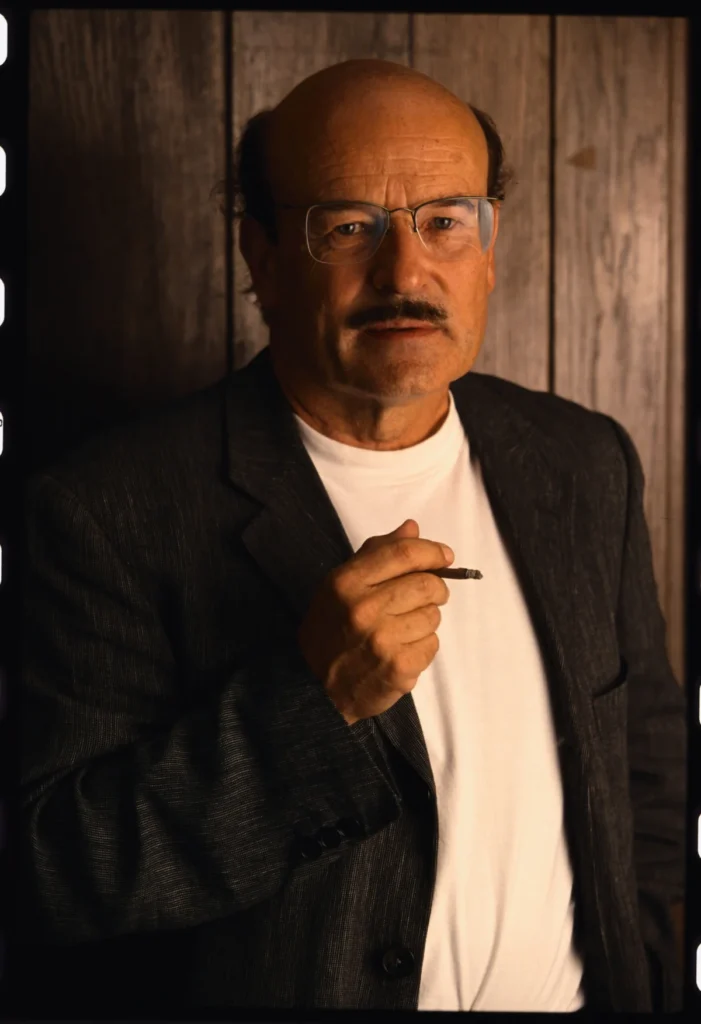

This year at the Cannes Film Festival, a seasoned veteran of global cinema, Volker Schlöndorff, finds himself in a rare and enviable position: here purely for the pleasure of it. The 87-year-old German director, a towering figure of the New German Cinema movement, recalls a recent conversation with former Cannes chief Gilles Jacob, who advised him, "Go there for the fun. You got the Palme already." This casual counsel underscores Schlöndorff’s unique standing on the illustrious Croisette, a place inextricably linked to the arc of his distinguished career, which has consistently intertwined cinematic artistry with profound historical and political inquiry.
A Pioneering Debut and the Birth of New German Cinema
Schlöndorff’s journey with Cannes began in 1966, a pivotal moment for German filmmaking. He arrived with Young Törless (Der junge Törless), his debut feature and a foundational work that heralded the emergence of the New German Cinema. This movement, characterized by its rejection of post-war "Papa’s Cinema" and its embrace of aesthetic innovation and political engagement, sought to confront Germany’s traumatic past and present. Other luminaries of this era included Rainer Werner Fassbinder, Werner Herzog, Wim Wenders, and Alexander Kluge. Young Törless, an adaptation of Robert Musil’s 1906 novel, delves into the disturbing dynamics of cruelty, sadism, and authoritarianism within an Austrian military boarding school. Its unflinching portrayal of moral decay and the precursors to fascism resonated deeply, causing an immediate stir. Schlöndorff vividly recounts a German cultural attaché storming out of the Palais mid-screening, declaring, "This is not a German film!" While intended as a denunciation, the incident inadvertently provided invaluable publicity, a testament to the film’s provocative power. The film’s critical reception, particularly at a morning press screening, was overwhelmingly positive, earning Schlöndorff the most satisfying applause of his career. This audacious debut not only launched his international career but also established his thematic commitment to dissecting the fault lines of European history, a thread that would run through his extensive filmography.
The Enduring Power of the Palme d’Or: The Tin Drum

Schlöndorff’s relationship with Cannes was far from a singular event; he returned repeatedly throughout the late 1960s and 1970s, sometimes with critical acclaim, other times with films he now good-naturedly admits have "fortunately been forgotten." These included his second feature, Degree of Murder (1967), starring Anita Pallenberg with music by Brian Jones, and his first English-language production, Man on Horseback (1969), an adaptation of Heinrich von Kleist’s Michael Kohlhaas. However, it was in 1979 that his career reached its undeniable zenith on the global stage.
That year, The Tin Drum (Die Blechtrommel), his epic and surreal adaptation of Günter Grass’s monumental anti-fascist novel, shared the coveted Palme d’Or with Francis Ford Coppola’s monumental Vietnam epic, Apocalypse Now. This joint award was more than just a critical triumph; it was a symbolic convergence, representing the pinnacle of artistic ambition for both New German Cinema and New Hollywood. Grass’s novel, published in 1959, had already established itself as a seminal work of post-war German literature, a sprawling narrative that used the perspective of Oskar Matzerath, a child who refuses to grow past his third birthday, to allegorize Germany’s descent into Nazism and the Second World War. Schlöndorff’s adaptation masterfully captured the novel’s blend of satire, grotesque imagery, and profound historical commentary.
The sharing of the Palme d’Or sparked a memorable anecdote. Schlöndorff, a friend of Coppola’s, had visited him on his yacht the day before the awards. Coppola, burdened by the immense financial weight of Apocalypse Now (reportedly $50 million of his own money), was rumored to have been promised the Palme as a condition for bringing his unfinished film to Cannes. Schlöndorff recalls the "David versus Goliath" dynamic, and Coppola’s initial apprehension that sharing the award might diminish its commercial impact. However, both films achieved significant commercial and critical success, forging an enduring bond between the two directors. Following its Cannes triumph, The Tin Drum went on to win the Academy Award for Best Foreign Language Film in 1980, a historic achievement as the first German film to do so since the end of World War II. This international recognition solidified Schlöndorff’s reputation and provided a sense of "tranquility" that allowed him to approach subsequent projects with less pressure to prove himself.
A "Political Animal": Tracing Europe’s Fault Lines
Schlöndorff’s cinema is defined by its unwavering engagement with history, which is never merely a backdrop but an active force shaping individual lives. This worldview is deeply rooted in his own biography. Born in Wiesbaden, Germany, in 1939, amidst the turmoil of World War II, Schlöndorff spent his formative years in France from the age of 15 to 25. This decade proved transformative, exposing him to the intellectual rigor of the French New Wave, where he apprenticed under cinematic giants like Louis Malle and Jean-Pierre Melville. He credits these years with shaping "everything I am in life, as well as in my profession, in my art."

His identity as a "political animal" was further forged in the ideological tumult of post-war West Germany in the 1960s and 1970s. This period was marked by student protests, a reckoning with Germany’s Nazi past, and the emergence of radical left-wing groups like the Red Army Faction (RAF). Schlöndorff’s films often directly confronted these issues. The Lost Honor of Katharina Blum (1975), co-directed with his then-wife Margarethe von Trotta and based on Heinrich Böll’s novel, critiques sensationalist journalism and state overreach during the "German Autumn" of counter-terrorism measures. The omnibus film Germany in Autumn (1978), a collective response by several New German Cinema directors to the RAF’s actions, offered a complex, multi-faceted perspective on the era. Later works like The Legend of Rita (2000) also explored themes of radicalization and ideological commitment.
Schlöndorff consistently sought to understand the anger driving the student movements, pushing back against simplistic condemnations of those who resorted to violence for political ends. While unequivocally stating, "I never justified political violence," he aimed to illustrate how post-war German society was still "infiltrated by old Nazis" in its institutions, creating a climate ripe for radical dissent. He reflects on the initial "good intentions" of those who used violence as a "wake-up call," acknowledging the tragic escalation that occurred as they became more isolated. His cinematic explorations of fascism, terrorism, war, and ideological collapse consistently examine the uneasy compromises between morality and survival, positioning him as a filmmaker who seamlessly navigated art house prestige, literary adaptation, and direct political confrontation.
Hollywood Detours and the Babelsberg Interlude
The international success of The Tin Drum opened doors to Hollywood. While he notably turned down an offer from Steven Spielberg to direct an episode of The Twilight Zone, Schlöndorff did embark on a series of American and international productions. These included the visually lush Swann in Love (1984) with Jeremy Irons, a television adaptation of Arthur Miller’s Death of a Salesman (1985) starring Dustin Hoffman and John Malkovich, Voyager (1991) with Sam Shepard and Julie Delpy, and the first cinematic adaptation of Margaret Atwood’s dystopian novel, The Handmaid’s Tale (1990), featuring Natasha Richardson, Faye Dunaway, and Robert Duvall. This period saw him briefly making New York his home, further broadening his international perspective.
However, history intervened once more, pulling him back to Germany. The fall of the Berlin Wall in 1989 and the subsequent reunification of Germany presented both challenges and opportunities. Schlöndorff dedicated nearly a decade to the arduous task of reviving Studio Babelsberg, one of the world’s oldest large-scale film studios, located in what was formerly East Germany. Established in 1912, Babelsberg had been the cradle of German cinema, home to UFA (Universum-Film AG) during the Weimar Republic and Nazi eras, and later DEFA (Deutsche Film AG) in East Germany. Post-reunification, the studio faced an uncertain future, threatened with collapse amidst privatization efforts. Schlöndorff describes this period as "necessary if frustrating," a stark shift from creative filmmaking to the complex world of finance, politics, and infrastructure renovation. He humorously notes the political irony of moving from a "leftist" position to one of "capitalist" studio management. Despite the personal cost of "losing five or eight years of filmmaking," he expresses profound satisfaction that Studio Babelsberg not only survived but thrives today, a testament to his dedication. He recently utilized the renovated facilities for sound work on his latest film, finally reaping the benefits of that significant investment.

A Legacy Undimmed: Visitation and Enduring Themes
His latest work, Visitation (Heimsuchung), adapted from Jenny Erpenbeck’s novel, brings Schlöndorff back to Cannes this year, screening out of competition. The film, featuring an ensemble cast including Lars Eidinger, Martina Gedeck, Susanne Wolff, and Angela Winkler, is set across decades at a lakeside property in Brandenburg. It follows successive inhabitants through the Nazi era, the German Democratic Republic (East Germany), and post-reunification, meticulously tracing how political systems and historical events subtly yet profoundly reshape ordinary lives, often without the characters’ full awareness.
Visitation is a quintessential Schlöndorff film, firmly rooted in the themes he has explored throughout his entire career: the pervasive influence of history, the fragility of private happiness, and the illusion that anyone can remain untouched by the broader political currents of their time. He notes that while he initially perceived it as a "pastoral," the inherent political nature of the narrative became evident during production. The film serves as a poignant reminder that while individuals may strive for personal joy and control, "history happens," often throwing lives off course, even as nature remains "beautiful and indifferent to our joys and our suffering." StudioCanal is handling international sales, bringing this latest meditation on German history to a global audience.
Reflections on a Life in Cinema: "Je Ne Regrette Rien"
Looking back across six decades marked by Cannes triumphs, controversies, detours, and reinventions, Schlöndorff emanates a remarkable sense of equanimity. He discusses the inherent unpredictability of a life devoted to filmmaking with the same unsentimental clarity that characterizes his cinematic approach to history itself. Citing Edith Piaf, he declares, "Je ne regrette rien" – I regret nothing.

This sentiment encapsulates a career marked by conscious choices and unforeseen historical interventions. He attributes his fundamental path to a decision made at 16 or 17 to attend boarding school in France and then pursue filmmaking with "intense will and energy." Everything else, he believes, flowed from that initial, powerful commitment. From his early exposure to the French New Wave and his apprenticeship with masters like Louis Malle and Jean-Pierre Melville, to his enduring friendship with Billy Wilder, who taught him the invaluable lesson of not letting one’s profession "entirely take over your life," Schlöndorff has absorbed influences that have enriched his unique perspective. Wilder, he recalls, emphasized the joy of discussing films, analyzing their mechanics, and always considering the audience’s experience.
Volker Schlöndorff’s presence at Cannes, now primarily for the "fun," is a celebration of a career that has consistently challenged, informed, and illuminated. He remains a vital voice, a testament to the power of cinema not just as entertainment, but as a crucial tool for historical reflection and political engagement, forever reminding us that personal lives are inextricably woven into the grand tapestry of history.