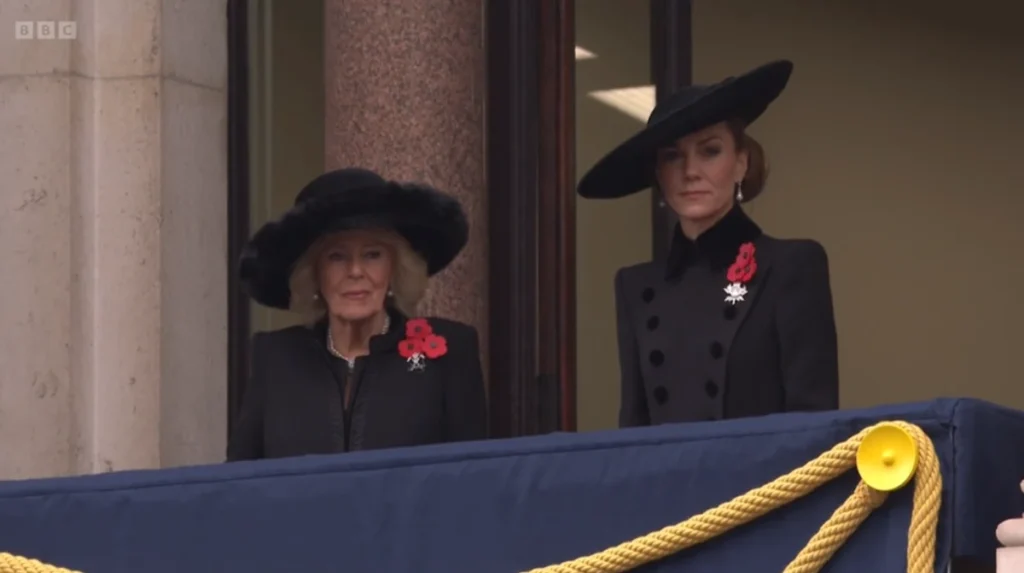

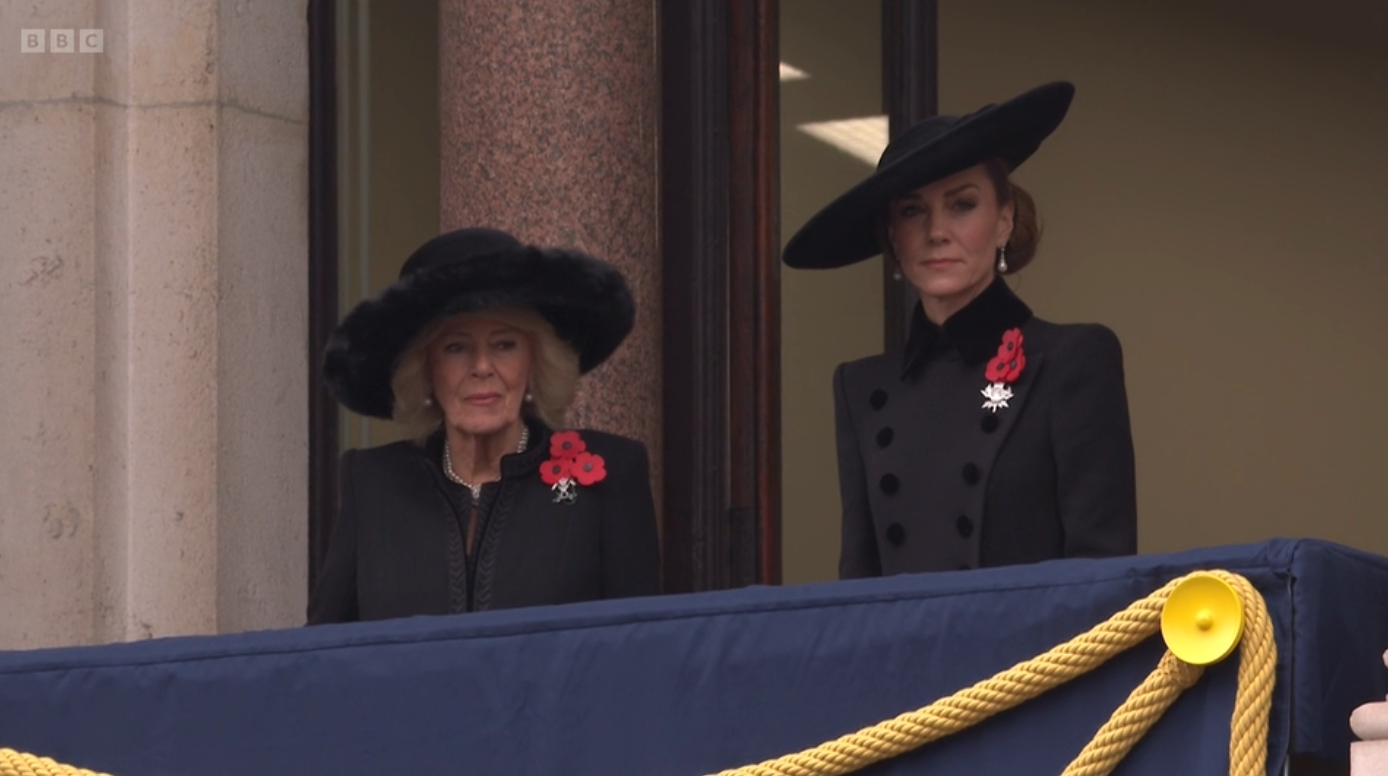
The solemn tradition of Remembrance Sunday once again brought the heart of the British capital to a respectful and poignant standstill as the nation honored its fallen service personnel. At the center of the observance, high above the historic thoroughfare of Whitehall, Queen Camilla and the Princess of Wales stood side by side to witness the solemn proceedings. Their unified presence on the central balcony of the Foreign, Commonwealth and Development Office became a defining visual of the national commemoration, capturing the public’s attention as generations past and present were remembered for their ultimate sacrifice.
The annual event, held on Sunday, 8 November, served as a powerful focal point for collective grief, national gratitude, and enduring respect. Down below, King Charles III led the nation in paying tribute, laying a meticulously crafted wreath at the base of the Cenotaph. The atmosphere was charged with solemnity, underscored by the deep silence of the crowd, the striking scarlet of commemorative poppies adorning winter coats, and the steady beat of muffled drums marking the solemn march of veterans and active-duty military personnel.
Main Facts of the National Service
The National Service of Remembrance remains one of the most significant fixtures in the British royal and civic calendar. This year’s gathering brought together senior members of the Royal Family, government officials, military leaders, and foreign diplomats to commemorate the service and sacrifice of members of the British Armed Forces who have defended the nation’s freedoms.
King Charles, performing his role as head of state, wore the distinguished uniform of a Marshal of the Royal Air Force as he stepped forward to lay the first wreath at the Cenotaph. Close behind in the order of service, various representatives of the royal household, the government, and the armed forces paid their respects through traditional floral tributes.
Positioned above the historic monument, the central balcony of the Foreign, Commonwealth and Development Office offered a clear view of the monument and the vast sea of onlookers stretching down Whitehall. Queen Camilla and Catherine, the Princess of Wales, occupied this central vantage point exclusively, underscoring their prominent senior roles within the modern monarchy. Their joint presence on the primary balcony provided a comforting and dignified image for the millions watching the broadcast across the United Kingdom and throughout the Commonwealth.
Further along the historic facade, other senior royals were accommodated on adjacent balconies, maintaining traditional protocols while ensuring all key family members were part of the national tableau. On the left-hand balcony, the Duke of Kent stood alongside the Duchess of Edinburgh and Vice Admiral Sir Tim Laurence, the husband of the Princess Royal. The Duke of Kent, whose personal bond with the military spans more than two decades of active service, maintained a poignant connection to the ceremony despite not laying his wreath in person this year. Instead, his tribute was placed at the Cenotaph by his equerry, Captain Thomas Baker-Cresswell of the Royal Scots Dragoon Guards. Meanwhile, the right-hand balcony was occupied by the Duke and Duchess of Gloucester, who observed the proceedings with solemn reverence.
Chronology of Remembrance Sunday
The structure of Remembrance Sunday follows a meticulously planned chronology designed to respect military precision and deep-seated tradition. The morning’s events unfold according to a schedule that has remained largely unchanged for decades, preserving the solemnity of the occasion.
The sequence of events typically begins hours before the official two-minute silence, as thousands of veterans, current service members, and families of the fallen gather at designated assembly points near Whitehall, Horse Guards Parade, and the surrounding streets. As the clock nears 11:00 AM, senior members of the Royal Family take their positions either at the Cenotaph or on the surrounding balconies.
At precisely 11:00 AM, the unmistakable sound of Big Ben striking the hour echoes across London, immediately followed by the firing of a single gun by the King’s Troop Royal Horse Artillery. This marks the beginning of the nationwide two-minute silence. The bustling metropolis falls entirely silent, a powerful collective pause observed by millions in public squares, churches
, and homes across the country.
Once the silence concludes with the sound of a bugler playing the Last Post and Reveille, the wreath-laying ceremony commences. King Charles III leads the procession, stepping forward to lay his wreath, followed by other senior royals, political leaders—including the Prime Minister and leaders of opposition parties—and representatives of foreign governments and Commonwealth nations.
Following the laying of the wreaths, religious leaders lead the assembly in Christian, interfaith, and non-denominational prayers, hymns, and acts of commitment, reaffirming the national promise to "remember them." The formal service concludes with the singing of the national anthem, after which the veteran march-past begins, allowing thousands of former service personnel to march past the Cenotaph and pay their personal respects to fallen comrades.
Supporting Data and Historical Context
Remembrance Sunday traces its origins back to the aftermath of the First World War, specifically rooted in the Armistice Day observances initiated by King George V in 1919. Initially focused on commemorating the cessation of hostilities on the Western Front on November 11, 1918, the scope of remembrance expanded significantly following the Second World War to honor those who fell in subsequent global conflicts, peacekeeping missions, and modern operational deployments.
The use of the Cenotaph as the focal point of the nation’s tribute dates back to the unveiling of the permanent stone monument, designed by Sir Edwin Lutyens, on Armistice Day in 1920. The monument’s stark, unadorned architectural design symbolizes an empty tomb, honoring all military personnel who died serving their country regardless of their specific rank, regiment, or theater of war.
The choice of the Foreign, Commonwealth and Development Office balconies for royal observers has historical precedent, offering both optimal sightlines and necessary security measures for senior family members. Over the years, the configuration of royals on these balconies has evolved to reflect changes in the composition of the working Royal Family. The pairing of Queen Camilla and the Princess of Wales on the central balcony highlights a strengthening partnership at the core of the institution, projecting continuity, stability, and mutual support during times of national reflection.
Furthermore, the involvement of senior royals with deep military backgrounds—such as the Duke of Kent’s 21-year tenure in the Armed Forces—underscores the enduring personal ties between the British Crown and the military establishment. These connections are not merely symbolic; they represent generations of active service, patronage of military charities, and regular visits to regiments stationed both at home and abroad.
Official Responses and Public Reception
The visual of Queen Camilla and the Princess of Wales standing together on the Whitehall balcony drew widespread praise from royal commentators, veterans’ organizations, and the general public. Media broadcasts and digital platforms highlighted the quiet dignity displayed by both women throughout the lengthy ceremony.
While formal statements from royal residences on Remembrance Sunday typically focus on the collective act of national mourning rather than individual commentary, public reactions underscored the emotional resonance of the day. Observers noted that the demeanor of both senior royals reflected the gravity of the commemoration, particularly at a time when global geopolitical tensions have brought the realities of international conflict back into sharp public focus.
Military charities and veterans’ associations expressed appreciation for the unwavering presence of the Royal Family at the Cenotaph. Representatives from the Royal British Legion emphasized that royal patronage and active participation play a vital role in keeping public awareness alive for the challenges faced by veterans, service families, and the bereaved. The sight of the monarch leading the nation in prayer, supported by the wider family from the balconies above, reinforced the message that the sacrifices of past generations remain permanently etched in the national consciousness.
Broader Impact and Implications
The National Service of Remembrance serves a dual purpose within British society: it honors the dead while acting as a vital cultural anchor for national identity and unity. In an era marked by rapid social change and political polarization, the structured, traditional nature of Remembrance Sunday provides a rare moment of shared purpose and reflection across diverse demographics.
For the modern monarchy, events of this magnitude carry significant institutional weight. The seamless execution of the ceremony under the leadership of King Charles III, alongside the visible unity of senior figures like Queen Camilla and the Princess of Wales, demonstrates the adaptability and resilience of the Crown. By maintaining these solemn traditions, the institution reinforces its role as a non-partisan symbol of continuity and national service.
The inclusion of younger generations of royals in preparatory events and eventual public ceremonies ensures the continuity of these traditions for the future. As living memory of the World Wars fades with the passing of the last veterans, the onus of remembrance shifts toward education, historical preservation, and symbolic acts such as the Whitehall service. Through their dignified participation, the members of the Royal Family help bridge the generational gap, ensuring that the lessons of history and the debt owed to those who served are never forgotten by the modern British public.