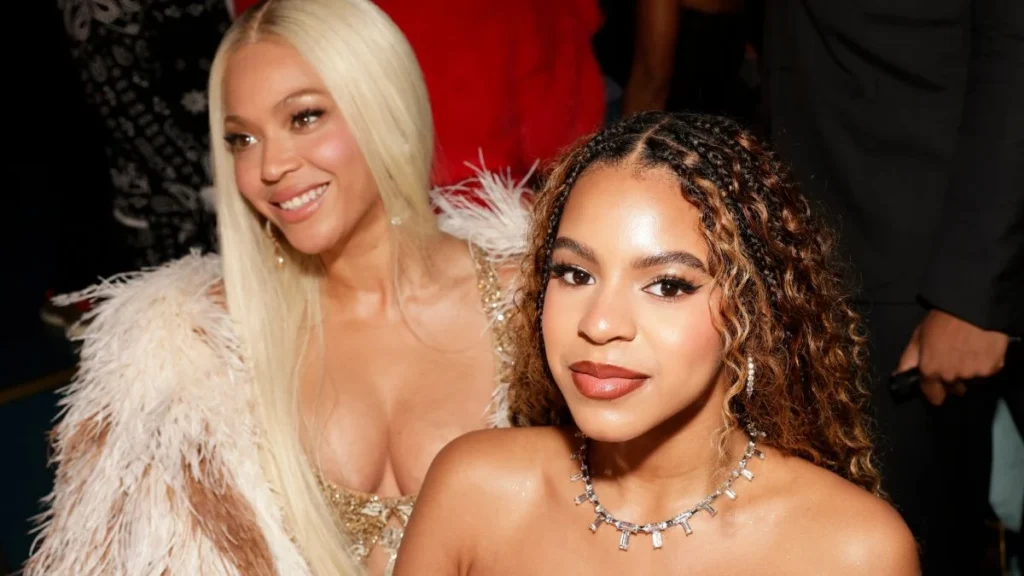

Music history and family milestones collided on a grand scale at Los Angeles’s iconic SoFi Stadium as Blue Ivy Carter made a surprise, commanding appearance during the first of her father Jay-Z’s two landmark 30th-anniversary concerts. The 14-year-old virtuoso not only captivated the packed arena with a poised and technically sound piano performance of two of her father’s most celebrated catalog tracks, but she also triggered an immediate, widespread digital sensation. Social media platforms—particularly X (formerly Twitter)—became instantly flooded with side-by-side photographic comparisons, comments, and viral threads highlighting her uncanny, increasingly undeniable resemblance to her superstar mother, Beyoncé. The event marked yet another significant step in the teenager’s burgeoning public life, seamlessly blending the legacy of two of the music industry’s most influential figures with her own developing artistic identity.
The Main Facts of the Surprise Stage Appearance
The unannounced segment unfolded midway through Jay-Z’s career-retrospective set at SoFi Stadium, a venue renowned for hosting massive global entertainment events. Blue Ivy stepped onto the expansive stage with a noticeable sense of calm professionalism that belied her youth. Taking her seat behind a grand piano, she delivered the foundational accompaniment for live renditions of Jay-Z’s critically acclaimed tracks “The Story of O.J.” and “Dead Presidents.”
Rather than serving as a mere novelty guest, the teenager maintained steady rhythm and composure throughout the complex arrangements. Upon concluding her performance, she stood up to walk directly toward her father for a warm, publicly televised embrace. Demonstrating a natural affinity for stagecraft, she turned to the massive audience to deliver a series of classic performance acknowledgments: bowing deeply, blowing kisses, and flashing a confident peace sign that elicited deafening cheers and applause from the tens of thousands of attendees present.
Her performance attire added an extra layer of visual commentary to the evening. Blue Ivy wore a vibrant, expertly tailored pink-and-blue statement jacket, accented with layered metallic necklaces and bold rings that caught the arena’s lighting. Her hair was styled in a voluminous, half-up, half-down boho configuration that framed her face, while professional stage makeup—featuring shimmering sky-blue eyeshadow, subtle rosy blush, and a high-shine pink lip gloss—solidified her polished, age-appropriate glamour.
Chronology of Blue Ivy’s Growing Stage Presence
Blue Ivy Carter’s trajectory from celebrity infant to active live performer has been meticulously documented by the public and media over the past decade and a half. Born on January 7, 2012, she was thrust into the global spotlight before she even uttered her first words, famously inspiring her father’s track “Glory,” which featured her actual newborn cries at the end of the recording and made her the youngest person ever to appear on a Billboard chart.
Her formal entry into performing arts began incrementally. In 2020, at the age of eight, she earned widespread critical acclaim and a Grammy Award for her creative contribution to her mother’s anthemic track “Brown Skin Girl,” winning the award for Best Music Video as a featured artist. This achievement instantly established her as a young talent with distinct commercial and artistic viability.
The definitive turning point in her live performance chronology, however, occurred during the historic 2023 Renaissance World Tour. Initially slated for a single surprise appearance as a backup dancer during a Paris show, Blue Ivy’s reception was so overwhelmingly positive that the engagement was extended across multiple legs of the international stadium tour. Critics and fans watched in real-time as her stage presence evolved from tentative choreography execution to fierce, synchronized execution alongside seasoned professional dancers.
Following the conclusion of the Renaissance tour, her appearances have grown more selective yet impactful. The SoFi Stadium piano debut represents a distinct pivot away from pure dance choreography toward instrumental musicianship, signaling a broadening of her artistic training and public ambitions. Industry observers note that this calculated, step-by-step introduction to the spotlight allows the young artist to build stamina, skill, and psychological resilience under the intense glare of global scrutiny.
The Digital Aftermath: The Resemblance Phenomenon
While the musical execution of “The Story of O.J.” and “Dead Presidents” earned high marks from music critics in attendance, the dominant cultural conversation following the concert centered entirely on genetics. Within minutes of her stepping into the stadium’s spotlight, digital platforms were inundated with commentary regarding her physical transformation.
Countless users pointed out that as Blue Ivy matures into her teens, facial structures, expressions, and posture patterns increasingly mirror those of a young Beyoncé during the height of Destiny’s Child’s commercial dominance in the late 1990s and early 2000s. Viral posts accumulated hundreds of thousands of interactions within hours. One user wrote, “Every time we see Blue Ivy, she looks more and more like her mama,” capturing a sentiment shared by a vast cross-section of the fandom. Another confessed to momentary confusion during the live stream and audience recordings, noting, “I THOUGHT IT WAS BEYONCÉ AT JAY-Z’S SHOW. OMG TWINSSSSS.”
This phenomenon of generational replication frequently occurs within high-profile celebrity families, but the Carter household attracts a unique level of analytical obsession. Psychologists and media analysts suggest that the public’s fascination with Blue Ivy’s resemblance to Beyoncé stems from collective nostalgia. Fans who grew up listening to Destiny’s Child and Beyoncé’s early solo work project their own timelines onto the child, viewing her physical maturation as a tangible marker of passing time.
Supporting Data and Context of the 30th Anniversary Shows
Jay-Z’s two-night residency at SoFi Stadium was conceptualized as a monumental celebration of his three-decade career in the music and entertainment industry. Marking thirty years since the independent release of his debut single and the eventual founding of Roc-A-Fella Records in 1995, the event was designed to be a comprehensive retrospective of hip-hop history, corporate empire-building, and cultural influence.
SoFi Stadium, boasting a seating capacity that can exceed 70,000 for major concert configurations, provided a fittingly grandiose backdrop for such a milestone. Tickets for the anniversary run sold out within minutes of release, driven by demand from a multi-generational demographic that spans early hip-hop purists to modern pop-culture enthusiasts.
Financially and logistically, producing a stage show of this magnitude requires months of pre-production, intricate guest curation, and stringent security protocols—particularly when minor family members are integrated into the live-action sequences. The decision to feature Blue Ivy on the piano was not an improvised backstage invitation but a rehearsed, integral component of the setlist designed to bridge the gap between Jay-Z’s foundational catalog and the future of his artistic lineage.
Broader Impact and Industry Implications
The integration of celebrity children into high-profile professional environments has long been a subject of debate within the entertainment industry, often touching upon discussions surrounding nepotism, child labor ethics, and the psychological impacts of early fame. However, the case of Blue Ivy Carter presents a distinct paradigm shaped by her parents’ hyper-controlled approach to media exposure.
Unlike historical child stars who were thrust into relentless daily schedules by management agencies, Beyoncé and Jay-Z have maintained a policy of calculated, highly curated visibility for their children. Every public appearance is treated as a rare, highly anticipated event rather than a routine promotional obligation. This strategy protects the minors from overexposure while simultaneously maximizing the cultural impact of their appearances when they do occur.
From an economic perspective, Blue Ivy’s involvement in her parents’ tours and projects generates substantial organic marketing value. Media coverage surrounding the SoFi Stadium shows surged exponentially across mainstream news outlets, trade publications, and social media algorithms specifically because of her surprise piano segment. This organic amplification translates directly into streaming spikes for the featured catalog tracks, heightened ticket demand for subsequent anniversary dates, and sustained relevance in a rapidly shifting digital attention economy.
Furthermore, the stylistic choices and performance competencies displayed by Blue Ivy serve as a powerful form of brand continuation. By demonstrating musical capability—moving beyond dance to active instrumentation like the piano—she signals to the industry that she is acquiring the foundational skills necessary for a legitimate, long-term career in the arts should she choose to pursue one independently.
As the dust settles on the first of the SoFi Stadium anniversary spectaculars, the overarching narrative extends far beyond a simple father-daughter collaboration. It stands as a masterclass in generational branding, artistic succession, and cultural resonance. Whether she ultimately chooses to step behind the piano full-time, command the dance stages of future world tours, or pursue endeavors entirely outside the entertainment sphere, Blue Ivy Carter has firmly cemented her status as a compelling figure in contemporary pop culture, ensuring that the next chapter of the Carter family dynasty is already well underway.