

The Official Announcement and Transition Period
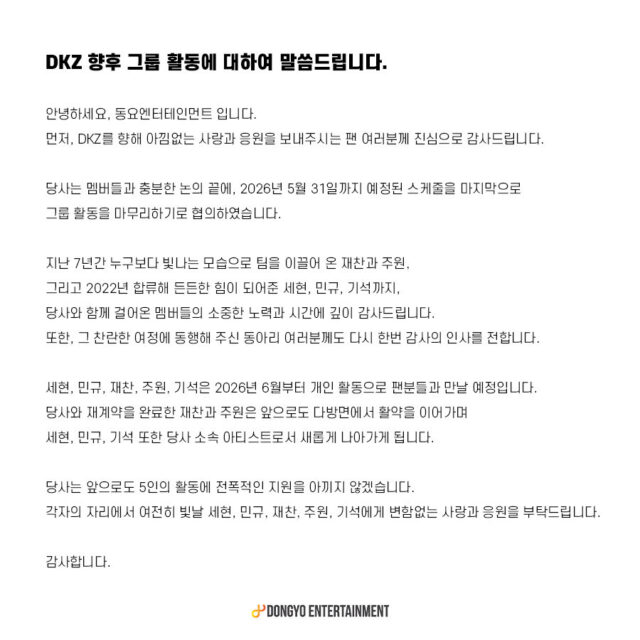
The news of DKZ’s disbandment was delivered through a comprehensive statement from Dongyo Entertainment, which sought to provide clarity to the group’s dedicated fandom, known as "Dongari." The agency emphasized that the decision was not made lightly but was the result of "thorough discussions" aimed at respecting the personal and professional aspirations of the members. The timeline for the group’s dissolution is set for the end of May 2026, allowing for a final period of engagement with fans.
In a move that is somewhat unconventional in the K-pop industry—where disbandment often coincides with members departing for different agencies—all five members of DKZ have opted to remain with Dongyo Entertainment. Jaechan and Juwon, the two remaining original members of the group’s initial lineup, have renewed their contracts to pursue multifaceted careers in music, acting, and variety. Meanwhile, Sehyeon, Mingyu, and Giseok, who joined the group during its 2022 restructuring, will also continue their artistic journeys as soloists under the company’s management. This internal continuity suggests a strategic pivot by the agency to capitalize on the individual brand power the members have cultivated over the years.
A History of Evolution: From DONGKIZ to DKZ
To understand the weight of this announcement, one must look at the unique trajectory of the group. DKZ originally debuted in April 2019 under the name DONGKIZ with the single "Dongkiz on the Block." At the time of their debut, the group was characterized by a "niche and funky" concept, often leaning into retro sounds and high-energy performances that set them apart from the more dark and experimental concepts prevalent among their peers.
The group’s early years were marked by steady growth but limited mainstream penetration. However, the year 2022 served as a pivotal turning point. Following the departure of original member Wondae due to health reasons and the hiatus of Munik, the group underwent a significant rebranding. They changed their name to DKZ and introduced three new members: Sehyeon, Mingyu, and Giseok. This "reboot" coincided with an unprecedented surge in popularity driven by external factors—specifically the massive success of the BL (Boys’ Love) web drama Semantic Error, which starred member Park Jaechan.

The "Jaechan Effect" brought a delayed spotlight to the group’s discography. Older tracks like "Lupin" and "Crazy Night" began climbing domestic music charts years after their release, and the group’s subsequent comeback with the single "Cupid" saw a massive increase in first-week album sales, jumping from a few thousand copies to over 100,000. This late-bloomer success story made DKZ one of the most interesting case studies in the fourth-generation K-pop market.
Timeline of Key Milestones
The history of DKZ is defined by resilience and adaptation. The following timeline outlines the group’s journey from its inception to the impending conclusion of group activities:
- April 2019: DONGKIZ debuts as a five-member group with a focus on energetic, retro-pop music.
- 2020–2021: The group maintains a consistent release schedule, building a loyal but modest domestic following with tracks like "Beautiful" and "Universe."
- Early 2022: A period of major transition occurs. The group rebrands to DKZ. Original leader Wondae departs the group, and Munik enters an extended hiatus (eventually departing in 2023). New members Sehyeon, Mingyu, and Giseok are added to the lineup.
- March 2022: Member Park Jaechan stars in Semantic Error. The show’s viral success transforms DKZ into a household name among K-pop fans.
- April 2022: DKZ releases "Cupid," achieving their highest commercial success to date and winning their first music show awards.
- 2023–2025: The group continues to release music and tour, while members increasingly explore solo opportunities in acting, musical theater, and radio hosting.
- April 2026: Dongyo Entertainment officially announces the end of group activities, effective May 31, 2026.
Analyzing the Strategic Pivot to Solo Careers
The decision for all members to remain with Dongyo Entertainment while pursuing solo careers reflects a growing trend in the Korean entertainment industry. As the K-pop market becomes increasingly saturated, the "7-year curse"—a term used to describe the difficulty groups face in renewing contracts after their initial seven-year term—remains a formidable barrier. For DKZ, the transition to solo activities appears to be a proactive move rather than a reactive one.
Park Jaechan, arguably the group’s most recognizable face, has already established a robust career as an actor and a solo musical artist. His ability to draw a dedicated audience independently makes a solo transition a logical next step. Juwon, known for his performance skills and tenure with the group, is expected to delve deeper into performance-based solo projects or perhaps musical theater, a field where several DKZ members have already dipped their toes.
For the newer members—Sehyeon, Mingyu, and Giseok—the transition presents an opportunity to define their individual identities outside of the "reboot" narrative of DKZ. Since joining in 2022, they have been integral to the group’s most successful era, and the agency’s commitment to supporting them suggests that they have developed distinct artistic directions that Dongyo Entertainment believes are viable in the solo market.

Industry Context and the Fourth Generation Landscape
DKZ’s disbandment comes at a time when the fourth generation of K-pop is reaching a stage of maturity. Groups that debuted between 2018 and 2020 are now navigating the complexities of long-term sustainability. While top-tier groups from major "Big 4" agencies often have the infrastructure to maintain group activities alongside solo work, groups from mid-sized or small agencies like Dongyo Entertainment often find it more efficient to focus resources on individual members who have demonstrated high marketability.
Furthermore, the K-pop industry is currently seeing a shift where "disbandment" does not necessarily mean the end of a brand, but rather a shift in operational focus. By maintaining the members under one roof, Dongyo Entertainment leaves the door open for potential "special" reunions or anniversary projects in the future, even if the group is no longer active on a day-to-day basis.
Fan Reactions and the "Dongari" Community
The reaction from the fandom has been a mix of melancholy and supportive anticipation. On social media platforms and community forums, fans have expressed gratitude for the group’s perseverance, especially during the lean years before their 2022 breakthrough. The hashtag #ThankYouDKZ and similar tributes began trending shortly after the announcement, with many fans highlighting the group’s "underdog" story as a source of inspiration.
The agency’s decision to announce the disbandment over a month in advance of the final date has been praised by some industry observers for providing fans with a sense of closure. This "grace period" allows for final fan meetings, video call events, or social media content that celebrates the group’s legacy, ensuring that the conclusion of their seven-year run is handled with dignity.
Broader Implications and Final Outlook
The conclusion of DKZ’s group activities marks the end of a significant chapter for Dongyo Entertainment. As the company’s flagship act, DKZ was instrumental in putting the agency on the map. Moving forward, the agency’s success will be measured by its ability to transition from managing a group to managing a roster of solo artists.
For the members, the road ahead is filled with both challenge and opportunity. The K-pop solo market is notoriously competitive, but the members of DKZ possess a unique advantage: a proven track record of adaptability. Having navigated lineup changes, a complete rebranding, and a sudden surge in fame, the quintet is well-equipped for the volatility of the entertainment industry.
As May 31, 2026, approaches, the focus remains on celebrating the achievements of Sehyeon, Mingyu, Jaechan, Juwon, and Giseok. While the "DKZ" name will move into the archives of K-pop history, the individual legacies of its members are only just beginning to take shape. The transition from a collective unit to five distinct artists represents a natural evolution in the lifecycle of a modern idol group, reflecting the changing priorities of both the performers and the industry at large.