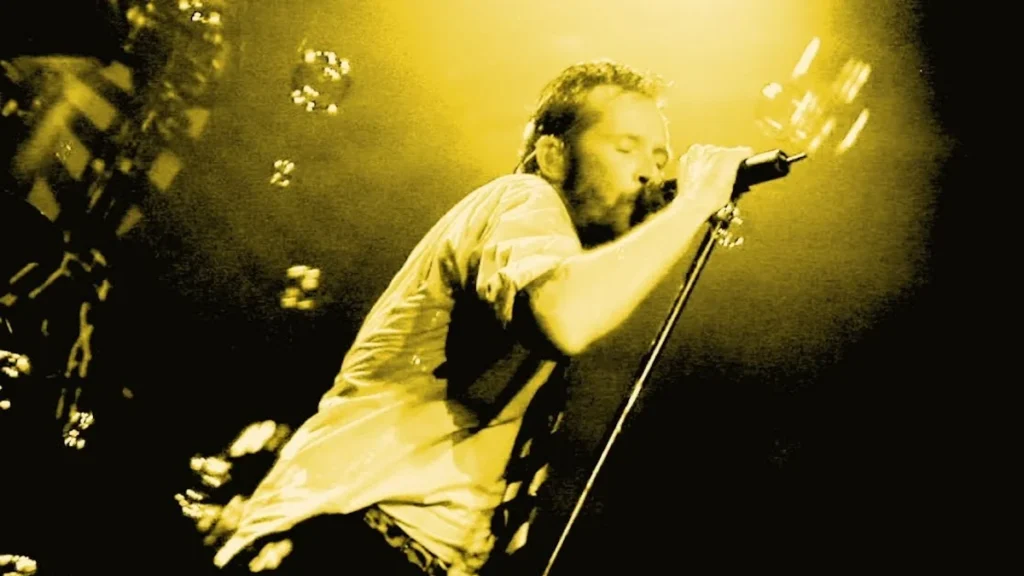

The legacy of late rock icon Scott Weiland continues to be cemented with the widespread release of the first official Scott Weiland live album, titled Scott Weiland: Live. Following an initial limited-edition vinyl release during the 2026 Record Store Day festivities, the collection is now available to the public across all major digital platforms and in CD format. To coincide with this long-awaited commercial debut, representatives have unveiled a piece of archival performance footage: a previously unseen video of Weiland performing the Stone Temple Pilots classic "Vasoline" at the House of Blues in Anaheim, California.
A Captivating Archival Performance
The newly released footage offers fans a unique vantage point into the vocal versatility of one of the 1990s’ most distinctive frontmen. In this particular live iteration of "Vasoline," Weiland diverges significantly from the deep, gravelly register that defined the original 1994 studio recording on the Stone Temple Pilots album Purple. Instead, listeners are treated to a more melodic, soaring vocal delivery that highlights his ability to adapt his instrument to the energy of a live room.
The musical arrangement accompanying his vocals is equally noteworthy. The performance features jagged, high-frequency lead guitar work that deviates from the studio version’s polished production. The raw, abrasive quality of the instrumentation—reminiscent of the feedback-heavy aesthetic of Neil Young—underscores the improvisational, "no-rules" atmosphere that defined Weiland’s live shows during the late 2000s. The footage serves as a stark reminder of the kinetic energy that made Weiland a premier performer of his generation.
Contextualizing the 2009 Era
The recordings featured on Scott Weiland: Live were captured during the tour supporting his second solo studio album, 2009’s Happy in Galoshes. This period in Weiland’s career was marked by a pivot toward more eclectic, experimental pop and alternative rock sensibilities. After departing Stone Temple Pilots for the first time in 2003 and fronting the supergroup Velvet Revolver, Weiland’s solo work during this era represented a deliberate effort to reclaim his own artistic identity outside the shadow of his massive commercial successes.
The Happy in Galoshes tour saw Weiland performing in intimate venues like the House of Blues, allowing for a level of technical precision and artistic risk-taking that was often sidelined during the massive stadium tours of the mid-90s. The release of this album provides a necessary retrospective on that specific chapter of his life, showcasing a man who was deeply committed to the craft of songwriting and live performance, even as he faced well-documented personal challenges.
Timeline of a Career and Legacy
To understand the significance of this release, it is necessary to look at the chronology of Weiland’s career:
- 1989: Weiland meets Robert DeLeo in San Diego, forming the band that would eventually become Stone Temple Pilots.
- 1992: The release of Core, which catapulted the band to international stardom and solidified Weiland as a grunge icon.
- 1994: The release of Purple, featuring "Vasoline," which peaked at number one on the Billboard 200.
- 2002: Formation of Velvet Revolver with former members of Guns N’ Roses.
- 2008-2009: Release of Happy in Galoshes and the accompanying tour from which these live recordings are sourced.
- 2015: Scott Weiland passes away on December 3 at the age of 48 in Bloomington, Minnesota.
- 2026: The official, widespread release of the archival live album Scott Weiland: Live, ensuring his performance history remains accessible to a new generation of listeners.
The Impact of Archival Releases
In the modern music industry, archival releases serve several critical functions. For the estates of deceased artists, these recordings act as a mechanism for preservation. By officially releasing soundboard-quality live tracks, the estate prevents the proliferation of low-fidelity bootlegs, ensuring that the artist’s legacy is represented by the best possible source material.
Industry analysts have noted that the release of Scott Weiland: Live is particularly timely. October 27, 2026, marks what would have been Weiland’s 59th birthday. The proximity of the album’s digital release to this milestone date serves as a tribute, allowing his vast fanbase to engage with his music during a period of reflection. Furthermore, the inclusion of "Vasoline"—a track that remains a staple of alternative rock radio—provides a bridge between his classic catalog and his more experimental solo years, offering a cohesive narrative for listeners who may have only known his radio hits.
Technical and Artistic Implications
From a musicology perspective, the performance of "Vasoline" in this live setting offers a fascinating study in vocal evolution. In the early 90s, Weiland utilized a baritone, chest-heavy vocal technique. By 2009, his approach had shifted to incorporate more nasal resonance and a higher, more agile pitch. This evolution was not merely a stylistic choice but a reflection of the wear and tear associated with decades of rigorous touring. Despite these changes, the archival footage confirms that his showmanship remained intact.
The decision to pair the album release with video content is a calculated move to maximize engagement. In an era dominated by short-form digital media, providing a visual component to a historical audio release helps generate social media traction and allows critics and fans alike to dissect the performance in real-time. The "no-rules" live atmosphere, as described by those who attended the tour, is captured not just in the audio mix, but in the visible body language and stage presence of a man who was clearly at home in the spotlight.
Industry and Fan Reactions
While official statements from surviving band members regarding this specific release have been limited, the general reception within the rock community has been overwhelmingly positive. Peers and collaborators have long acknowledged Weiland’s status as a generational talent, often citing his ability to command an audience as a benchmark for contemporary frontmen.
Fans have expressed appreciation for the high-quality restoration of the audio, noting that previous live recordings of Weiland often suffered from poor capture quality or inconsistent mixing. By releasing this through a major distributor, the estate has ensured that the "House of Blues" sessions are preserved in a way that respects the original intent of the performance.
Broader Implications for the Industry
The release of Scott Weiland: Live is part of a larger trend of high-profile archival projects surfacing in the mid-2020s. As digital streaming platforms continue to dominate the consumption of music, the demand for "complete" artist catalogs has grown. Labels are increasingly looking to their vaults to find high-value content that can be digitized and marketed to both die-hard collectors and casual listeners.
For the Scott Weiland estate, this release is likely the first step in a broader strategy to manage his intellectual property and performance rights. By establishing a standard for quality with this live album, the estate sets a precedent for how future unreleased material—demos, studio outtakes, and additional live footage—might be presented to the public.
Conclusion
The arrival of the Scott Weiland: Live album and the accompanying footage of "Vasoline" serves as a poignant reminder of the enduring power of rock music. It is more than just a commercial product; it is a historical record of an artist who pushed boundaries and defined the sound of an era. As fans listen to these tracks and watch the Anaheim footage, they are not merely revisiting the past—they are participating in the ongoing life of a musical legacy.
With the digital release now available, and the archival footage providing a new window into his creative process, Scott Weiland’s influence on the landscape of alternative rock remains as potent as ever. Whether one is a longtime admirer of the Stone Temple Pilots catalog or a newer listener discovering his solo work, this collection offers an essential addition to any comprehensive rock music library. As we approach what would have been his 59th birthday, the release stands as a testament to the fact that while the artist may be gone, the music remains a vibrant, evolving force in the cultural zeitgeist. Those interested in experiencing this slice of rock history can find the album on all major streaming services and retail platforms, including Amazon.