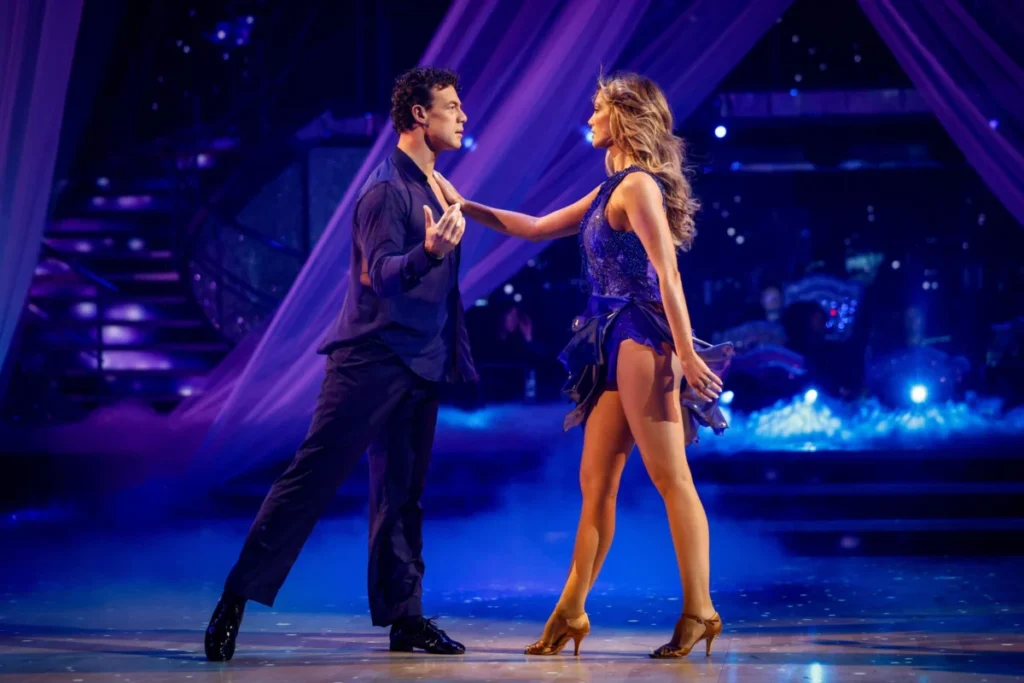

The latest episode of the BBC’s flagship dance competition proved to be a night of high stakes and emotional breakthroughs, as Winter Olympic champion Tabby Stoecker delivered the highest score of the current series. In a display of technical precision and raw vulnerability, Stoecker and her professional partner, Mark Karmalita, captivated the judges with a Couple’s Choice routine set to Olivia Rodrigo’s "Stupid Song." The performance, which was dedicated to Stoecker’s late father, resonated deeply with the judging panel, ultimately earning the pair two perfect 10s and a series-high total of 37 points.
This peak in the competition comes at a pivotal juncture, as the remaining celebrities reach the midpoint of the series. The intensity of the training schedule, combined with the pressure of live performance, has already taken a toll on several contestants, making Stoecker’s achievement all the more significant.
The Return of Delta Goodrem
Prior to Stoecker’s record-setting performance, the ballroom witnessed the highly anticipated return of singer Delta Goodrem. Goodrem, 41, had been sidelined during the previous week’s “Icons Special” due to a painful fractured rib, an injury that cast doubt on her ability to continue in the competition. Partnered with professional dancer Kai Widdrington, Goodrem delivered an emotionally charged rumba to Celine Dion’s "It’s All Coming Back To Me Now."
The performance was met with unanimous acclaim from the judges. Anton Du Beke, visibly moved by the display, awarded the pair a 10—the first of the series—and praised the routine as his “favourite dance of the series by a million miles.” In a lighthearted moment that underscored the difficulty of the choreography, Du Beke jokingly suggested that, given the quality of the performance, Goodrem should consider sustaining further rib injuries to maintain her current standard of excellence. Motsi Mabuse echoed this sentiment, labeling the rumba one of the most compelling she has seen in the history of the programme.

Goodrem, reflecting on the arduous week, acknowledged the psychological and physical hurdles she faced. “It was a tough week, and it’s been a process of working through the pain,” she explained. “But when you know you have a specific time frame, you just have to keep getting up step by step. I think that was a positive mindset to adopt.”
The Competitive Landscape: Leaders and Laggards
While the top of the leaderboard provided moments of brilliance, the lower end of the spectrum highlighted the unforgiving nature of the show. Social media personality John Nellis and Katya Jones maintained a strong position in third place, earning 32 points for a crisp, energetic quickstep to McFly’s "Five Colours In Her Hair." The performance received praise for its technical clarity, with Craig Revel Horwood describing it as “clean,” a compliment rarely handed out by the famously stringent judge.
However, the bottom of the table was occupied by two contestants facing potential elimination. Emmerdale actor Lawrence Robb and partner Jowita Przystal struggled to find their rhythm, scoring 19 for a jive set to a mash-up of Fatboy Slim and The Knack. The routine was roundly criticized by the panel for being “flat-footed” and lacking essential timing.
Joining them in the bottom two was former England international footballer Shaun Wright-Phillips, who, despite the support of his father—Arsenal legend Ian Wright—in the audience, failed to impress with his jive to Stevie Wonder’s "Faith." The performance was described by Revel Horwood as “a disaster,” leaving the pair with the night’s lowest score of 17 points. This leaves both Robb and Wright-Phillips in a precarious position ahead of the upcoming elimination vote.
Mid-Table Stalemate
The middle of the leaderboard saw a significant cluster of talent, with three couples finishing tied on 31 points. TV dog trainer Graeme Hall, Big Brother host Will Best, and former Love Island winner Dani Dyer all demonstrated consistent improvement.

For Dani Dyer and partner Nikita Kuzmin, the 31-point total was a vital recovery. Having narrowly escaped the bottom two during the previous week, the pair’s performance to Rosalia’s "Despecha" was lauded by Anton Du Beke as “magnificent.” While Craig Revel Horwood suggested the pair could have “sold it more” with increased performance flair, the result indicates a positive trajectory for the duo.
Other notable performances included:
- Lacey Turner and Vito Coppola: The EastEnders star performed a tango to Blondie’s "Atomic." Despite a temporary confusion regarding the scoring graphics, which initially displayed 29 before being corrected to 28, the pair remains in the middle of the pack.
- Jaime Winstone and Carlos Gu: Their foxtrot to Olivia Dean’s "Man I Need" earned them a respectable 25 points.
- Bethany Antonia and Nancy Xu: The pair also secured 25 points for their Argentine tango, which explored the darker, more dramatic tones of the evening.
- Cach Mercer and Maddie Ingoldsby: Their cha-cha to Måneskin’s "Beggin’" rounded out the mid-table with a score of 24.
Analytical Overview: The Pressure of the Ballroom
The 2026 series of Strictly Come Dancing has been characterized by a high degree of variability. As the competition progresses, the divide between those with prior performance experience and those learning from scratch has begun to narrow, largely due to the rigorous training regimens mandated by the production.
The injury sustained by Delta Goodrem serves as a reminder of the physical demands placed upon the celebrities. With the show requiring long hours of rehearsals, the risk of burnout and physical strain is a constant variable. The "rib injury" narrative that emerged this week highlights the "pro-celebrity" aspect of the show, where the resilience of the amateur is just as vital as their technical aptitude.
From a production standpoint, the judges’ scoring patterns have become increasingly polarized. As the field thins, the disparity between a 17 and a 37 indicates that the judges are beginning to grade with greater severity, looking for professional-level nuance rather than simple competency.

Broader Impact and Implications
The success of Tabby Stoecker’s performance has significant implications for the betting markets and audience sentiment. As an Olympic athlete, Stoecker brings a high level of physical discipline to the ballroom, a trait that often translates well to the requirements of ballroom and Latin dance. Her ability to channel personal loss into an “exquisite” performance has made her a clear frontrunner, shifting the narrative away from the entertainment-focused contestants toward those demonstrating high-level athletic artistry.
Conversely, the struggles of Shaun Wright-Phillips and Lawrence Robb emphasize the unpredictable nature of the public vote. Historically, high-profile figures from the sporting world often rely on a strong fan base to survive weeks where their technical scores are low. Whether Wright-Phillips can overcome the “disaster” critique through public support remains to be seen.
As the series moves into its next phase, the focus will likely shift toward consistency. With the leaderboard currently dominated by Stoecker and Goodrem, the remaining contestants face the unenviable task of matching these high benchmarks under increasingly intense scrutiny. The coming week will be critical, as the margin for error effectively disappears, and the pressure to avoid the bottom two becomes the primary driver for all remaining participants.
The production team, meanwhile, continues to manage the logistics of the show, evidenced by the swift correction of the scoring graphic for Lacey Turner. Such technical accuracy is paramount to maintaining the integrity of the competition in the eyes of the viewing public, ensuring that each point awarded reflects the consensus of the judging panel accurately.
As the dancers prepare for their next routines, the combination of technical training, emotional storytelling, and the inevitable physical fatigue of the competition will continue to dictate the narrative arc of the season. For the frontrunners, the challenge will be to maintain their momentum; for those in the lower tiers, the challenge is nothing short of survival.