
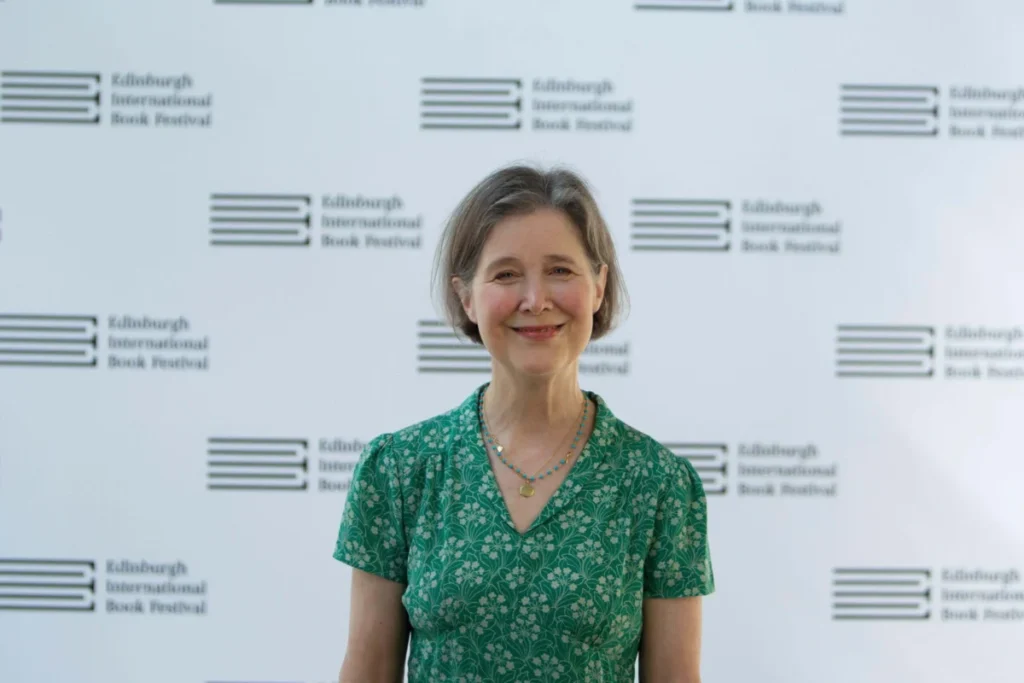

The celebrated American novelist Ann Patchett, a fixture in contemporary literature with a career spanning over three decades, has offered a candid reflection on the nature of creative ambition and the pragmatic realities of the writing life. Speaking on the long-running BBC Radio 4 program Desert Island Discs, the 62-year-old author dismantled the romanticized notion of the "inevitable author," while simultaneously revealing that her own professional journey was driven by a singular, modest objective: the ability to sustain herself solely through her craft.
A Singular Goal in a High-Stakes Industry
For Patchett, whose bibliography includes ten novels, four works of nonfiction, and three children’s books, the path to literary prominence was never paved with dreams of global fame or literary immortality. Instead, her aspirations were anchored in a specific, tangible milestone. "My greatest dream in life was to be able to pay my bills with writing. That’s the only dream I ever had," Patchett told host Lauren Laverne.
She elaborated on the simplicity of this vision, noting that she did not harbor desires for wealth or property ownership in the early stages of her career. "I didn’t want to be rich or famous or wanted to buy a house. I just thought that one day I wanted to be able to have a tiny apartment that was mine and that I could pay for by writing. Mostly I made my living as a writer and that’s all I wanted and I never revised that, ever."
This pragmatic approach provides a fascinating contrast to the often-mythologized path of the "star author." In an industry where marketability and commercial success are often emphasized, Patchett’s focus on professional sustainability highlights a shift in how modern writers view their career trajectories—prioritizing the endurance of their practice over the volatility of fame.
Deconstructing the Myth of the Universal Novelist
Beyond her personal reflections, Patchett offered a critique of the pervasive cultural belief that "everyone has a book inside them." This sentiment, frequently cited in creative writing circles and self-help literature, was dismissed by the author as fundamentally flawed.

"Oh I don’t believe that, any more than I believe that everyone has one mathematical proof in them, or one perfectly prepared pot roast," she explained. "If somebody said to you that everybody has one perfect symphony in them, you would say that is ridiculous. But there is something about the notion that because we can all write and tell stories, we all have a book in us. We all have something in us, but it’s not necessarily a book."
This perspective carries significant implications for the publishing industry, which currently faces an unprecedented volume of submissions. Patchett’s comments serve as a professional recalibration, suggesting that while storytelling is a universal human trait, the discipline and technical architecture required to construct a novel are specific skills that do not necessarily exist in every individual.
The Crucible of Early Success: A Chronology of Persistence
The trajectory of Patchett’s career serves as a masterclass in persistence, beginning with the challenging gestation of her debut novel, The Patron Saint of Liars, published in 1992. The process of writing the book, which occupied seven months of her life after a year of contemplation, nearly ended in abandonment.
"I had been thinking about the story for a long time—about a year—and I started writing and I was about three days in when I thought: ‘This is the worst idea for a novel and I need to come up with a completely different idea,’" she recalled.
It was only through the intervention of a peer that she continued. A fellow writer provided what Patchett described as the "Voice of God" advice: "You are absolutely allowed to come up with a new idea when you are finished writing this novel." This advice proved pivotal, allowing her to view the book as a contractual obligation to herself rather than a reflection of her total creative potential. Upon completing the manuscript, Patchett described the experience as the most meaningful moment of her life—a fulfillment of a self-imposed promise.
The financial reality of that early success was modest but transformative. She recalled receiving a $30,000 advance for the novel, a sum she intended to use to repair her car’s air conditioning, which had been broken for five years. The realization that the repair cost only $17—and that she had spent half a decade enduring the heat for such a trivial expense—remains a poignant memory of her transition into professional writing.

A Career Defined by Accolades and Evolution
Since that debut, Patchett’s career has evolved into one of the most respected in American letters. Her bibliography includes acclaimed titles such as Taft, The Magician’s Assistant, Bel Canto, Commonwealth, The Dutch House, and her most recent release, Whistler.
The breadth of her recognition is substantial:
- 2002: Won the Orange Prize for Fiction for Bel Canto.
- 2019/2020: Finalist for the Pulitzer Prize for Fiction for The Dutch House.
- Recognition: Recipient of the PEN/Faulkner Award.
- Translation: Her work has been translated into over 30 languages, marking her as a truly global literary figure.
In addition to her fiction, Patchett has established herself as a formidable essayist, with contributions to The New Yorker, Elle, GQ, and Vogue. Her formative years included a decade-long stint writing for Seventeen magazine, a period that likely honed her ability to write for diverse audiences and manage the rigorous demands of professional deadlines.
The Intersection of Public Service and Private Achievement
While Patchett’s professional milestones are many, she identified her receipt of the 2021 National Humanities Medal as her "dearest moment." The award, presented by then-President Joe Biden at the White House, served as a culmination of her lifelong dedication to the humanities.
Recalling the ceremony, Patchett noted the personal nature of the exchange: "When I was there standing on the stage and he put a medal around my neck and was holding my hand and he said: ‘Good work kiddo’ and I thought I was going to burst into tears. It was the dearest moment of my life."
Implications for the Literary Landscape
The insights provided by Patchett in her BBC interview offer a rare look at the intersection of artistic integrity and economic reality. In an era where the "gig economy" has encroached upon creative fields, her career serves as a blueprint for sustainability. By refusing to let the pressures of success—or the anxiety of failure—distract from the act of writing itself, Patchett has maintained a level of output and quality that remains the envy of her peers.

Furthermore, her rejection of the "universal novelist" trope is an important contribution to the discourse on arts education. It shifts the focus from the idea that writing is an inherent identity to the understanding that writing is a trade, requiring apprenticeship, resilience, and the willingness to finish what one starts, even when the spark of inspiration has faded.
As the publishing industry continues to navigate the digital age, with shifting models of distribution and an increasing emphasis on platform-based marketing, Patchett’s insistence on the primacy of the work remains a vital anchor. Her story serves as a reminder that for even the most decorated authors, the ultimate prize is not the medal or the bestseller list, but the ability to continue the work for another day.
For aspiring writers, her journey underscores the necessity of professional discipline. The transition from a struggling writer with a broken car air conditioner to a National Humanities Medalist is not merely a story of talent, but a story of endurance. By treating her ambition as a job to be performed rather than a dream to be chased, Patchett has ensured that her voice remains a permanent fixture in the American literary canon.


![Sex Pistols Berate Dude for Infiltrating Women-Only Mosh Pit [Updated]](https://thecelebnews.com/wp-content/uploads/2026/10/sex-pistols-berate-dude-for-infiltrating-women-only-mosh-pit-updated-150x150.webp)
