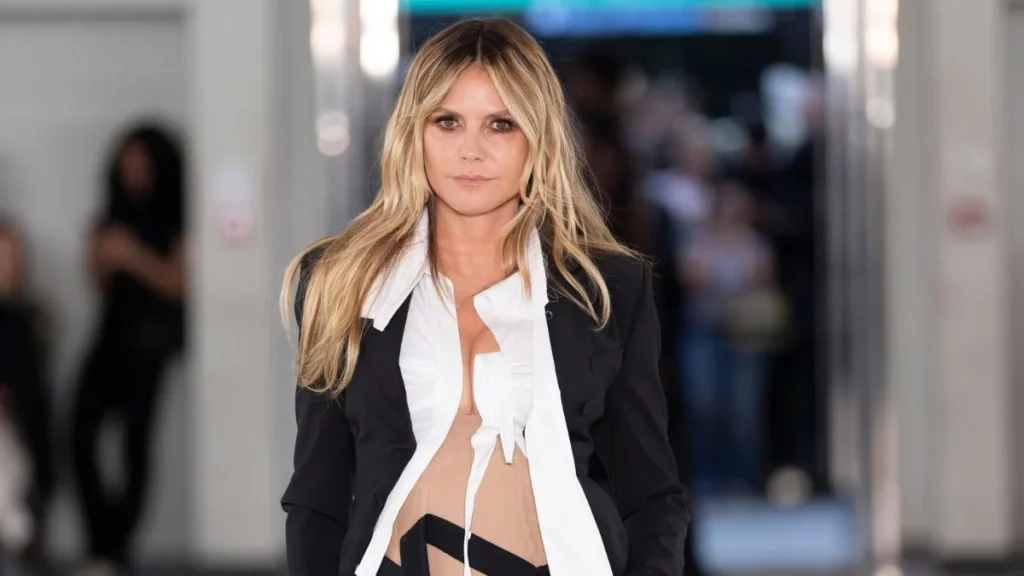

Paris Fashion Week Spring/Summer 2027 delivered a series of high-profile design moments across the French capital, but few captured the attention of the global style community quite like Heidi Klum’s unexpected return to the catwalk. Closing out the presentation for the avant-garde label Ottolinger, the supermodel and media personality commanded the room in a look that directly challenged conventional tailoring and redefined contemporary runway presentation. Stepping out in an ensemble featuring a dramatically deconstructed white shirt, a plunging nude corset, and asymmetric outerwear, Klum proved that her decades-long modeling tenure continues to wield significant influence within the upper echelons of high fashion.
The presentation, which took place amid the bustling schedule of Paris Fashion Week, immediately dominated industry discussions and digital fashion platforms alike. Ottolinger, known for its radical approach to sustainability, deconstruction, and unconventional textiles, found an ideal partner in Klum. By casting a legendary supermodel to anchor its closing look, the brand successfully bridged the gap between disruptive underground design and mainstream high-fashion prestige.
The Anatomy of the Look: Deconstruction Meets Haute Engineering
The centerpiece of Ottolinger’s Spring/Summer 2027 closing look was an intricate study in contrasts. The outfit married corporate-inspired structure with chaotic, deconstructed elements, staying true to the design ethos of founders Christa Bösch and Cosima Gadient. Rather than presenting a clean, traditional silhouette, the design subverted classic wardrobe staples.
At the core of the ensemble was a structured black blazer paired with a dramatically reworked white button-down shirt. Instead of being fastened in a conventional manner, the shirt hung open in sweeping, asymmetric panels. This intentional disarray exposed a plunging nude corset underneath, creating a sharp tension between exposure and architectural tailoring. The corset provided an anchoring foundation of support while visually breaking up the monochrome palette with skin-toned warmth.
The experimental theme extended downward to the relaxed black trousers. The waistband of the trousers appeared deliberately shifted and partially unraveled, introducing bold cutout details that wrapped around the hips. This technique of exposed construction has become a hallmark of Ottolinger’s design language, symbolizing a rejection of rigid manufacturing standards in favor of a fluid, living garment.
To anchor the complex outfit, Klum was styled in Christian Louboutin’s black patent leather Miss Z Sling Back pumps. Featuring a sharp, pointed silhouette, slim slingback straps, and the designer’s iconic lacquered red soles, the footwear added a sleek, polished finish. The glossy patent leather provided a sophisticated texture that balanced the raw, unfinished edges of the deconstructed clothing.
For accessories and beauty, the styling remained intentionally restrained to keep the focus squarely on the garments. Klum wore her signature blonde hair loose in soft, straight waves parted cleanly down the center. Her makeup palette was fresh and understated, featuring luminous, glowing skin, softly defined eyes, subtle facial contouring, and a neutral nude lip. This minimalist beauty approach grounded the avant-garde styling, preventing the overall look from tipping into theatrical excess.
Chronology of Paris Fashion Week Spring/Summer 2027
Paris Fashion Week remains the crown jewel of the international fashion month calendar, following preceding legs in New York, London, and Milan. The Spring/Summer 2027 collections brought hundreds of international journalists, buyers, celebrities, and influencers to France to view upcoming trends for the warm-weather season.
Ottolinger slotted its presentation into the mid-section of the densely packed PFW schedule, a strategic placement designed to capture maximum media saturation before fatigue set in among attendees. The brand’s runway show unfolded in an industrial-style venue that matched the gritty, urban aesthetic of its collections.
The runway show progressed through a series of wearable yet challenging garments, showcasing the brand’s progression toward a more mature, structured form of deconstruction. As the final segment of the show approached, anticipation built within the room. The transition from the core collection to the finale was marked by a shift in lighting and sound design, signaling a major moment. When Klum emerged from backstage to close the show, the audience reaction was immediate, with digital cameras flashing continuously as she executed her final walk with the precision of a seasoned runway veteran.
Following the physical presentation, the digital rollout was executed with equal speed. Klum immediately leveraged her massive social media presence, sharing behind-the-scenes footage and professional runway captures on her official Instagram account. The resulting content generated millions of impressions within hours, cementing the partnership between the heritage supermodel and the contemporary label as one of the most viral moments of the week.
The Designers and the Brand Identity: Christa Bösch and Cosima Gadient
To fully understand the impact of Klum’s appearance, it is necessary to examine the trajectory of Ottolinger. Founded by Swiss designers Christa Bösch and Cosima Gadient, the brand has steadily built a reputation as a disruptor since its inception. Graduates of the Basel Academy of Art and Design, the duo established Ottolinger in Berlin before relocating their operations to Paris, the epicenter of global luxury fashion.
Ottolinger’s design philosophy rejects pristine perfection. Instead, the brand celebrates the handmade, the destroyed, and the reconstructed. Signature techniques include burnt fabrics, exposed seams, engineered cutouts, and garments that appear as though they are perpetually in the process of being assembled or taken apart.
By inviting Heidi Klum—a titan of commercial and high-fashion modeling from the 1990s and 2000s—to close their Spring/Summer 2027 show, Bösch and Gadient achieved a powerful juxtaposition. The collaboration demonstrated that avant-garde deconstruction is not exclusively reserved for youthful subcultures; rather, it can be embodied by established icons who command universal recognition. This casting choice expanded the demographic reach of the brand while validating its artistic credibility on a global stage.
Broader Impact and Industry Implications
Surprise celebrity runway appearances have become a major marketing and cultural strategy for contemporary fashion houses. In an era where digital engagement dictates commercial success, brands constantly seek high-impact moments that transcend traditional runway reviews. Klum’s turn for Ottolinger achieved this objective by generating cross-generational appeal.
From an economic and public relations perspective, such partnerships drive measurable value. Fashion analytics firms frequently note that high-profile runway cameos generate spikes in search volume, social media engagement, and direct-to-consumer interest for emerging and mid-tier luxury labels. For Ottolinger, an independent label navigating a competitive global market, aligning with a household name like Klum provides a vital megaphone, amplifying its design credentials to a wider audience that extends far beyond niche fashion circles.
Furthermore, Klum’s presence on the runway speaks to a broader cultural shift within the fashion industry regarding ageism and inclusivity. While the fashion world has historically prioritized youth, recent seasons have seen a notable increase in veteran supermodels returning to the catwalk. Figures from Klum’s generation are increasingly reclaiming runway space, proving that high fashion is no longer bound by strict age limits. This evolution reflects changing consumer expectations, as audiences increasingly value longevity, authenticity, and enduring personal style over transient trends.
Conclusion
Heidi Klum’s return to the runway at Paris Fashion Week Spring/Summer 2027 was much more than a fleeting viral spectacle. By anchoring Ottolinger’s closing look in a masterclass of deconstructed tailoring, she reinforced her status as an enduring force in fashion. The synthesis of Bösch and Gadient’s avant-garde vision with Klum’s peerless runway presence created a definitive moment for the season—one that highlighted the power of unexpected collaborations in modern luxury design. As the industry continues to evolve, moments like this demonstrate that heritage expertise and experimental creativity can intersect to produce unforgettable cultural milestones.