

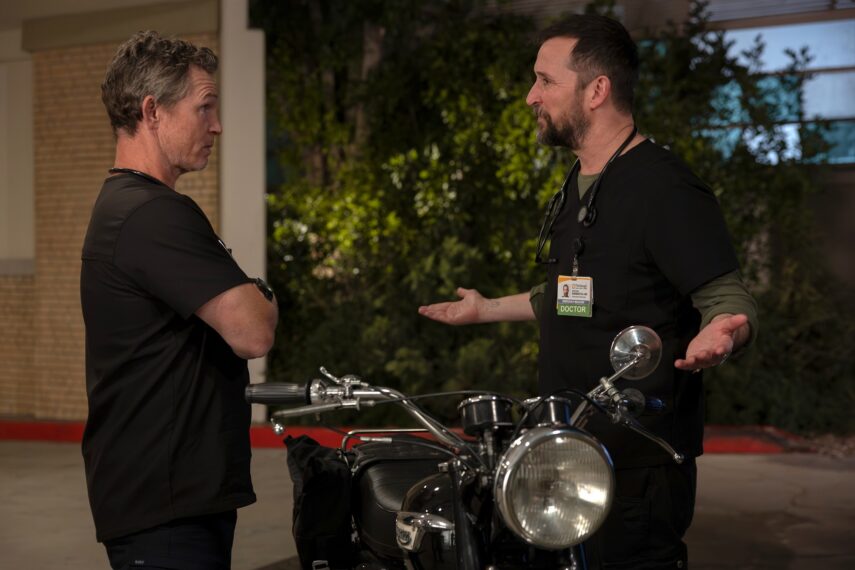
The season two finale of the medical drama The Pitt, which aired during the Fourth of July shift, concluded with a profoundly impactful conversation between Dr. Robby (Noah Wyle) and Dr. Abbot (Shawn Hatosy). This climactic exchange, echoing the dramatic intensity of the previous season’s finale, has already generated significant buzz within the television industry, with many predicting potential Emmy wins for both Wyle and Hatosy for their commanding performances. Beyond this central duo, the episode also provided crucial moments for other key characters, including Dr. King (Taylor Dearden), Dr. Al-Hashimi (Sepideh Moafi), and Dr. Mohan (Supriya Ganesh), whose future at the hospital remains uncertain.
The episode’s conclusion, set against the backdrop of the chaotic trauma room, served as a powerful culmination of Abbot’s efforts to support Robby, a mission initiated by Dana (Katherine LaNasa). Abbot’s deep understanding of Robby’s struggles stems from their shared experiences in the high-pressure environment of the emergency room. As Hatosy explained in a post-finale interview for Post-Op: The Pitt Aftershow, "It’s not easy to get him to listen. They’re both people that have had to run this very challenging, stressful environment. And so Abbot understands it on a level that most others don’t, and they’re best friends." He further elaborated on the depth of their bond, noting, "He says, ‘I’m your emergency contact,’ which that provides another layer of how deep their friendship is."
A Harrowing Journey and a Plea for Resilience
The season finale saw Robby grappling with immense emotional turmoil, a sentiment he had confided to Duke (Jeff Kober) in the preceding episode, admitting to a profound sense of detachment and weariness. Abbot’s intervention in the trauma room was not merely a professional obligation but a deeply personal one, drawing from his own traumatic past. He revealed the raw truth of his survival, stating, "You want to know why I never killed myself? After what I saw and lived through, losing my leg, losing my wife? Because it comes for all of us, you and I know it more than most. We see it every shift, but we can’t let ourselves succumb to it." Abbot’s words underscored the brutal realities of their profession, yet he also offered a glimmer of hope, acknowledging the inherent beauty and humor that coexist with the suffering. "Yes, life can suck, it can be unbearable and brutal and ugly and heartbreaking, but it’s also beautiful and hilarious," he asserted, pointing to their shared purpose: "Saving patients, like a pregnant woman and her baby as they just did, that’s what we’re here for."

Noah Wyle’s portrayal of Robby’s descent into emotional exhaustion was lauded as one of his most powerful performances of the series. The scene captured Robby’s internal struggle with visceral authenticity, from the unspoken pain evident in his voice to the eventual release of tears. Robby’s poignant confession articulated the cumulative toll of witnessing countless deaths: "The most important things I’ve ever done in my life have been in this hospital. Nothing will ever matter more than what I’ve done in this hospital, but it is killing me. You know how they say that a part of you dies when you lose someone you love? I’m not convinced that a part of you doesn’t die every time you see a fellow human pass, and I’ve seen so many people die that I feel like it’s leeching something from my soul." His weariness extended beyond the emotional burden, as he expressed, "I’m tired of being a role model. I’m tired of feeling like you can’t get ahead. I’m tired of feeling like I’m drowning every day. I’m tired of all of it."
In response, Abbot urged Robby to seek external help, emphasizing the critical need for self-care amidst the relentless demands of their work. "You need this place as much as it needs you," Abbot advised, acknowledging Robby’s profound distress. He offered a stark but honest assessment: "Yes, he’s ‘f**ked up,’ but nobody works here as long as you and me doesn’t get screwed up. You gotta find somebody to help you. Dance through the darkness." Abbot’s final words, delivered with a protective urgency, reinforced his commitment to Robby’s well-being: "I do not want to be contacted." Reflecting on the interaction, Hatosy conveyed Abbot’s perspective: "I think he thinks he did the best he could."
Uncertain Futures and the Search for Community
The season finale also delved into the evolving circumstances of other characters. Dr. Mohan’s departure from the series was confirmed, leaving her storyline with an open-ended resolution. Her initial plans to relocate to New Jersey with her mother were unexpectedly disrupted, leading to a desperate search for accommodation in Pittsburgh. Supriya Ganesh, in her Post-Op interview, shed light on Mohan’s motivations: "It’s strange because we’re talking about this in terms of finding a fellowship or an elective, but what I think she’s really trying to do is stay in Pittsburgh. I think she’s really trying to figure out a way to stay in the hospital because there’s nothing left for her in Jersey. Her mom really was her only tether there, and it is her realizing she has a few more tethers here than she does back home." Ganesh further articulated Mohan’s underlying need for connection, stating, "So it’s like, yes, this idea of what I should do to stay, but she’s really scrambling to feel like she has community." She expressed a personal wish for her character: "But I also think, for me, I wish there was this sense of, ‘I wish you could just take a break. I really want you to take a break. I think you’re so burnt out. I think you’re reaching this point of exhaustion emotionally, physically, all of those things. And you’ve really gone through one of the worst days of your life.’ I almost want her to stop thinking about all of those things and focus on something else."
Dr. Al-Hashimi’s professional future at PTMC also faced significant challenges. Robby deemed her proposed double coverage strategy unrealistic in managing her seizure disorder, especially after experiencing two episodes during the shift. Sepideh Moafi elaborated on Al-Hashimi’s approach, explaining, "I think she’s been trying to appeal to his intellect, appeal to his practice, appeal to him emotionally, and everything is falling flat. So I think in approaching him, she brings her wound and appeals to his wound." Moafi also shared her positive experience working with Noah Wyle on these intense scenes. She described a collaborative process that allowed for both deep focus and moments of levity: "Noah and I were talking a lot. We were kind of shooting the s**t, and we were laughing, but then as soon as cameras would go up, we would get back in that place. And it was nice to dip in and out with him because I think there’s a certain agility about the both of us as actors where we can really focus intensely and then be loose."
Navigating Professional Scrutiny and the Power of Connection
Meanwhile, Dr. King found herself facing an unexpected and daunting prospect: a second deposition, adding to her already considerable stress throughout the shift. Her invitation for a night out with Santos (Isa Briones), which culminated in a karaoke session over the credits, served as a much-needed respite. Taylor Dearden commented on King’s emotional state, noting, "More than she can handle. The truth is she’s been handling more than she can handle for her whole life by a lot." Dearden elaborated on the deposition’s impact: "The kind of challenge the deposition is is something new to her. I think every young doctor has doubts if they’re going to be good enough. Every person in every profession is going to feel that, but obviously it’s a lot more heated when it’s life and death."
The season finale of The Pitt not only delivered gripping medical emergencies and interpersonal drama but also explored the profound emotional and psychological toll that a career in emergency medicine can exact. The interactions between the characters, particularly the central figures of Robby and Abbot, highlighted the resilience required to navigate such a demanding profession. The series’ ability to weave together these complex narratives, coupled with strong performances from its ensemble cast, has set a high bar for its upcoming third season. Executive producer R. Scott Gemmill has offered insights into the direction of the show, hinting at Robby’s continued healing journey and the potential for new developments within the hospital’s dynamic. The departure of Supriya Ganesh as Dr. Mohan marks a significant shift, underscoring the transient nature of relationships and careers within the high-stakes environment of PTMC.
Fans can revisit the key moments and behind-the-scenes discussions from the finale through the Post-Op: The Pitt Aftershow, featuring extended interviews with Supriya Ganesh, Sepideh Moafi, Taylor Dearden, Shawn Hatosy, and Jeff Kober. The future of The Pitt has been secured with a renewal for Season 3, promising more of the compelling medical drama and character-driven storytelling that has captivated audiences.