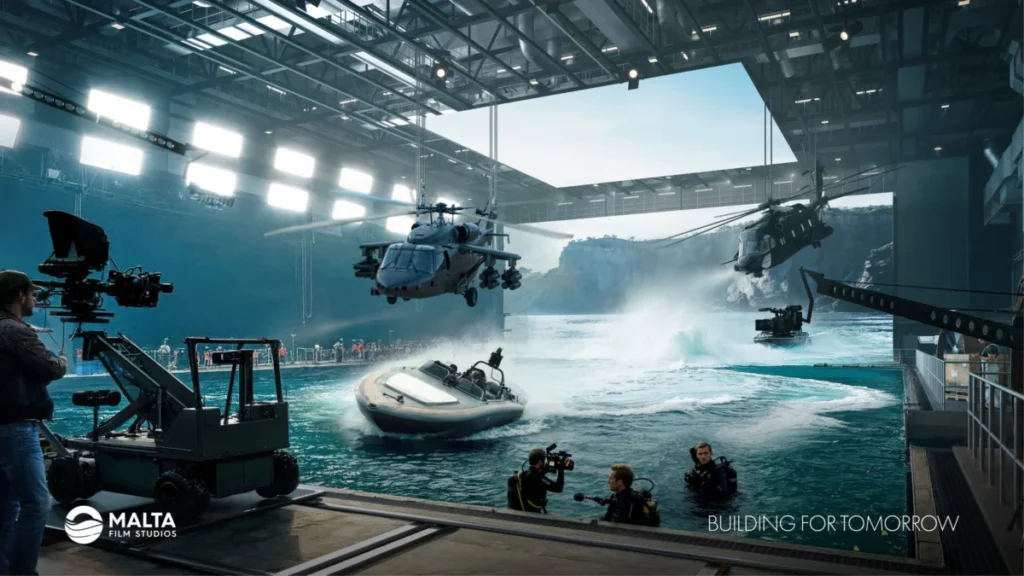

The Mediterranean island nation of Malta has officially initiated a monumental phase in its cinematic evolution, launching a public call for proposals to finance, construct, and operate the world’s first-of-its-kind Land Sea Super Stage. Spearheaded by the Malta Film Commission and film commissioner Johann Grech, the ambitious infrastructure project aims to inject more than €80 million in private investment directly into the country’s burgeoning film ecosystem. First teased earlier this summer during the annual Mediterrane Film Festival, the proposed facility represents the crown jewel in Malta’s long-term strategy to cement its status as a premier global hub for high-end Hollywood blockbusters and major international franchises.
With submissions now officially open for a three-month evaluation period, the international production community is turning its attention toward the small European archipelago. The project promises to revolutionize how complex, multi-medium sequences are filmed by seamlessly integrating advanced soundstage capabilities with marine production infrastructure. As global studios increasingly demand versatile, all-in-one facilities that can accommodate both dry-stage visual effects work and massive water-tank sequences, Malta is positioning itself at the absolute forefront of industry innovation.
Ambitious Blueprints and Technical Specifications
At the heart of the proposed development is the Land Sea Super Stage, an engineering marvel slated for construction at the historic Malta Film Studios. While traditional soundstages and water facilities typically operate as separate entities—requiring costly and time-consuming unit moves—the new superstudio is designed to bridge the gap between terrestrial and aquatic filmmaking.
According to preliminary blueprints revealed by the Malta Film Commission, the facility will feature an integrated water tank paired with a heavy-duty structural grid. The engineering parameters are specifically tailored to handle the rigorous demands of modern action filmmaking, boasting a ceiling and rigging capacity sturdy enough to safely suspend heavy military aircraft, such as two twin-rotor Black Hawk helicopters simultaneously.
Beyond the primary stage itself, the €80 million master plan encompasses a fully comprehensive studio campus. The facility layout includes expansive construction workshops, dedicated technical offices, high-end production suites, and secure storage warehouses. By consolidating every facet of physical production into a single, cohesive location, Malta aims to offer international filmmakers an frictionless working environment that drastically reduces logistical overhead and principal photography timelines.
The Chronology of an Ambitious Vision
The path toward the Land Sea Super Stage has been meticulously plotted by the Malta Film Commission under the leadership of Johann Grech. The vision was first brought to the global stage in June during the Mediterrane Film Festival, where Grech offered industry insiders a preliminary look at the conceptual designs. At the time, Grech emphasized that the project was not merely a speculative concept, but a fully realized plan awaiting only the formal administrative rollout.
"To build the entire facility — in addition to the soundstage, there will be workshops, offices, production offices, warehouses, etc. — it will take two years," Grech stated during the unveiling. "We have every detail in place. We just need to issue this public call."
True to his word, the formal public call for investment proposals has now been activated via official procurement portals, opening a critical three-month window for qualified private entities, consortiums, and infrastructure developers to submit comprehensive bids. If the project adheres to the projected two-year construction timeline following the selection of a private partner, the Land Sea Super Stage could realistically open its doors to incoming productions, transforming the Mediterranean landscape for large-scale cinema.
Capitalizing on a Legacy of Cinematic Success
Malta is no stranger to the silver screen. For decades, the island’s dramatic topography, historic architecture, and reliable Mediterranean sunlight have made it a favorite backdrop for Hollywood directors. The nation’s cinematic legacy includes timeless classics and modern epics alike, ranging from Ridley Scott’s original Academy Award-winning Gladiator to Wolfgang Petersen’s Troy, Steven Spielberg’s Munich, Paul Greengrass’s Captain Phillips, and Kenneth Branagh’s Murder on the Orient Express.

More recently, Malta has experienced a resurgence in major studio bookings. The island served as a crucial production hub for Ridley Scott’s legacy sequel Gladiator II, as well as entries in the globally lucrative Jurassic World franchise and Netflix’s mystery adventure Enola Holmes 3. Studio executives have consistently praised the jurisdiction’s unique coastal geography and its specialized water-filming capabilities, which have long given the Malta Film Studios a distinct competitive advantage over landlocked European competitors.
However, industry analysts note that while Malta’s natural backlot and existing water tanks have historically drawn productions for specific sequences, the island lacked a truly world-class, modern soundstage complex capable of hosting full-scale, indoor-outdoor blockbuster shoots year-round. The Land Sea Super Stage is specifically designed to eliminate this historical bottleneck, ensuring that productions no longer need to split their shooting schedules between Malta’s outdoor tanks and soundstages located elsewhere in Europe.
Official Responses and Strategic Implications
The launch of the investment call has drawn widespread praise from regional economic stakeholders who view the multi-million-euro injection as a transformative milestone for the local economy.
"Today’s launch marks the final piece of the jigsaw in creating a world-class film industry in Malta," said Grech upon announcing the opening of submissions. "We are committed to taking Malta’s film infrastructure to the next level. We have already seen major franchises such as Gladiator and Jurassic World repeatedly choose Malta for our versatile locations and our water tanks. We now want to complete Malta’s offer to the global film industry by developing a world-class studio facility that is truly unique."
Grech further emphasized that the strategic expansion is engineered to attract the highest tier of global capital. "By developing the world’s first Land-Sea Super Stage at the Malta Film Studios, we will strengthen our ability to attract more high-end, high-budget and high-value productions. Malta can become the home of some of the world’s biggest movies and film franchises. I’ve always been ambitious for Malta’s film industry and now we are ready to reach even higher."
The economic implications of an €80 million private infrastructure investment extend far beyond the direct receipts of the construction sector. A facility of this magnitude is expected to generate hundreds of high-paying, permanent technical jobs for local crew members, set builders, digital artists, and administrative personnel. Furthermore, the presence of a permanent super-stage infrastructure encourages longer stays for international cast and crew, amplifying spillover revenues for the island’s hospitality, transport, catering, and service industries.
Broader Industry Trends and Future Outlook
Malta’s aggressive infrastructure play comes at a time of profound evolution within the global entertainment industry. In the wake of post-pandemic production resurgences and shifting studio spending models, international film commissions are increasingly competing not just on tax incentives, but on the sophistication and readiness of their physical studio assets. Virtual production volumes, LED stages, and hybrid water-stage facilities have become the definitive battleground for attracting major studio slates.
By focusing on a proprietary hybrid concept—the Land Sea Super Stage—Malta is carving out a highly defensible niche in the global market. While numerous jurisdictions boast standard warehouse conversions or green-screen soundstages, very few possess the maritime access and historical water-tank infrastructure that Malta has cultivated over the past fifty years.
As the three-month tender window proceeds, industry observers will be closely monitoring which international development partners step forward to underwrite the project. With meticulous blueprints already drafted, regulatory frameworks prepared, and the backing of the Maltese government firmly established, the nation stands on the precipice of a new golden age in filmmaking—one where the boundaries between land and sea, soundstage and open ocean, are permanently erased.