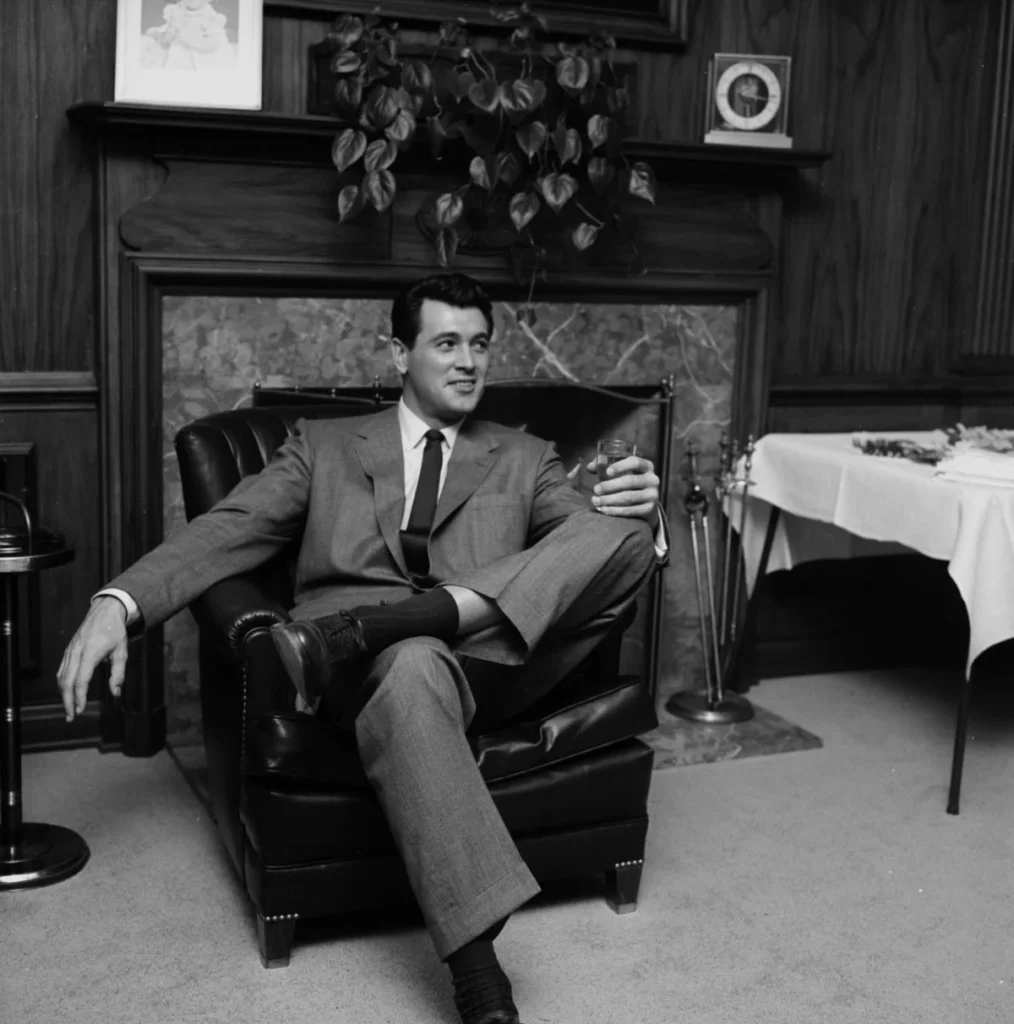

Roy Harold Scherer Jr., known globally as the quintessential leading man Rock Hudson, remains one of the most recognizable figures of Hollywood’s Golden Age. While he was a titan of the silver screen, starring in landmark films such as Giant, Pillow Talk, and All That Heaven Allows, his life behind the camera was defined by a stark contrast between his public persona and his private reality. Born in suburban Chicago on November 17, 1925, Hudson’s early life was marked by extreme modesty. According to biographer Sara Davidson in Rock Hudson: His Story, the future star spent his formative years in a cramped one-bedroom bungalow at 719 Center Street, a space shared by eleven people—six adults and five children—with only a single bathroom. This humble beginning stood in direct opposition to the sprawling, high-security estates he would eventually cultivate as a sanctuary from the relentless scrutiny of the mid-century celebrity machine.

For Hudson, his homes were not merely status symbols; they were defensive bastions. In an era where a public outing could result in unwanted tabloid attention or the exposure of his closeted life, the gated property became his only true refuge. He was known to be a hands-on homeowner, finding solace in manual labor—tearing down walls, laying bricks, and tending to the landscaping of his various residences.
The Early Years and Shared Living Arrangements
As Hudson’s career began to ascend in the early 1950s, he maintained living arrangements that reflected both his burgeoning success and his personal life. In 1952, he shared a home with actor Bob Preble. Their domestic partnership spanned three years and four different locations, culminating in a residence on Avenida del Sol. This property was notable for its then-futuristic glass design and panoramic views of the Los Angeles valley and surrounding mountains.

Historical context suggests that these living arrangements were often subject to intense speculation. While Preble later characterized their time together as a period of experimental proximity rather than a definitive romantic relationship, the narrative surrounding their cohabitation highlights the precarious nature of life for a closeted gay man in 1950s Hollywood. The pressure to conform to heteronormative standards was immense, and by the time Preble married actor Yvonne Rivero, the landscape of Hudson’s personal life had already begun to shift toward the marriage that would define his public image for years to come.
The Marriage to Phyllis Gates
In 1955, Rock Hudson married Phyllis Gates, a move widely interpreted by contemporary historians as an attempt to suppress rumors regarding his sexuality and maintain his marketability as a romantic lead. Hudson had purchased a two-bedroom ranch-style home at 9151 Warbler Place, near Sunset Boulevard, in 1954, specifically for the couple. The residence was characterized by a warm, traditional kitchen and a somewhat austere living room, as the star had invested the majority of his capital into the property itself, leaving little budget for interior decoration.

The marriage, which lasted until 1958, was marked by the pressures of public scrutiny. Gates later maintained that her affection for Hudson was genuine, noting his charm, his physical stature, and his immense professional success as compelling reasons for their union. Upon their divorce, the settlement included $250 in weekly alimony for a decade and the transfer of the Warbler Place home, then valued at $35,000, to Gates. This period served as a transitional phase for Hudson, who subsequently retreated to the coast to recalibrate his life.
The Malibu Coastal Retreat
Following the dissolution of his marriage, Hudson moved to a house in Malibu, elevated on stilts above the Pacific Ocean. This residence served as his primary home during the production of the 1959 hit Pillow Talk. The house offered a lifestyle of relative freedom, with Hudson and a circle of friends—including actors and stuntmen—engaging in a routine of year-round ocean swimming, hiking in the Malibu hills, and sailing. The environment fostered a sense of camaraderie that was, in many ways, an antidote to the rigid, manufactured nature of his professional life. By the summer of 1959, however, Hudson’s wanderlust and the demands of his career led him to briefly relocate to Newport Beach, marking the end of his tenure as a Malibu resident.

The Rise of The Castle
The most significant residence in Hudson’s life was the property at 9402 Beverly Crest Drive, which he affectionately dubbed The Castle. Originally owned by agent Sam Jaffe, the three-and-a-half-acre estate became a focal point of Hudson’s life in the early 1960s. The property, featuring classic Spanish-style architecture with red-tile roofing, stucco walls, and exposed dark wood beams, was perfectly suited to Hudson’s vision of a personal fortress.
The acquisition of this property is a case study in the leverage held by major studios during the studio system era. When Hudson’s contract with Universal Studios was set to expire in 1962, he expressed a desire to purchase the Beverly Crest residence from Jaffe. Unable to afford the $167,000 price tag at the time, Hudson successfully negotiated the purchase as part of his contract renewal. Universal bought the home and eventually transferred the title to the star in 1967.

Architectural Expression and Personal Sanctuary
Hudson approached the renovation of The Castle with the diligence of a professional architect. Relying on literature regarding Mexican colonial design, he transformed the interior into a curated reflection of his personal tastes. The home was filled with an eclectic mix of African masks, zebra skins, and massive pewter candlesticks.
Perhaps most striking was his penchant for recurring motifs, such as the nude male form, which appeared in sculptures by Victor Salmones and in intricate carvings on his bedroom headboard. The property also featured high-end amenities, including a 40-foot swimming pool, a private theater, and an outdoor fireplace, which facilitated a lifestyle that was simultaneously opulent and secluded.

Despite his public reputation for privacy, those close to Hudson noted a paradox in his behavior. He famously operated an "open-door" policy, often leaving his home unlocked. Actor George Nader remarked that Hudson welcomed the possibility of the unknown, desiring the world to enter his space. His housekeeper, Joy, often noted his intense engagement with the outside world through the telephone and fan mail, remarking that his connection to his public was so strong he would likely "answer the phone from the casket."
Gardening as a Therapeutic Pursuit
Beyond the architectural and interior design elements, The Castle functioned as a productive landscape. Hudson, inheriting the services of gardener Clarence Morimoto, turned the grounds into a thriving ecosystem. He cultivated a wide array of produce, including limes, peaches, mint, corn, and tomatoes. For Hudson, the garden was a site of psychological restoration. He frequently noted that the act of pruning, watering, and pulling weeds allowed him to process the stresses of his career and rehearse roles in his head. He once remarked that had he not pursued acting, he would have likely become a professional landscape architect.

Legacy and Property Valuation
Rock Hudson resided at The Castle until his death on October 2, 1985, from AIDS-related complications. His passing marked a pivotal moment in the public conversation surrounding the HIV/AIDS epidemic, and his memorial service, held at the residence, was attended by 300 guests, including his long-time co-star Elizabeth Taylor.
The valuation of the property has tracked the broader trends of the Los Angeles real estate market over the decades. Appraised at $3 million at the time of his death, the estate was later acquired by Microsoft co-founder Paul Allen in 1997 for $9 million. Following Allen’s death in 2018, the property remained in his estate’s portfolio until it was listed for sale in 2021 for $55.5 million. This astronomical increase in value underscores not only the prime location of the Beverly Crest estate but also its historical significance as the final, enduring sanctuary of one of Hollywood’s most enduring icons. Today, the estate stands as a monument to a man who, despite living in the glare of the spotlight, ultimately sought and found his greatest peace within the walls he built for himself.