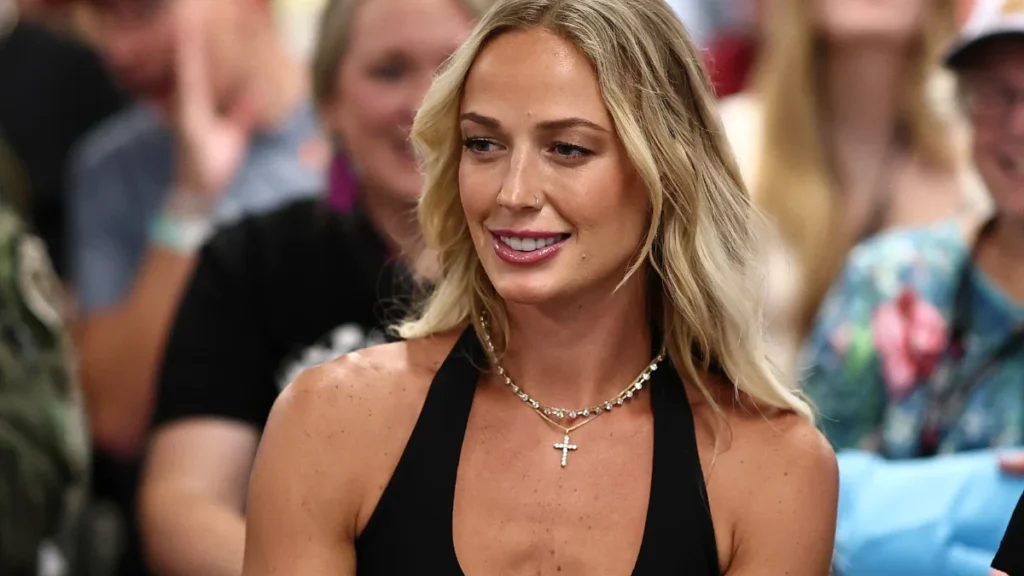

The intersection of professional sports, celebrity culture, and digital advertising has once again sparked intense public debate, this time drawing commentary from prominent figures in both the athletic and entertainment spheres. WNBA standout and Indiana Fever guard Sophie Cunningham has officially entered the discourse surrounding actress Sydney Sweeney’s widely discussed promotional campaign for a sports prediction platform. Speaking candidly on her newly rebranded podcast, No Hesitation With Sophie Cunningham & Drew Hanlen, the professional basketball player addressed the friction, cultural implications, and online reactions that have followed the release of the controversial commercial.
The advertisement, which features Sweeney posing in minimal attire alongside various pieces of athletic equipment to promote a digital gambling and sports prediction platform, immediately triggered a polarizing response across social media platforms. While the campaign was designed to capture maximum attention—a strategy that aligns closely with contemporary digital marketing trends—it also invited significant scrutiny regarding authenticity, the ethics of gambling sponsorships, and the representation of women in media. Cunningham’s analysis of the campaign offers a multifaceted perspective from an elite athlete who navigates the world of sports marketing and public endorsement on a daily basis.
The Genesis of the Controversy and the Podcast Breakdown
The conversation surrounding the advertisement intensified in the weeks following its launch, with fans and followers inundating Cunningham’s digital channels with requests for her opinion. Acknowledging the flood of direct messages, comments, and text messages, Cunningham used her platform to dissect the nuances of the campaign alongside her co-host, Drew Hanlen.
Central to Cunningham’s critique was the question of authenticity, a metric that has become increasingly valuable to modern consumers. Specifically, the WNBA guard questioned whether the prominent Hollywood actress genuinely engages with sports gambling outside of the commercial agreement. “The amount of text messages, DMs, comments of people wanting me to talk about the Sydney Sweeney ad. I have so many takes, but like it’s just first of all, like does she even gamble on sports? Like it’s just so unauthentic. You know what I mean?” Cunningham remarked during the episode.
Despite her reservations regarding the authenticity of the partnership, Cunningham maintained a pragmatic stance on the business realities of the entertainment industry. She noted that the aesthetic choices present in the advertisement were entirely consistent with the branding trajectory that has defined much of Sweeney’s career to date. “Like, am I surprised of how she represented the brand? No. Like, that’s what she’s made her whole career off,” Cunningham observed.
However, she remained critical of the specific creative direction chosen for the sports prediction platform, admitting, “Do I like it? Like, that particular ad. Not really. Like, I think, what are we doing?” Yet, true to her balanced approach, Cunningham immediately contextualized her critique within the broader framework of economic autonomy and personal enterprise, adding, “She’s making her money. Go do your thing, sis.”
Analyzing the Public Backlash and Female Solidarity
The commercial’s release prompted varied reactions, with segments of the public expressing disapproval over the use of provocative imagery to market a financial risk product such as sports betting. Interestingly, Cunningham also addressed the specific demographic of critics, questioning why certain female commentators appeared particularly upset by the campaign.
“Why are girls mad? Like, that is literally what she does. Why is anyone mad?” Cunningham asked, pointing out the predictability of the creative choices given Sweeney’s established public persona. While she acknowledged that the juxtaposition of the imagery and the product felt somewhat unconventional from a traditional marketing standpoint, she ultimately leaned toward a philosophy of personal liberty, stating that while the ad felt “kind of weird” morally, it remains a case of “to each their own.”
Furthermore, Cunningham emphasized the importance of female solidarity, cautioning against a cultural tendency to tear women down over individual career choices and commercial partnerships. Despite her initial hesitation regarding the ad’s premise, Cunningham made it explicitly clear that her critique was not a personal attack, stating, “And hey, don’t get me wrong, I like her.”
Sydney Sweeney’s Defense and Precedent in Sports Media
As the criticism mounted across various digital platforms, Sydney Sweeney herself responded to the backlash by introducing historical context to the conversation. The actress shared archival photographs of prominent male and female athletes who had previously posed nude for high-profile publications, most notably ESPN The Magazine’s annual Body Issue. By drawing a parallel between her commercial and the artistic athletic photography historically celebrated by sports media outlets, Sweeney’s defense sought to normalize the aesthetic presentation of the human form within a sports-adjacent context.
However, the defense sparked a secondary wave of debate among critics and industry observers. A primary counterargument raised by detractors focused on the distinction between professional athletes and entertainment celebrities. Critics pointed out that while athletes featured in publications like the Body Issue are recognized for their physical prowess and contributions to competitive sports, Sweeney’s primary domain is acting and entertainment rather than athletic competition. This distinction fueled further discussion regarding the appropriateness of utilizing non-athletes to front high-stakes sports prediction and gambling platforms.
The Broader Impact and Implications of Sports Gambling Endorsements
The controversy surrounding the advertisement arrives at a critical juncture for the sports industry. In recent years, the rapid legalization and expansion of sports betting across numerous jurisdictions have led to a massive influx of gambling advertising within traditional and digital sports media. Leagues, teams, athletes, and media personalities have increasingly entered into lucrative partnerships with sportsbooks and prediction platforms, transforming the economic landscape of modern athletics.
This integration has raised complex regulatory, ethical, and cultural questions. Public health advocates and financial analysts have frequently expressed concern over the normalization of gambling, particularly regarding the potential impact on younger audiences and vulnerable demographics. When high-profile entertainment figures with massive youth followings, such as Sweeney, become the face of sports prediction platforms, the visibility of these products expands exponentially, often bypassing traditional sports fanbases and penetrating mainstream pop culture.
Simultaneously, the reaction from athletes like Cunningham highlights an ongoing internal dialogue within the sports community regarding credibility and authenticity in endorsements. As athletes increasingly build their own personal brands and media empires through podcasts, social media channels, and entrepreneurial ventures, the standards by which commercial partnerships are judged have evolved. Athletes who spend their entire lives mastering a physical discipline often view sports-related marketing through a lens of lived experience, making the intersection of Hollywood glamour and sports analytics a fertile ground for public debate.
Conclusion
Sophie Cunningham’s recent commentary on her podcast encapsulates the complex web of modern celebrity endorsements, digital marketing strategies, and public accountability. By balancing a critique of the advertisement’s authenticity with an acknowledgment of economic agency and personal choice, Cunningham navigated a polarizing cultural moment with nuance. As the sports prediction and gambling industry continues to expand its footprint within mainstream media and entertainment, controversies regarding creative direction, representation, and authenticity are likely to persist, ensuring that the dialogue between athletes, entertainers, and consumers remains dynamic and heavily scrutinized.