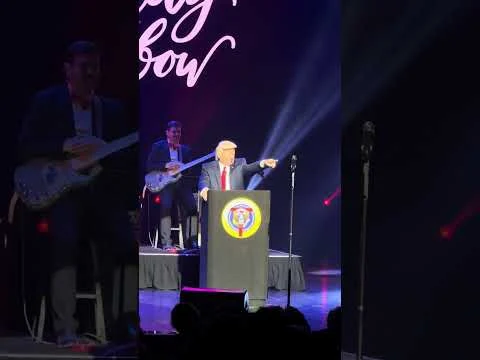

Celebrity blogger Perez Hilton recently ignited considerable discussion within entertainment and political satire circles by sharing a video showcasing acclaimed impersonator John Di Domenico’s portrayal of Donald Trump. The footage, captured by Hilton himself during a performance at Randy Rainbow’s highly anticipated show, quickly circulated, drawing renewed attention to Di Domenico’s widely praised act. Hilton’s enthusiastic endorsement, unequivocally declaring "Johnny D is the best!!!", positions Di Domenico firmly at the forefront of contemporary political impersonation, sparking conversations about the craft, its cultural impact, and the enduring appeal of satirizing prominent public figures. The event, documented on July 20, 2026, underscored the continuing relevance of detailed political mimicry in public discourse and entertainment.
The Performer: John Di Domenico’s Mastery
John Di Domenico, often referred to as "Johnny D," has carved out a distinguished career as one of the entertainment industry’s most sought-after impressionists. His particular skill in embodying Donald Trump has garnered him widespread critical acclaim and a dedicated following. Di Domenico’s approach transcends mere vocal mimicry; it is a holistic performance that captures the former president’s distinctive cadence, rhetorical patterns, physical mannerisms, and even subtle facial expressions. His portrayal is not simply a caricature but a meticulously researched and executed artistic interpretation that aims for both accuracy and comedic effect.
Di Domenico’s journey to becoming the preeminent Trump impersonator began long before Trump’s presidential bid. With a career spanning decades, Di Domenico has honed his craft impersonating a diverse range of public figures, from politicians to celebrities. However, it was his uncanny ability to channel Trump that elevated his profile significantly during and after the 2016 election cycle. He has appeared on numerous national television programs, including "The Tonight Show Starring Jimmy Fallon," "Conan," and "The Howard Stern Show," showcasing his versatile talent. His performances often involve a blend of scripted material and improvisational wit, allowing him to react to current events with the authentic voice and style of Trump. This adaptability is crucial in the fast-paced world of political satire, where relevance is paramount.
What distinguishes Di Domenico’s impersonation from others, such as Alec Baldwin’s well-known portrayal on "Saturday Night Live" or James Austin Johnson’s more recent take, is often cited as its depth and consistency. Critics and fans frequently note his profound understanding of Trump’s speech patterns—the declarative statements, the self-aggrandizement, the distinctive hand gestures, and the repetitive phrasing. He reportedly spends hours analyzing Trump’s speeches, interviews, and public appearances to perfect every nuance. This dedication allows him to deliver performances that resonate deeply with audiences, whether they are supporters or critics of the former president, because the authenticity of the portrayal is rarely in question.
A Night of Satire: Randy Rainbow’s Stage
The context of Di Domenico’s performance at Randy Rainbow’s show adds another layer of significance to Perez Hilton’s video. Randy Rainbow is a celebrated comedian, singer, and satirist renowned for his viral musical parodies that blend show tunes with political commentary. His unique format involves "interviewing" political figures by interspersing real news clips with his own comedic questions and then breaking into elaborate musical numbers, often featuring himself in multiple roles. Rainbow’s work is characterized by its sharp wit, elaborate production, and a distinct blend of camp and political critique.
Rainbow’s live shows are an extension of his online persona, offering audiences an immersive experience of his signature style. The inclusion of John Di Domenico in such a setting suggests a deliberate artistic choice to amplify the satirical impact. Di Domenico’s direct, "in-character" appearance as Trump would undoubtedly have provided a compelling contrast to Rainbow’s own stylized interactions, creating a dynamic and memorable comedic synergy. For an audience accustomed to Rainbow’s musical send-ups of political figures, seeing a highly authentic impersonator like Di Domenico on stage would have been a significant highlight, further blurring the lines between reality and parody that are central to Rainbow’s art. The collaboration likely underscored the collaborative and evolving nature of political satire in the digital age.
Perez Hilton’s Endorsement and Its Impact
Perez Hilton, born Mario Armando Lavandeira Jr., rose to prominence in the early 2000s as a pioneering celebrity blogger. His website, PerezHilton.com, became a go-to source for celebrity gossip, known for its unfiltered commentary and unique visual style (often involving doodles on celebrity photos). Over the years, Hilton has evolved from a controversial figure to an established media personality with a significant social media presence across various platforms. His endorsement, therefore, carries considerable weight within entertainment circles, particularly among audiences interested in pop culture, celebrity news, and viral content.
When Hilton declares Di Domenico "the best!!!" and shares a personal video, it acts as a powerful amplifier. His reach ensures that the performance gains exposure far beyond the immediate audience of Randy Rainbow’s show. For Di Domenico, a public endorsement from a figure like Hilton translates into increased visibility, potential new bookings, and reinforced credibility within the entertainment industry. It validates his artistry in a tangible way, confirming his status among influential media personalities. In the highly competitive world of impersonation, such celebrity testimonials are invaluable for career advancement and public recognition. The viral nature of social media ensures that such endorsements can quickly spread, generating significant buzz and debate among followers and the broader online community.
The Art of Political Impersonation in the Modern Era
Political impersonation has a long and storied history, serving as both entertainment and a form of social and political commentary. From Vaughn Meader’s iconic John F. Kennedy impressions in the 1960s to Dana Carvey’s George H.W. Bush and Darrell Hammond’s Bill Clinton on "Saturday Night Live," impersonators have played a crucial role in shaping public perception and offering a comedic lens through which to view powerful figures. In the modern era, with the proliferation of digital media and the 24/7 news cycle, the role of political impersonators has become even more pronounced. They often act as immediate interpreters of political events, transforming serious discourse into digestible and often biting satire.
Donald Trump, with his highly distinctive voice, mannerisms, and often unconventional public statements, presented a unique challenge and opportunity for impersonators. His persona offered a rich tapestry of material for comedic artists. The sheer volume of his public appearances and pronouncements provided an endless source of inspiration, allowing impersonators to continuously update and refine their acts. The cultural phenomenon surrounding Trump ensured that any accurate and humorous portrayal would resonate deeply with a broad audience, regardless of political affiliation, due to the figure’s undeniable impact on public consciousness.
Crafting the Illusion: Techniques and Challenges
The creation of a convincing political impersonation is a complex art form that demands a specific set of skills. For John Di Domenico, mastering Donald Trump involved several key techniques:
- Vocal Mimicry: This is often the most immediately recognizable aspect. Di Domenico has meticulously studied Trump’s vocal patterns—the inflection, the pauses, the emphasis on certain words, and the signature breathy exhalations. He captures the varying tones, from commanding to conversational, and the specific rhythm of Trump’s speech.
- Physicality and Mannerisms: Beyond the voice, Trump’s distinct physical presence is crucial. Di Domenico replicates the hand gestures (the pointing, the "ok" sign, the chopping motions), the posture, the facial expressions (the pursed lips, the squinting eyes), and even the way Trump moves. These non-verbal cues are powerful communicators and contribute significantly to the illusion.
- Rhetorical Style: Di Domenico doesn’t just parrot words; he embodies Trump’s unique rhetorical approach. This includes the use of superlatives ("the best," "tremendous"), repetitive phrases, direct addresses to the audience, and a tendency towards anecdotal evidence over data. Understanding how Trump constructs his arguments, even in a comedic context, is essential.
- Improvisation and Adaptability: A truly great impersonator can react to live situations or current events in character. This requires not just mimicry but an understanding of the subject’s worldview and likely responses. Di Domenico’s ability to improvise as Trump keeps his performances fresh and relevant.
- Costuming and Makeup: While not always the primary focus, subtle choices in hair, makeup, and wardrobe can enhance the overall resemblance, making the visual aspect of the impersonation more compelling.
The challenges in such an endeavor are numerous. Impersonators must walk a fine line between satire and caricature, aiming for humor without devolving into mere mockery that alienates segments of the audience. They must also stay constantly updated on their subject’s public persona, as political figures evolve, so too must their impersonations. Furthermore, maintaining objectivity while performing a highly political figure requires considerable skill, ensuring the humor lands without overtly alienating diverse audiences.
Social Media Echoes and Public Discourse
The release of Perez Hilton’s video featuring Di Domenico immediately tapped into the powerful currents of social media, particularly platforms like YouTube, Twitter (now X), and TikTok. Such content quickly becomes a focal point for discussion, commentary, and sharing. The video’s virality would likely be driven by several factors:
- Celebrity Endorsement: Hilton’s own significant following ensures initial reach.
- Topicality: Donald Trump remains a highly polarizing and discussed figure, ensuring broad interest.
- Quality of Performance: Di Domenico’s acclaimed skill makes the video inherently engaging.
- Debate: The question posed in the original article ("Is This A Good Donald Trump Impersonator?") naturally invites discussion, with users weighing in on who they believe is the "best" and why.
Online reactions would likely range from enthusiastic agreement with Hilton’s assessment to critical comparisons with other impersonators. Comments would dissect Di Domenico’s vocal inflections, physical cues, and comedic timing. The video would also likely be shared across political divides, with some appreciating the humor, others finding it insightful commentary, and still others perhaps viewing it critically. This kind of content fuels a broader public discourse about political satire, the role of humor in politics, and the enduring cultural footprint of figures like Trump. The shareability of the content ensures a rapid dissemination, contributing to an ongoing, dynamic conversation that spans various demographics and viewpoints.
Beyond Comedy: The Cultural Resonance of Impersonations
The impact of political impersonators extends beyond mere comedic entertainment. They serve as a unique form of cultural barometer, reflecting and sometimes shaping public sentiment towards political leaders. By distilling complex political figures into recognizable and often humorous archetypes, impersonators can make politics more accessible and less intimidating for a wider audience. They offer a space for collective catharsis, allowing audiences to laugh at figures of authority, thereby deflating tension or expressing frustration in a socially acceptable manner.
In the case of Donald Trump, impersonations have played a particularly significant role. His presidency was marked by unprecedented media attention and constant public scrutiny. Impersonators like Di Domenico provided a consistent, comedic counter-narrative, often highlighting the very aspects of Trump’s persona that were most debated or criticized. This consistent presence in popular culture ensures that even after his time in office (as implied by the 2026 date), Trump remains a highly recognizable and culturally relevant figure, continually re-interpreted through the lens of satire. The continued demand for such performances, evidenced by Di Domenico’s appearance at a high-profile show and Hilton’s enthusiastic praise, underscores the enduring legacy of Trump’s persona in the American cultural landscape.
The broader implications suggest that political satire, far from being a niche genre, remains a vital component of democratic societies. It provides a platform for critical engagement, offering alternative perspectives and fostering public debate. The intersection of celebrity culture, as represented by Perez Hilton, and political commentary, as embodied by Randy Rainbow and John Di Domenico, highlights how modern media blurs traditional boundaries, creating new avenues for engagement and influence. As societies continue to grapple with complex political realities, the art of impersonation will likely remain a potent tool for both entertainment and insightful critique, ensuring that figures who leave an indelible mark on history will continue to be interpreted and re-interpreted for generations to come. The enthusiastic reception of Di Domenico’s performance, amplified by influential voices like Perez Hilton, serves as a testament to the enduring power and relevance of this unique form of artistic expression.