
When King Carl XVI Gustaf of Sweden marked his historic Golden Jubilee on September 15, 2023, the milestone was much more than a routine constitutional commemoration. As the first monarch in Swedish history to reign for fifty years, the sovereign presided over a weekend of meticulously orchestrated pomp, pageantry, and state-level diplomacy. Heads of state, foreign dignitaries, and members of Europe’s interconnected royal houses converged on Stockholm to honor a half-century on the throne. Yet, amidst the glittering array of orders, medals, and state gowns, it was the historic high jewelry worn by the royal women at the gala dinner that captured the global spotlight.
For several prominent royal figures, the glittering evening provided a rare and sentimental opportunity to revisit their personal archives by donning their original wedding tiaras. These magnificent pieces of craftsmanship, laden with dynastic heritage and deeply personal memories, transformed the modern state banquet into a living museum of European royal nuptial history.

The Khedive of Egypt Tiara: A Pan-Scandinavian Heirloom
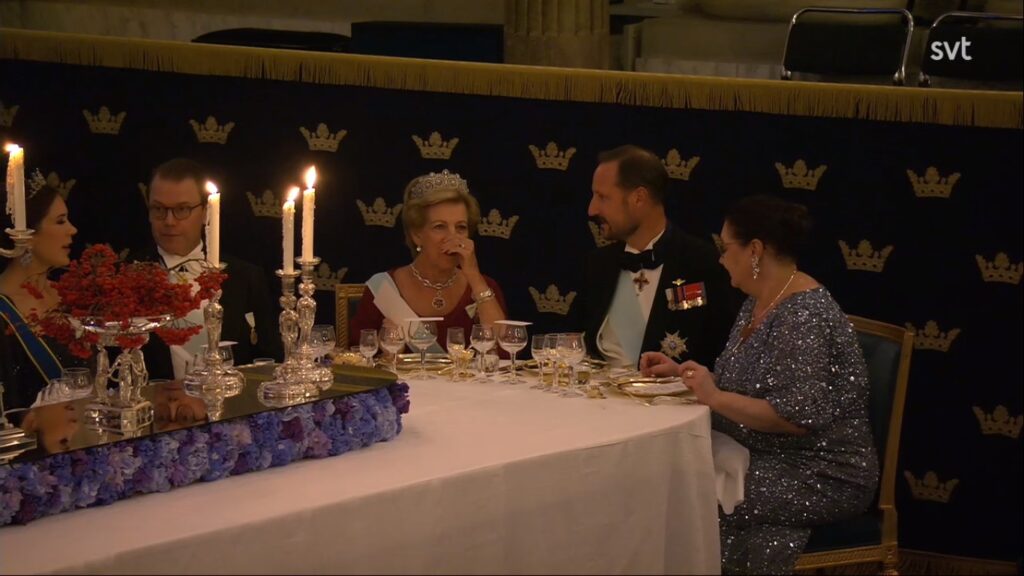
Chief among the historical pieces worn during the jubilee celebrations was the Khedive of Egypt tiara, worn by Queen Anne-Marie of Greece. Crafted by the prestigious French house of Cartier at the dawn of the twentieth century, this breathtaking diamond laurel scroll tiara was originally commissioned as a wedding gift for Princess Margaret of Connaught from the last Khedive of Egypt, Abbas Hilmi II, ahead of her marriage to the future King Gustaf VI Adolf of Sweden in 1905.
Upon Princess Margaret’s untimely death in 1920, the tiara passed to her only daughter, Ingrid. When Princess Ingrid married the future King Frederik IX of Denmark in 1935, the jewel crossed the Baltic Sea, where it quickly became a foundational cornerstone of the Danish royal jewel collection. Queen Ingrid established a unique tradition of generosity, making the Khedive of Egypt tiara available to female descendants and close relatives for their walk down the aisle. Consequently, a remarkable lineage of brides has worn the Cartier masterpiece, including Queen Margrethe II of Denmark, Queen Anne-Marie herself, Princess Benedikte, Princess Alexandra of Sayn-Wittgenstein-Berleburg, Princess Nathalie of Sayn-Wittgenstein-Berleburg, and Princess Alexia of Greece and Denmark.
Queen Anne-Marie’s personal association with the tiara dates back to September 18, 1964, when, at just 18 years of age, she married King Constantine II of Greece. On that historic day, she paired the Cartier creation with an antique lace veil originally worn by Princess Margaret in 1905—a textile tradition maintained by almost every bride in the family. Following Queen Ingrid’s passing in 2000, Queen Anne-Marie officially inherited the tiara. Seeing it light up the Stockholm banquet hall in 2023 served as a poignant reminder of the enduring familial bonds connecting the royal houses of Sweden, Denmark, and Greece.

Queen Mary’s Versatile Diamond Creation
Another standout piece at the Stockholm gala was the wedding tiara worn by Queen Mary of Denmark, who attended the jubilee alongside King Frederik X. The delicate diamond headpiece was originally presented to Mary Donaldson as a deeply personal wedding gift from Queen Margrethe II and Prince Henrik ahead of their marriage on May 14, 2004.
Unlike many royal jewels that remain strictly tethered to institutional foundations or state trusts, Queen Mary’s wedding tiara is a private possession. Its exact provenance has never been publicly disclosed by the Danish court, distinguishing it from loaner pieces destined to return to central vaults. Featuring intricate motifs of hearts and fleurs-de-lys set upon a slender band, the tiara is celebrated for its extraordinary versatility. Designed to be converted into a necklace, Queen Mary has frequently worn it in both configurations over the past two decades.
The tiara’s journey continued to evolve in 2011, when Danish jeweler Marianne Dulong was commissioned to alter the piece. Dulong added a delicate row of pearls along the base, alongside interchangeable pearl toppers that could be securely fitted to the framework’s vertical elements. This adaptability allowed Queen Mary to subtly shift the aesthetic of the jewelry to match the solemnity of state events or the romantic ambiance of evening galas, perfectly complementing the pageantry of King Carl XVI Gustaf’s jubilee.
Princess Sofia’s Secret Royal Transformation
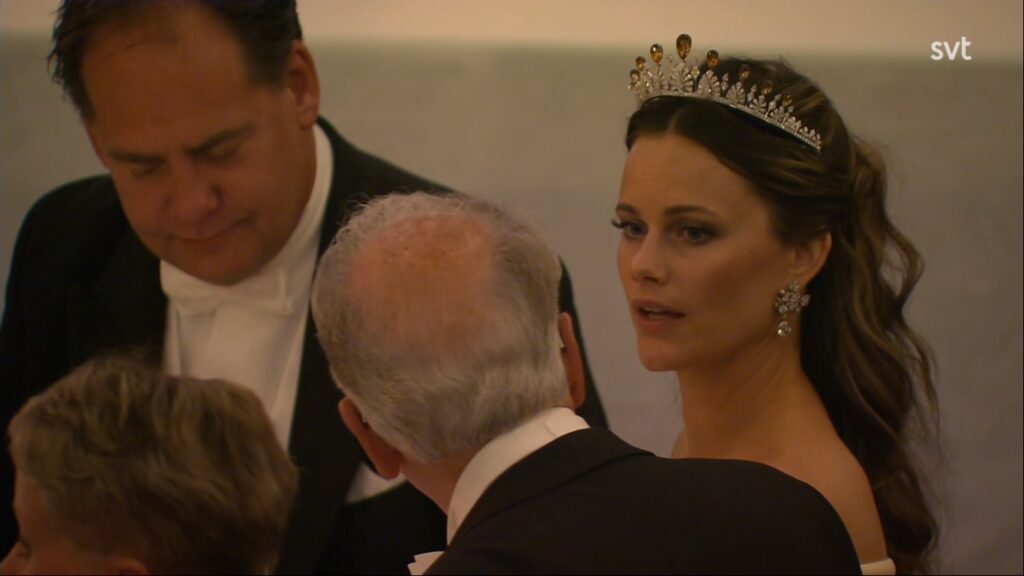
Representing the host nation’s younger generation, Princess Sofia of Sweden delivered one of the most visually striking appearances of the evening by wearing her own wedding tiara—a piece defined by both its modern elegance and its clandestine origins. When Sofia Hellqvist married Prince Carl Philip on June 13, 2015, she debuted a delicate frame composed of diamond palmettes and vertical spikes.
The tiara was an anniversary and wedding gift from King Carl XVI Gustaf and Queen Silvia. To preserve the element of surprise for the bride, Queen Silvia orchestrated the creation of the jewelry in absolute secrecy. Reports indicate that the stones were repurposed from an existing necklace belonging to Queen Silvia, and the construction was quietly commissioned in Thailand to prevent any premature leaks to the international press.
Since its debut, Princess Sofia’s wedding tiara has proven to be an exceptionally dynamic design. While it was initially paired with striking emerald attachments for her wedding ceremony, the modular engineering of the piece allows the wearer to swap the colored gemstones at will. Over the years, Princess Sofia has updated the tiara with interchangeable settings featuring pearls, diamonds, turquoises, and, in a widely praised debut just days prior to the jubilee, rich citrines. This clever modularity has positioned the tiara as one of the most versatile and modern pieces in the Swedish royal vault.

Princess Madeleine and the Modern Fringe Mystery
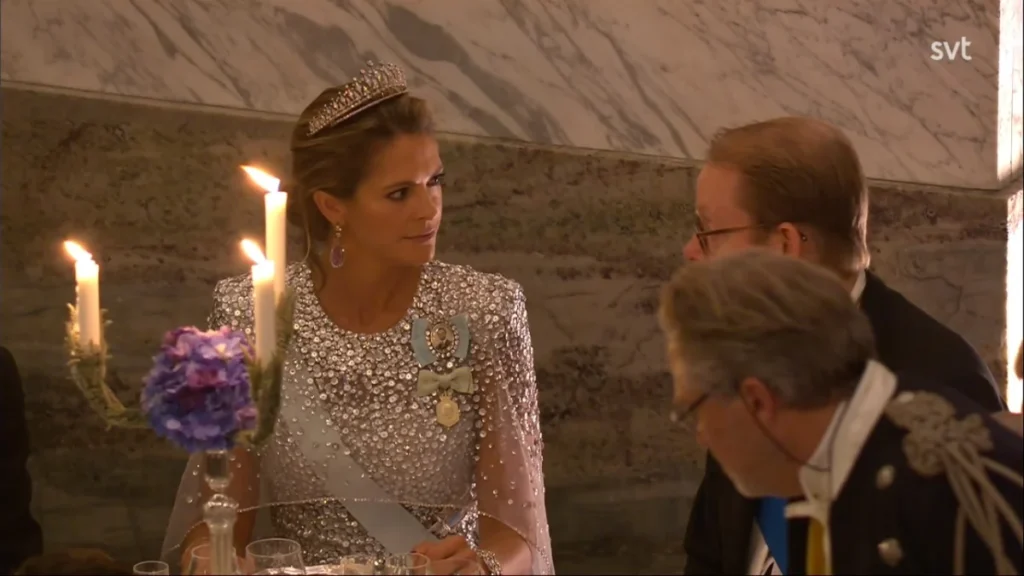
Adding further depth to the Swedish royal family’s jewelry display was Princess Madeleine, who selected the Modern Fringe tiara for the jubilee gala—the exact headpiece she wore on June 8, 2013, during her wedding to financier Christopher O’Neill.
The provenance of the Modern Fringe tiara remains shrouded in a degree of royal mystery. First appearing in public inventories associated with the Swedish royal family around 1986, jewelry historians and royal watchers have long speculated that the piece was commissioned by King Carl XVI Gustaf as a tenth-wedding-anniversary gift for Queen Silvia. Unlike historical heirlooms tied to the Bernadotte family’s official jewel foundation—a trust established to manage maintenance and ownership across generations—the Modern Fringe is a private asset belonging personally to Queen Silvia.
Characterized by stylized diamond elements that evoke delicate floral motifs, the tiara can also be adapted to function as a necklace. Over the decades, it transitioned from being primarily associated with Queen Silvia to becoming a signature piece for Princess Madeleine. The Swedish Royal Court eventually confirmed that the tiara had been formally gifted to Madeleine by her parents, securing its place as a treasured maternal heirloom destined to be passed down through her own branch of the family.
Broader Implications and Cultural Significance
The prominent display of wedding tiaras at King Carl XVI Gustaf’s Golden Jubilee offers valuable insight into the evolving nature of modern European monarchies. In an era where royal houses must carefully balance public accountability with the preservation of cultural heritage, high jewelry serves a dual purpose. It functions simultaneously as a diplomatic tool of soft power and as a tangible link to dynastic continuity.
By choosing to wear their wedding tiaras—garments and accessories deeply imbued with personal commitments and vows—the royal women elevated a state-level political anniversary into an emotionally resonant family celebration. The visibility of these pieces reinforces public interest in European monarchies, driving tourism, academic study of historical craftsmanship, and media engagement. Furthermore, the modern modifications seen on pieces like Princess Sofia’s modular tiara and Queen Mary’s adaptable diamond band demonstrate that contemporary royals are actively bridging the gap between centuries-old tradition and modern personal expression.
As King Carl XVI Gustaf looks toward the twilight of his historic reign, events such as the Golden Jubilee serve to solidify the institutional memory of the house of Bernadotte. Through the careful curation of historical artifacts and the celebration of enduring matrimonial bonds, Europe’s royal families continue to demonstrate the living, breathing relevance of their ancient traditions in the twenty-first century.