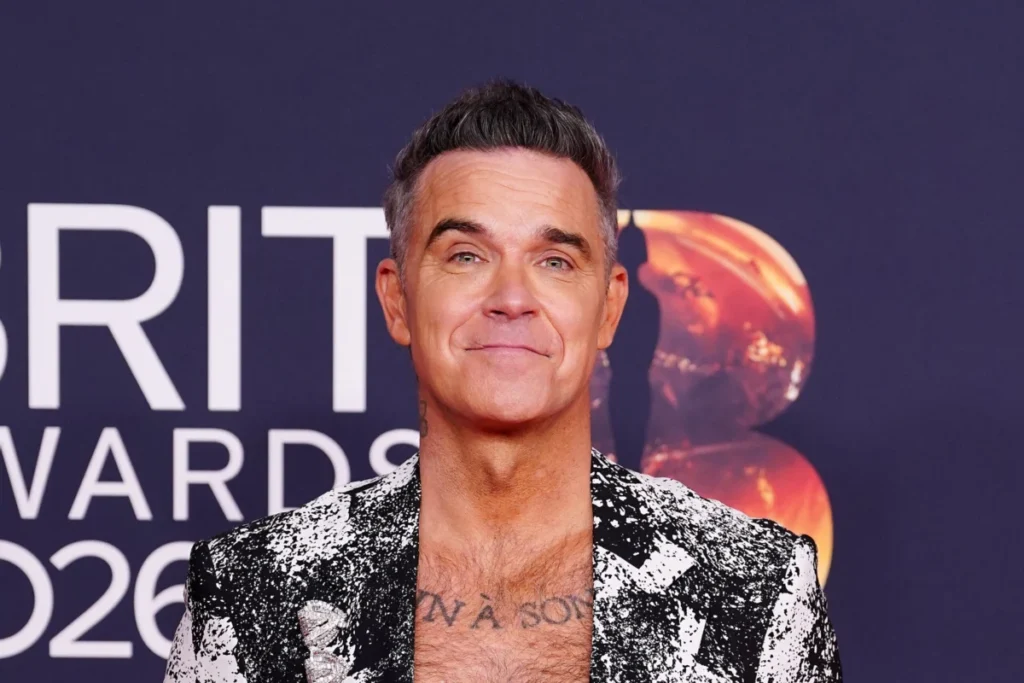

The final moments of the FIFA World Cup 2026, a global spectacle culminating in the intense championship match between Argentina and Spain, were punctuated not only by sporting drama but also by a series of high-profile entertainment events and an unexpected, albeit minor, celebrity mishap involving British pop icon Robbie Williams. The 52-year-old singer found himself at the center of a viral moment during his appearance on German television channel Magenta Sport following his performance at the tournament’s closing ceremony, an incident he swiftly addressed with characteristic candour and humour, turning what could have been a PR challenge into a widely discussed, light-hearted episode that captivated online audiences.
The Incident Unfolds: A Play-by-Play of the On-Air Mishap
The moment that captured widespread attention occurred during Williams’ post-performance interview with pundits on Magenta Sport. As the conversation progressed, viewers observed Williams accidentally spitting out a small, white, circular object onto his microphone. In a visible attempt to discreetly manage the situation, he picked up the object, held it momentarily in his hand, and then, in a seemingly unconscious gesture, rubbed his head, resulting in the object sticking to his forehead. The sequence of events, broadcast live to a global audience, quickly became a talking point across social media platforms, with many speculating about the nature of the object and the potential implications of the "deeply unprofessional" blunder, as Williams himself later described it.
The context of this incident is crucial. The World Cup closing ceremony is one of the most-watched television events globally, drawing hundreds of millions of viewers across more than 200 territories. Performers and guests at such high-stakes events are under immense pressure to maintain decorum and professionalism, knowing that every action is magnified. For a seasoned entertainer like Williams, known for his flamboyant stage presence and often unfiltered personality, such a visible gaffe, however minor, immediately triggered a wave of reactions ranging from genuine concern to amused speculation. Initial online discussions saw theories ranging from a piece of chewing gum to an accidental food particle, reflecting the public’s immediate curiosity and the rapid dissemination of viral content in the digital age. The incident underscored the pervasive scrutiny that accompanies high-profile appearances at major international events, where every gesture and action is instantly analyzed and amplified in real-time by an interconnected global audience.
Robbie Williams’ Swift Response: Unpacking the "Mint-gate" Resolution
Recognizing the immediate virality of the moment, Robbie Williams wasted no time in offering an explanation. Less than 24 hours after the incident, he took to social media, specifically Instagram, to share a video clarifying the situation. Filming himself casually lying in bed, a setting that lent an air of authenticity and informality to his message, Williams addressed the concerns directly. "I’d just like to apologise for the object that fell on to the microphone yesterday," he began, acknowledging the widespread attention and his own assessment of the gaffe. "I was deeply unprofessional, and people worried about me."
However, in a move characteristic of his self-deprecating humor and ability to connect with his audience, Williams quickly pivoted from apology to playful revelation. "But it’s OK. Because I had several more," he continued, before sticking out his tongue to reveal two perfectly round, white mints. The video then showed him breaking into laughter before cutting off, leaving viewers with a clear, humorous resolution. He further cemented the light-hearted tone with his Instagram caption: "Just woke up and feeling…. Mint x."
This swift and candid response proved highly effective in managing the public perception of the incident. In an era where celebrities often face intense criticism for even minor missteps, Williams’ approach diffused potential controversy by offering a simple, relatable, and amusing explanation. It demonstrated a savvy understanding of social media dynamics, allowing him to control the narrative and transform a potentially awkward moment into a memorable, endearing anecdote. This strategy contrasted sharply with more formal, often delayed, apologies that can sometimes exacerbate public scrutiny, highlighting the evolving landscape of celebrity-fan interaction in the digital age. The direct engagement offered a sense of transparency that resonated positively with his millions of followers and global media outlets, effectively closing the chapter on "mint-gate" with a smile.
The Broader Context: World Cup Closing Ceremony Extravaganza in Qatar

The incident involving Robbie Williams unfolded against the backdrop of the FIFA World Cup 2026 closing ceremony, held at the state-of-the-art Lusail Stadium in Qatar. This event was designed to be a grand spectacle, a fitting conclusion to a tournament that had captivated billions worldwide over several weeks. Williams was one of several international music stars enlisted to perform, sharing the stage with American singer Nicole Scherzinger, formerly of the Pussycat Dolls, and acclaimed Italian singer Laura Pausini. Their combined performances aimed to provide a vibrant musical send-off, blending different genres and cultures to reflect the global and diverse nature of the tournament and its host nation.
The closing ceremony itself was a meticulously planned production, featuring elaborate stage designs, intricate choreography, and stunning visual effects that utilized the stadium’s advanced technological capabilities. It served as a symbolic bridge between the intense sporting competition and the celebration of unity, cultural exchange, and global camaraderie that the World Cup often embodies. The choice of performers like Williams, Scherzinger, and Pausini underscored FIFA’s intent to deliver a diverse and appealing entertainment package, targeting a broad international demographic across continents. These artists, with their extensive global fan bases and proven stage presence, were tasked with delivering a memorable performance that would resonate long after the final whistle. The scale of such an event, from technical production and sound engineering to artist coordination and live broadcasting to a potential audience of over 1.5 billion people, is immense, demanding flawless execution under the glare of unparalleled global media attention.
The Inaugural World Cup Half-Time Show: A Mixed Reception for a New Format
Adding another unprecedented layer of entertainment to the final match day, the 2026 World Cup also introduced its first-ever dedicated half-time show, a format clearly inspired by the highly successful and iconic Super Bowl halftime show in American football. FIFA’s decision to extend the customary 15-minute half-time interval to more than 27 minutes for this inaugural spectacle signaled a deliberate effort to elevate the entertainment value of the final match beyond the game itself. The aim was to create a multi-faceted experience that would appeal not only to hardcore football fans but also to a wider audience drawn by celebrity performances, thereby broadening the tournament’s commercial and cultural appeal.
The star-studded lineup for this extended 11-minute performance was ambitious, featuring an eclectic mix of global music icons designed to appeal to diverse demographics. Reports and announcements prior to the event had teased appearances from megastars such as American pop queen Madonna, Colombian superstar Shakira (a veteran of past World Cup anthems), South Korean K-Pop sensation BTS, and Canadian pop idol Justin Bieber. The presence of such diverse acts reflected FIFA’s strategy to cater to various musical tastes and cultural demographics, leveraging the immense popularity of these artists to maximize viewership and engagement. The logistical challenges of orchestrating such a complex show within the confines of a football stadium, with rapid stage setup and dismantling, are considerable, requiring extensive rehearsals, precision timing, and technical coordination to ensure a seamless transition between the first and second halves of the match, all while maintaining strict broadcast schedules.
Expert Commentary and Public Reaction: The Pundits Weigh In on the Spectacle
While the closing ceremony performances received general appreciation, the inaugural half-time show elicited a far more polarized response, particularly from football purists and pundits. Among the most vocal critics was former England forward Wayne Rooney, who was present at the New York New Jersey Stadium working as a BBC pundit alongside fellow ex-footballers Joe Hart and Micah Richards, with Gabby Logan hosting the coverage. Rooney, known for his forthright opinions, did not hold back.
When asked by Logan for his highlights of the half-time show, Rooney did not mince words. His blunt assessment quickly became a talking point, contrasting sharply with the celebratory atmosphere FIFA had aimed to cultivate. "I’ll be honest, mine was when it finished," Rooney declared, cutting through any pretense of diplomatic politeness. "I like a lot of them artists but I thought it was crap." He elaborated on his disappointment, stating, "It just didn’t get me going and I wanted the football to come back on. I like Burna Boy, I like Bieber, I like Shakira, but that was too flat." Rooney’s critique highlighted a common sentiment among traditional football fans who prefer the focus to remain primarily on the game, viewing extended entertainment breaks as an unwelcome distraction from the sporting contest.
Rooney’s strong reaction sparked immediate banter on the BBC panel. Micah Richards playfully called Rooney "miserable" for his candid assessment, while Gabby Logan, ever the professional, quipped, "I’ll tell you what else you get on the BBC: honest reviews." This exchange highlighted the inherent tension between the desire for pure sporting focus and the increasing integration of elaborate entertainment elements into major sporting events. Many football fans echoed Rooney’s sentiments online, expressing a preference for the traditional short half-time break focused on tactical analysis and anticipation of the game’s resumption. Others, however, welcomed the additional entertainment, viewing it as a valuable enhancement to the overall World Cup experience, aligning with the global entertainment trends set by events like the Super Bowl, which consistently draws massive audiences for its halftime performances. The debate underscored a generational and cultural divide in how major sporting events are perceived and consumed, reflecting evolving tastes in sports entertainment.
Robbie Williams’ History and Public Image: A Legacy of Relatability

Robbie Williams’ ability to swiftly defuse the "mint-gate" incident with humor and honesty is deeply rooted in his established public persona and his well-documented personal journey. Throughout his illustrious career, Williams has been remarkably open about his struggles with mental illness, obesity, self-esteem issues, alcoholism, and substance abuse. This transparency has fostered a strong sense of relatability with his fan base, creating an image of an artist who is not only talented but also deeply human and fallible.
His willingness to discuss his vulnerabilities has cultivated a public perception of authenticity, making audiences more forgiving of minor mishaps and more receptive to his self-deprecating humor. When he apologizes for being "deeply unprofessional" but then immediately reveals the mundane, humorous truth about the mints, it aligns perfectly with the down-to-earth, slightly cheeky persona he has carefully constructed over decades. This established rapport allowed the "mint-gate" incident to be perceived not as a serious breach of etiquette, but rather as another quirky, human moment from a beloved, albeit occasionally unconventional, entertainer. His history demonstrates how a consistent public narrative, even one that includes past struggles, can build resilience against negative media cycles and foster a loyal, understanding audience, enabling him to navigate such minor controversies with grace and good humour.
The Mechanics of Mega-Events: Logistics, Performance Pressure, and Unpredictability
The World Cup final and its associated ceremonies represent the pinnacle of global event management, a logistical masterpiece requiring intricate coordination across myriad domains: security, broadcasting, infrastructure development, and, crucially, live performance. The pressure on artists performing at such events is immense. They are not merely performing for a stadium audience of tens of thousands but for billions worldwide, with every note, every movement, and every technical detail scrutinized in real-time by an army of cameras and social media users.
From a technical perspective, the challenges are staggering. Rapid stage assembly and disassembly for the half-time show, ensuring crystal-clear audio in a vast open-air stadium, coordinating complex visual displays involving hundreds of personnel, and managing multiple high-profile artists with their individual requirements all contribute to an environment where even the smallest deviation can be amplified. Performers must contend with factors such as jet lag, unfamiliar stage layouts, the pressure of live global television, and the sheer weight of expectation from an eager audience. In this high-stakes environment, minor unpredictable incidents, like Robbie Williams’ mint mishap, are almost inevitable. They serve as a stark reminder of the human element inherent in even the most meticulously planned global spectacles, demonstrating that despite advanced technology and rigorous rehearsals, live events always retain an element of spontaneity and human imperfection. The success often lies not in avoiding all errors, but in how swiftly and effectively any unexpected moments are managed.
Implications for Celebrity Image Management and Media Scrutiny
The "mint-gate" incident, though trivial in the grand scheme of the World Cup, offers a valuable case study in modern celebrity image management and the pervasive nature of media scrutiny. In an age dominated by social media, where clips go viral in seconds and public opinion coalesces almost instantaneously, the ability of a public figure to respond quickly and authentically can be decisive. Williams’ immediate, humorous, and transparent explanation effectively neutralized any potential negative fallout, transforming a moment of awkwardness into an amusing anecdote that further endeared him to his audience.
This highlights the shift from traditional PR strategies, which often involved formal statements and carefully curated apologies issued through official channels, to a more direct, social media-driven approach where celebrities engage directly with their audience. It underscores the power of authenticity and self-awareness in navigating the relentless gaze of global media. For other celebrities and their management teams, Williams’ response provides a template for handling minor blunders: address it promptly, explain it clearly, and, if appropriate, inject humor and self-deprecation. The incident ultimately reinforced his image as an approachable, genuine, and resilient entertainer, proving that even a small, white object can have a surprisingly significant, albeit positive, impact on a celebrity’s public narrative during a global event. It demonstrated that in the digital age, a quick, human reaction often trumps a delayed, overly polished one.
Conclusion
The conclusion of the FIFA World Cup 2026 was a multifaceted affair, blending the intense drama of a championship football match with ambitious entertainment spectacles and moments of unexpected, human levity. Robbie Williams’ "mint-gate" incident, while initially causing a ripple of curiosity and concern, was deftly managed by the singer, transforming a potential embarrassment into an endearing viral moment through his characteristic humor and candor. Simultaneously, the inaugural World Cup half-time show sparked a lively debate, highlighting the evolving expectations of global sporting events and the tension between traditional sporting purism and the desire for expansive, star-studded entertainment. As the dust settled on both the pitch and the stage, these incidents collectively underscored the unique pressures and immense global scrutiny that accompany events of such monumental scale, where every performance, every reaction, and even every accidental mint, becomes part of the enduring narrative. The World Cup, in its grand finale, once again proved to be a mirror reflecting not just sporting prowess, but also the intricate dynamics of celebrity, media, and public engagement in the 21st century.