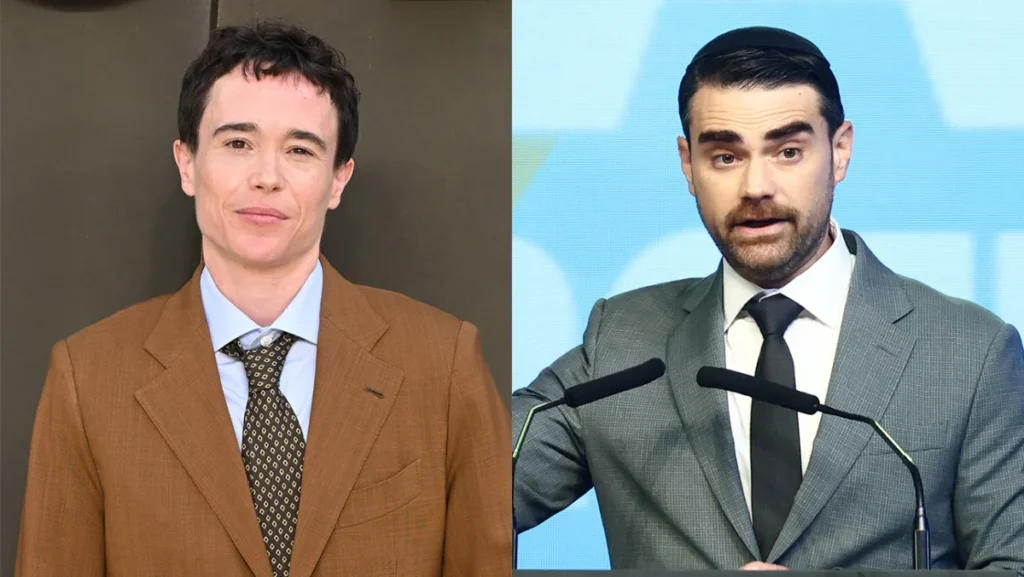

In a surprising turn that has sparked further debate within conservative media circles, right-wing influencer Ben Shapiro has lauded Christopher Nolan’s latest cinematic endeavor, The Odyssey, as a "masterpiece," despite facing considerable pre-release backlash from certain segments of the "MAGA-verse." Shapiro’s extensive 18-minute review, disseminated via YouTube, offers a nuanced critique, awarding the film an impressive 8.5 out of 9 on a 10-point scale, yet it simultaneously reignites a contentious dialogue surrounding casting choices, particularly concerning actor Elliot Page.
A Masterpiece Under Scrutiny: Nolan’s Ambitious Adaptation
Christopher Nolan, renowned for his intricate narratives, non-linear storytelling, and visually stunning spectacles in films like Inception, The Dark Knight trilogy, and most recently, the Oscar-winning Oppenheimer, ventured into the realm of ancient Greek epic with The Odyssey. Adapting Homer’s millennia-old saga of Odysseus’s arduous ten-year journey home after the Trojan War presents a monumental challenge. The epic poem, a cornerstone of Western literature, is rich with mythological creatures, divine interventions, and profound themes of heroism, perseverance, and identity. Nolan’s decision to tackle such a revered text immediately drew significant anticipation, tempered by the inherent difficulties of modernizing an ancient narrative for a contemporary audience. His choice of a star-studded cast, including Matt Damon as the titular hero Odysseus, Robert Pattinson as the conniving suitor Antinous, and Tom Holland as Odysseus’s son Telemachus, alongside Zendaya as the goddess Athena and Lupita Nyong’o as Helen of Troy, signaled a grand-scale production typical of Nolan’s oeuvre.
The Genesis of Backlash: Culture Wars and Classical Retellings
Prior to its official release, The Odyssey found itself at the nexus of the ongoing culture war, particularly drawing fire from elements within the "MAGA-verse" and broader conservative online communities. The pre-release backlash primarily revolved around perceived deviations from historical or mythological accuracy, specifically concerning certain casting decisions and the alleged incorporation of "modern dialogue." Critics within these spheres often decry what they view as "woke" casting—the practice of selecting actors based on diversity metrics rather than strict adherence to traditional interpretations of characters’ physical attributes or historical context. This phenomenon is not new, having previously targeted other major studio productions for similar reasons. For a story as foundational as The Odyssey, deeply embedded in Western cultural heritage, any perceived alteration to its established imagery or narrative can provoke strong reactions from those who view such changes as an erosion of traditional values. This sentiment underscores a broader ideological conflict where artistic interpretation intersects with deeply held cultural and political beliefs, particularly concerning representation and authenticity in media.
Shapiro’s Unexpected Endorsement: A Deep Dive into the Review
Ben Shapiro’s review emerges as a significant data point within this landscape, given his prominent position as a leading conservative voice and commentator. As co-founder of The Daily Wire and host of one of the most popular conservative podcasts, his opinions wield considerable influence over a substantial audience. His endorsement of The Odyssey as a "masterpiece" therefore carries weight, potentially guiding his followers’ perceptions despite the prior conservative critiques.
-
Praises for Performance and Direction: Shapiro’s high praise for the film begins with its overall cinematic quality. He unequivocally declares it a "masterpiece," commending Nolan’s directorial prowess in weaving together a complex narrative on an epic scale. He highlights the performances of the lead actors, specifically citing Matt Damon’s portrayal of Odysseus, Robert Pattinson’s take on Antinous, and Tom Holland’s role as Telemachus, as particularly effective. These endorsements align with general critical appreciation for strong acting and direction, transcending political divides.
-
Defending Diverse Casting: Helen and Athena: Interestingly, Shapiro directly addresses some of the earlier criticisms regarding diverse casting. He expresses little issue with Zendaya as Athena or Lupita Nyong’o as Helen of Troy. He pointedly pushes back against complaints about Nyong’o’s casting, stating, "I know a lot of people were like, ‘Oh my God, Lupita Nyong’o is supposed to look like Diane Kruger.’ I don’t know. Diane Kruger doesn’t look very Greek. She’s German." This specific rebuttal showcases a willingness to engage with, and in this instance, dismiss, racially charged critiques when he perceives them as unfounded or historically inaccurate in their own right. He further clarifies his acceptance of Zendaya’s casting, adding, "Casting Zendaya in that role doesn’t change anything… Zendaya does a fine job, doesn’t bother me at all." He acknowledges rapper Travis Scott’s role as Bard as "a bit jarring" but dismisses it as a minor point, not detracting significantly from the film’s quality. This selective acceptance of diverse casting signals a pragmatic approach to film criticism, where the perceived quality of the performance and its impact on the narrative takes precedence over a strict adherence to traditional racial or ethnic depictions for certain roles.
-
The "Unforced Error": Elliot Page as Sinon: The singular, yet significant, point of contention for Shapiro lies with the casting of Elliot Page as Sinon. This is where his "moviegoing sensibility," which prioritizes narrative immersion above all else, encounters a "red zone." Sinon, a pivotal character in the Trojan War narrative, is the Greek spy who persuades the Trojans to bring the Wooden Horse inside their city walls. Shapiro’s critique is sharp and direct: "It’s stupid to cast Elliot Page as a dude. It’s just stupid." He elaborates, personally criticizing Page’s physical appearance and voice, which he believes undermines the role’s credibility. "Elliot Page was a woman with mental issues who believes that she is a man and has had surgeries to make her appear more man-like, but still she is about five foot two inches and 105 pounds, soaking wet, and has the voice of a woman. It doesn’t work," Shapiro argues. This intensely personal commentary on Page, who publicly came out as transgender in 2020, underscores a fundamental ideological clash for Shapiro. For him, the casting choice is an "unforced error" that pulls him out of the film’s narrative, a cardinal sin in his critical framework. He then proceeds to speculate on Nolan’s motives, suggesting possibilities ranging from personal friendship and sympathy to an attempt at "Oscar bait," thereby implying that the casting was driven by factors external to purely artistic or narrative considerations. This particular critique resonates deeply within conservative circles that are often critical of transgender representation and gender identity discussions in mainstream media.
Elliot Page’s Journey and Representation in Hollywood
Elliot Page’s journey to becoming a prominent transgender actor is a significant aspect of contemporary Hollywood’s evolving landscape of representation. Page, who had previously collaborated with Nolan on the acclaimed 2010 film Inception, announced his gender transition in December 2020, becoming one of the most visible transgender individuals in the entertainment industry. His public coming out was met with widespread support from colleagues and fans, while also drawing scrutiny from anti-trans commentators. Page has since used his platform to advocate for transgender rights and visibility, making his casting in a high-profile film like The Odyssey a symbolic moment for many. For proponents of inclusive casting, Page’s presence in the film represents progress in diversifying the types of roles available to transgender actors and normalizing their presence in mainstream narratives. However, for critics like Shapiro, it becomes a flashpoint for broader debates about gender identity, biological sex, and the perceived politicization of casting decisions. The contention around Page’s role highlights the deep schisms in how different audiences perceive and react to identity politics within artistic works.
The Broader Context: Nolan’s Vision and Industry Trends
Christopher Nolan, known for his singular artistic vision and a steadfast commitment to his craft, rarely comments on casting controversies or political interpretations of his work. His films often prioritize grand concepts, intricate plotting, and a certain classical gravitas, making his adaptation of The Odyssey a natural fit for his sensibilities. The decision to cast Elliot Page, given their previous collaboration on Inception, could be seen simply as a director working with an actor he trusts and admires, regardless of external factors. However, in the current climate, any casting that deviates from traditional norms can be interpreted through a socio-political lens.
Hollywood itself has been undergoing a significant transformation, with a growing emphasis on diversity, equity, and inclusion in casting, storytelling, and behind-the-scenes roles. Major studios and industry bodies have instituted initiatives and guidelines to promote greater representation, often in response to calls from audiences and activists for more inclusive media. This industry-wide shift, while celebrated by many, has simultaneously fueled the "culture war" narrative among certain conservative factions who view it as an imposition of "woke ideology" onto entertainment. Page’s casting, therefore, becomes a microcosm of this larger industry trend and the ideological resistance it faces.
Navigating the Culture Divide: Shapiro’s Call to Conservative Audiences
Despite his strong disapproval of Elliot Page’s casting, Shapiro’s review concludes with a crucial directive to his conservative audience: they should still see The Odyssey. He explicitly advises against wishing for the film’s box office failure simply because of Page’s involvement. "No, the movie’s not going to bomb because of that. It turns out that when people are willing to be entertained, they’re willing to entertain even bad flaws in the teeth, if it turns out the smile is nice," he asserts. This analogy suggests that the film’s overall quality and its adherence to themes that resonate with conservative values should outweigh a single, albeit significant, perceived flaw.
Shapiro elaborates on this point, emphasizing that the movie’s overarching message aligns with conservative thought. "The broader theme of the movie is actually very much in line with many things that conservatives think. If you let Elliot Page kill that for you, I think you’re missing out on an incredible moviegoing experience," he added. This appeal to look beyond a specific casting decision and appreciate the broader thematic content is a strategic move. It attempts to reconcile the conservative critique of "woke" Hollywood with an appreciation for what Shapiro deems a genuinely great film. It also reflects a pragmatic understanding that boycotting every film with a perceived "woke" element would significantly limit entertainment options. His message implies a hierarchy of conservative concerns, where the integrity of the film’s core narrative and its underlying values can sometimes override objections to individual casting choices, particularly if the overall artistic merit is exceptionally high.
Implications and Future Outlook
Shapiro’s review of The Odyssey offers a fascinating case study in the complexities of contemporary film criticism and the ongoing culture wars. It demonstrates that even within ideologically aligned communities, there can be nuanced and sometimes contradictory reactions to cultural products. For The Odyssey, this means navigating a diverse critical landscape. The film will likely be scrutinized by traditional film critics for its artistic merit, by proponents of diversity for its representation, and by conservative commentators for its adherence to, or deviation from, specific ideological tenets.
The debate sparked by Shapiro’s review also highlights the continuing struggle for Hollywood to balance artistic freedom, commercial viability, and increasing demands for social responsibility and representation. As audiences become more fragmented along ideological lines, the task of creating universally appealing content becomes increasingly challenging. The future success of films like The Odyssey will depend not only on their artistic quality but also on their ability to resonate with, or at least be tolerated by, diverse and often ideologically polarized audiences. Shapiro’s call for conservatives to engage with the film, despite his specific objection, suggests a path toward selective engagement rather than outright rejection, potentially setting a precedent for how certain cultural products are discussed and consumed within conservative media.
The narrative surrounding Nolan’s The Odyssey and Shapiro’s review serves as a potent reminder that in an increasingly politicized cultural landscape, even an epic journey from antiquity can become a battleground for modern ideologies, where critical reception is as much about cultural values as it is about cinematic artistry.