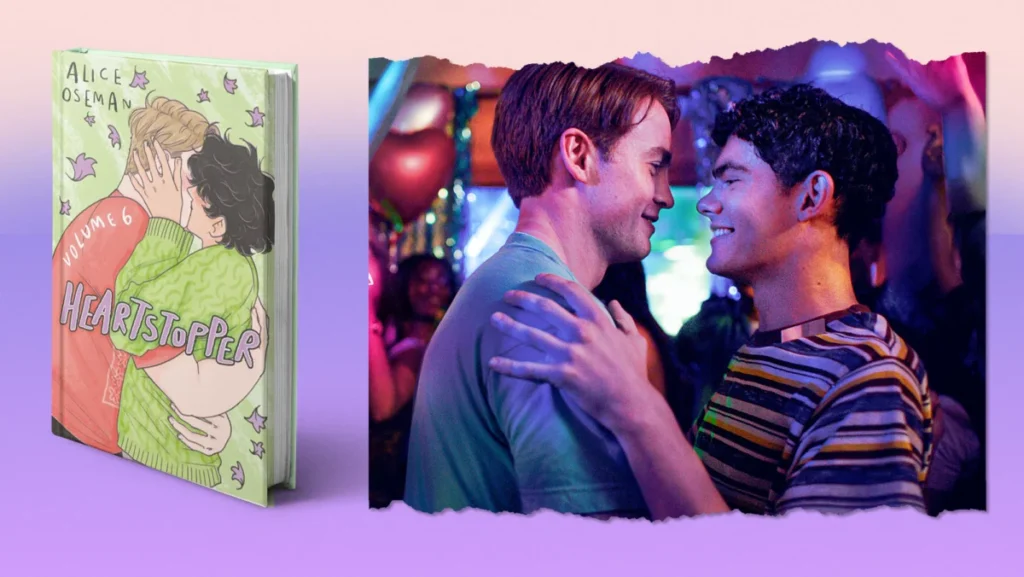

After years of captivating audiences across webcomic pages, graphic novels, and a critically acclaimed Netflix series, the beloved Heartstopper saga reaches its cinematic conclusion with Heartstopper Forever. This highly anticipated film, directed by Wash Westmoreland, marks a pivotal moment for writer and artist Alice Oseman, who has had the unique experience of bidding farewell to their cherished characters, Nick and Charlie, across multiple formats. The movie, which debuted recently on Netflix, navigates the complexities of young adulthood, evolving relationships, and the enduring power of community, while simultaneously addressing the challenges inherent in adapting a dynamic, ongoing narrative for the screen.
The narrative arc of Heartstopper Forever finds the newly confident Truham Grammar School head boy, Charlie Spring (Joe Locke), confronting a deepening emotional chasm with his boyfriend, Nick Nelson (Kit Connor). As Nick grapples with anxieties surrounding university decisions and their future together, he begins to withdraw, raising questions about the couple’s next steps. Their wider circle of friends, including Tara, Darcy, Elle, and Tao, navigate their own significant milestones, from prom and Pride celebrations to graduation and an unexpected temporary separation within their group. The film, stepping beyond the episodic television format, ventures into new emotional and narrative territories for its ensemble cast, all while reverently acknowledging the foundational moments that defined their journey – from their initial, tentative connection to shared experiences like snowball fights and trips to the seaside.
The Journey to Forever: A Chronology of Heartstopper‘s Evolution
The phenomenon of Heartstopper began humbly in 2016 as a webcomic on platforms like Tapastic and Webtoon, quickly garnering a dedicated global following. Alice Oseman’s tender portrayal of queer teenage love and friendship resonated deeply with readers, leading to a successful crowdfunding campaign in 2018 for a limited print run. Hachette Children’s Group subsequently acquired publishing rights, launching the graphic novel series, with Heartstopper: Volume One in 2019. The series rapidly became a bestseller, lauded for its honest and empathetic depiction of LGBTQ+ experiences, mental health, and the everyday joys and challenges of adolescence.
The graphic novel’s immense popularity paved the way for its adaptation into a Netflix original series, which premiered in 2022. The series, also written by Oseman, was an instant critical and commercial success, celebrated for its authentic casting, warm tone, and groundbreaking representation. It quickly cemented its status as a cultural touchstone, drawing millions of viewers worldwide and consistently ranking among Netflix’s top-performing titles in numerous countries. Seasons two and three further expanded the narrative, deepening character arcs and exploring more complex themes.

Heartstopper Forever represents the cinematic culmination of this multi-platform journey, released shortly after the final pages of the webcomics were published in April 2025 and the physical release of Heartstopper: Volume Six in July 2025. This simultaneous development across different media created a unique production environment, as director Wash Westmoreland noted, "For the first time, the book isn’t complete before we’ve started filming." Oseman herself recalled during a July 2025 set visit, "I was writing the last volume of Heartstopper last year, but several times, we’ve had to film a scene that I hadn’t drawn yet, which was kind of scary. We had no references." This unprecedented overlap required a delicate balance of creative foresight and adaptability from Oseman and the production team.
Adapting the Final Chapter: Navigating Uncharted Territory
The transition from a multi-season television format to a two-hour feature film presented significant adaptation challenges. Oseman emphasized the necessity of precision: "Having less screen time to work with in a film was a big challenge, and it forced me to have to be really precise about what’s in the story and to get rid of anything that’s not necessary." This constraint led to a more focused narrative, allowing for extended immersion in the main characters’ perspectives. "You stay with the main characters for much longer periods of time, which feels very different to the TV show," Oseman explained.
Director Wash Westmoreland, in his sole interview for the film at publish time, detailed the creative choices made to accommodate this format. "Alice wrote the script so that it focused predominantly on Nick and Charlie," he told The Hollywood Reporter. "It seemed right that this final chapter should take a deep dive into the complexities of this central relationship as the story moves to its conclusion." Concessions were inevitable, such as condensing a Christmas montage, but the core focus remained steadfast. Westmoreland highlighted the film’s visual evolution, noting, "Right at the beginning, when Charlie plays with the dogs in the garden, surrounded by both practical falling autumn leaves and the animated leaves that have always been part of Heartstopper – for me, it quietly announces what the film is trying to do: honour the visual language of the series while taking it into a more grounded, realistic world." He added that as the characters matured, the filmmaking mirrored this growth, aiming for deeper emotional complexity and visual language.
Maturing Relationships: Intimacy, Vulnerability, and Growth
A significant aspect of Heartstopper Forever is the candid exploration of Nick and Charlie’s maturing physical and emotional relationship. While the Heartstopper series has often been characterized by its earnest and wholesome sentimentality, the film ventures into more nuanced territory, portraying the realities of young adult intimacy. "I think sometimes people can cringe away from that a little bit, and they’re like, ‘It’s too much,’ but I love that about it," Oseman shared, defending the series’ characteristic warmth.

The film showcases four primary scenes of physical intimacy, each meticulously crafted to reflect a distinct stage in Nick and Charlie’s journey. Westmoreland explained, "We felt it was very important that none of them existed simply for their own sake. Each scene had to carry the story forward and reflect where the characters were emotionally at that particular moment." These sequences are designed to be sex-positive and depict a healthy, equal partnership that consciously avoids reinforcing traditional stereotypes about roles in queer relationships, emphasizing emotional connection. Oseman was clear about the characters’ sexual versatility, a point Westmoreland affirmed, stating, "Our focus was always on the emotional truth of the scenes – so that the physical intimacy expressed what they couldn’t yet put into words." He also noted that for Nick, physical closeness sometimes served as a way to defer difficult conversations. The collaborative process with intimacy coordinator Robbie Taylor Hunt, and the actors Joe Locke and Kit Connor, ensured these scenes were handled with professionalism and thoughtfulness.
Adding a layer of unexpected drama, Heartstopper Forever introduces a significant relationship hurdle: a dramatic breakup between Nick and Charlie. This plot point, notably absent from Volume Six of the graphic novel, was adapted by Oseman from their 2015 novella, Nick and Charlie. "I felt like when I was making Volume Six, that scenario just didn’t make sense for those characters, whereas with the film, we’re always looking to push the tension and angst just a little bit more, so it felt like an idea that could work really well for the film," Oseman revealed.
This temporary separation is fueled by a role reversal for the duo. Charlie, previously depicted as vulnerable due to bullying and mental health struggles, emerges as a more confident and resilient individual. Kit Connor observed, "In this film, we see that Charlie is actually someone to look up to. He’s not just this person who’s been through a lot, but who’s used it to triumph and take a step in the direction that he wants to be with his life." Conversely, Nick, often the strong and emotionally intelligent partner, becomes "quite strong and wise beyond his years; a very mature and emotionally intelligent character who closes down [in the film]. He isn’t really able to discuss and articulate the things going on inside his head."
The breakup scene, set at Harry Greene’s party, was intentionally crafted to be emotionally hostile, with Westmoreland describing it as "a kind of teenage manosphere – a basement rave full of young men, pounding dubstep, vivid lighting and huge projections of Mako sharks." This environment underscored the breakdown in communication, which had always been Nick and Charlie’s "superpower." Oseman modified the novella’s argument to align with the characters’ screen incarnations, reflecting their anxieties about the future and their love leading them to believe the other might be better off without them. Connor noted that this conflict serves as a powerful reminder that "these characters are human and that sometimes the person who you think has everything sorted out might not have everything worked out."
A Broader Canvas: Celebrating and Defending the LGBTQ+ Experience
From its inception, Heartstopper has been an unwavering advocate for LGBTQ+ rights and experiences, a commitment that shines brightly in Heartstopper Forever. The film continues the thread of Elle Argent’s (Yasmin Finney) storyline, expanding on the transphobia she faced in season three. Elle takes a central role, leading a vibrant Pride parade float, surrounded by trans community members and allies, delivering a poignant message that for LGBTQ+ teens, the world often presents challenges far greater than personal heartbreak.

Westmoreland shared that he and Oseman discussed "expanding Elle’s storyline to reflect some of the realities facing trans young people today." This culminated in a deeply moving scene in Charlie’s bedroom where Elle articulates her fears and the constant pressures she faces. Oseman emphasized the importance of this moment: "I wanted Elle to have that moment where she lets it all out in one go." The authenticity of this speech was a result of a collaborative writing process between Oseman and Finney, ensuring it truly resonated.
The Pride parade sequence itself was a monumental undertaking. Rather than attaching to an existing event, the production team orchestrated their own, taking over Burnham Town Council’s High Street. The logistical challenge involved recruiting approximately 600 supporting artists, a call Oseman put out on Instagram, receiving over 5,000 applications within an hour. Westmoreland recounted, "They arrived dressed, energized and ready to go… It was genuinely queer, genuinely wonderful, and genuinely something AI cannot replicate." This celebratory moment, filmed on the final day of shooting, captured a genuine sense of community and triumph.
Beyond Elle’s powerful narrative, Heartstopper Forever continues to champion the diversity of LGBTQ+ identities through other characters. Nick’s friend Imogen (Rhea Norwood), Charlie’s friend Isaac (Tobie Donovan), and Charlie’s sister Tori (Jenny Walser) all illustrate journeys of self-discovery and comfort with one’s sexuality. Tori’s conversation about her asexuality with Charlie is a particularly affirming moment, highlighting that not every queer experience needs to fit a specific label. Oseman articulated this philosophy: "We do have a lot of characters who have an identity label… but we have other characters who are just queer and they don’t need to explain, and we don’t even need to know the specifics." This approach reinforces the idea that identity is personal and multifaceted.
The Unwritten Future: Decoding Heartstopper Forever‘s Ambiguous Endings
Crafting a satisfying conclusion for a diverse cast of beloved characters within a two-hour film proved to be one of Oseman’s greatest challenges. "There’s just not enough room to do big sweeping storylines for every single one of the characters," Oseman admitted. The film addresses this by featuring a montage that offers glimpses into the near future for various couples and friends as they connect or reconnect. Westmoreland described the sequence as technically complex due to its multiple locations, but designed to "feel like one continuous emotional journey rather than a collection of separate scenes," linking the entire Heartstopper gang as they step into their futures.
For Tara (Corinna Brown) and Darcy (Kizzy Edgell), their ending sees them choosing a path together, foregoing traditional college plans for a gap year filled with travel. Brown expressed her excitement for Tara’s growth: "She finally gets the courage to just make the jump and explore the world… It leaves the door wide open." This choice symbolizes self-discovery beyond academic pressures and a commitment to their relationship.

Tao and Elle, in a more ambiguous conclusion, decide against a long-distance relationship for university, leading to a split. However, Oseman intentionally left their ending open-ended, suggesting their story is far from over. "Does this mean they’re actually getting back together, or are they just friends? We don’t really know, and I don’t even really know for sure what I want the answer to be," Oseman stated, emphasizing that "your story doesn’t end when you leave school." The final scene subtly hints at Elle’s continued love for Tao, even as her artistic career blossoms.
Regarding Nick and Charlie’s conclusion, Joe Locke confirmed, "We always knew that they were going to end up together. It was always going to be a happy ending," while appreciating that the film "doesn’t sugarcoat any of that." Kit Connor elaborated on the nuance: "One of the beauties of this ending is the fact that it doesn’t necessarily say that they’re going to be together forever… The beauty is that they may end up together, and they may not, but they’ve had this amazing formative time together." This perspective highlights the importance of their journey and mutual growth, emphasizing independence while cherishing their connection. Westmoreland concurred, stating the ending "needed to feel that, through everything they’d experienced in the break-up, they had reached a place where they were ready to make a deeper commitment to each other."
As for the potential for future returns to the Heartstopper universe, both Locke and Connor expressed cautious optimism. Locke stated he wouldn’t return "for the sake of it, so if there was a good story and Alice wanted to, then never say never." Connor echoed this, suggesting interest if involved in an executive producing capacity and a compelling story presented itself.
Impact and Legacy: Heartstopper‘s Cultural Footprint
Heartstopper Forever not only concludes a beloved narrative but also solidifies the franchise’s enduring impact on young adult literature and screen adaptations. Its global success on Netflix underscores the significant demand for authentic, diverse, and hopeful LGBTQ+ narratives. The series has been instrumental in normalizing queer relationships for a mainstream audience, offering a vital sense of validation and belonging for countless young people worldwide. It has demonstrated that stories centered on joy and kindness, even when tackling serious themes, can achieve immense popularity and critical acclaim, setting a new benchmark for representation in media.
The unique production challenges of Heartstopper Forever, particularly the simultaneous development of the book and film, highlight the evolving landscape of intellectual property adaptation. Alice Oseman’s unparalleled creative control across all iterations, from webcomic to graphic novel to screenplay, is a testament to the power of original vision and the importance of authorial voice in adaptations. This model has allowed for a consistent tone and message that resonates deeply with the source material’s spirit.

Heartstopper‘s legacy extends beyond its narrative, influencing discussions around mental health, healthy relationships, and the importance of chosen family. It has fostered a vibrant, inclusive fan community that mirrors the show’s own values. As Heartstopper Forever brings this chapter to a close, its impact on the cultural conversation surrounding queer youth, the YA genre, and the future of inclusive storytelling is undeniable, leaving an indelible mark for years to come.
Heartstopper Forever is now streaming globally on Netflix, offering fans a poignant and satisfying conclusion to Nick and Charlie’s journey.