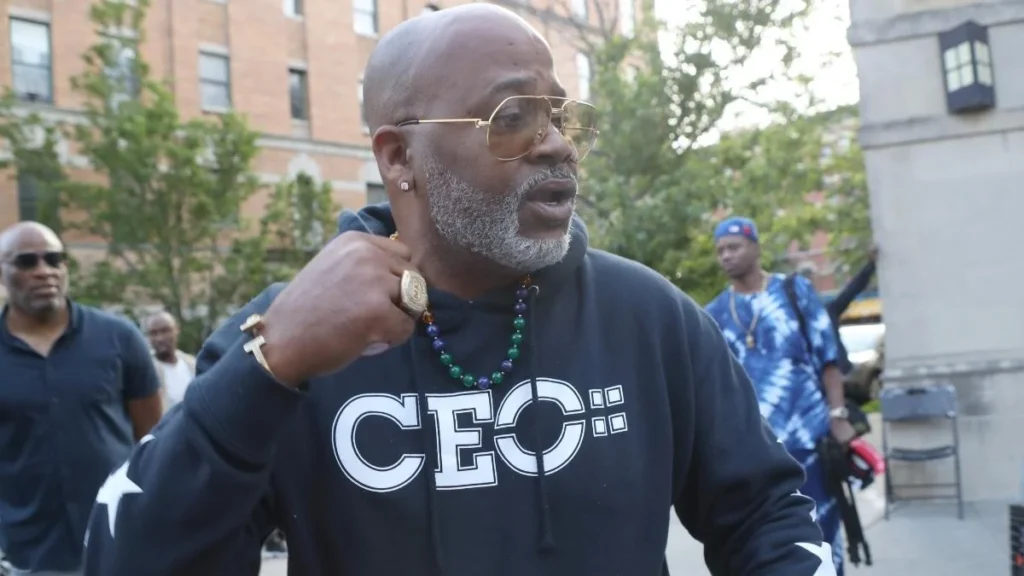

The long-standing friction between Roc-A-Fella Records co-founders Damon "Dame" Dash and Shawn "Jay-Z" Carter has entered a new chapter following Dash’s public disparagement of Jay-Z’s recent Yankee Stadium concert series. The residency, organized to celebrate the 30th anniversary of Jay-Z’s seminal debut album, Reasonable Doubt, has been hailed by many as a historic cultural milestone. However, Dash, speaking in a candid interview with The Art of Dialogue, characterized the event as "all glitter and no gold," arguing that the production prioritized corporate synergy and product placement over the raw musical legacy of the 1996 masterpiece.
Dash’s critique centers on the perceived shift from hip-hop as an art form to hip-hop as a vehicle for global branding. During his appearance on the platform, Dash questioned the authenticity of the anniversary celebration, noting that the overwhelming presence of merchandise and promotional activations made the concerts feel more like a calculated marketing campaign than a tribute to one of the most influential albums in the genre’s history. The music executive pointed specifically to the heavy integration of New York Yankees branding and various lifestyle products, which he suggested diluted the emotional and historical weight of the occasion.
The Evolution of Reasonable Doubt and the Roc-A-Fella Legacy
To understand the weight of Dash’s criticisms, one must look back at the origins of Reasonable Doubt. Released on June 25, 1996, the album was the cornerstone of Roc-A-Fella Records, an independent label founded by Jay-Z, Dame Dash, and Kareem "Biggs" Burke. At the time, the trio was forced into independence after being rejected by major labels. The album’s themes of street hustle, high-end luxury, and corporate ambition set the blueprint for Jay-Z’s career and the broader "hustler" ethos of the late 1990s.
Reasonable Doubt initially saw modest commercial success, debuting at number 23 on the Billboard 200. However, its critical standing grew exponentially over the decades. It is now frequently cited in "Greatest Albums of All Time" lists by publications such as Rolling Stone and Pitchfork. The 30th-anniversary shows at Yankee Stadium were designed to honor this trajectory, moving from the independent grind of Brooklyn to the global stage of a Major League Baseball stadium.
Dash’s disillusionment stems from the fact that he was a primary architect of the original Roc-A-Fella movement. He argues that the spirit of the label was rooted in a specific type of authenticity that he believes is missing from Jay-Z’s modern, highly polished stadium productions. "I would like to see something fresh and not an overly polished, nostalgia-driven production," Dash remarked, suggesting that the current iteration of Jay-Z’s brand has become too detached from its foundational roots.
Analysis of Commercial Synergy and Branding at Yankee Stadium
The Yankee Stadium residency was not merely a series of concerts but a massive commercial undertaking. According to industry reports, the event featured exclusive merchandise drops, including limited-edition apparel that blended the iconic "NY" Yankees logo with Reasonable Doubt iconography. For Jay-Z, the connection to the Yankees is a long-standing element of his brand, famously referenced in his 2009 hit "Empire State of Mind," where he claimed to have made the "Yankee hat more famous than a Yankee can."
However, Dash viewed this synergy as a distraction. He suggested that the crowd shots and various promotional "activations" throughout the stadium were part of a larger, pre-planned marketing ploy. While Dash admitted he had no insider knowledge of the specific business arrangements for these shows, his observations reflect a broader critique of the "experience economy" in live music. In this model, the concert is just one component of a multi-sensory brand experience designed to maximize revenue through sponsorship and social media engagement.
The music executive also took aim at the cinematic elements of the show. Specifically, he criticized an opening sequence that featured Jay-Z’s wife, global superstar Beyoncé, shaving Jay-Z’s head. Dash described the segment as "thoroughly unconvincing and contrived," arguing that it was a forced attempt to bring the celebrity couple into a shared limelight. In a more lighthearted but pointed comment, Dash added that he personally wouldn’t trust a partner with a razor, further emphasizing his view that the moment was staged for theatrical effect rather than genuine intimacy.
A History of Friction: The Dash-Carter Timeline
The tension between Dash and Jay-Z is not a new development. Their relationship has been marked by a series of legal and personal disputes spanning two decades. To provide context for Dash’s current stance, a timeline of their professional dissolution is essential:
- 1995-1996: Dash, Jay-Z, and Biggs Burke found Roc-A-Fella Records and release Reasonable Doubt independently.
- 1997-2003: The label achieves massive success with artists like Kanye West, Cam’ron, and Beanie Sigel. Jay-Z becomes one of the biggest stars in the world.
- 2004: Def Jam Recordings purchases Roc-A-Fella Records. Jay-Z is appointed President of Def Jam, a move that effectively sidelined Dash. The partnership dissolves, leading to a public and acrimonious split.
- 2005-2020: The two moguls occasionally exchange barbs in interviews. Dash experiences various financial and legal setbacks, while Jay-Z’s net worth soars into the billions through ventures like Roc Nation, Tidal, and Armand de Brignac.
- 2021: A major legal battle erupts when Dash attempts to sell his share of Reasonable Doubt as a Non-Fungible Token (NFT). Roc-A-Fella Records files a lawsuit to block the sale, arguing that Dash does not own the copyright to the album, only a one-third stake in the company that owns it.
- 2024-2026: As the 30th anniversary of the debut album approaches, the divide remains unbridged. Dash continues to voice his disapproval of Jay-Z’s business tactics and the direction of the Roc-A-Fella legacy.
This history suggests that Dash’s critiques of the Yankee Stadium shows are inextricably linked to his feelings of exclusion from the brand he helped build. While Jay-Z has moved into the stratosphere of "corporate hip-hop," Dash has often positioned himself as a purist or a disruptor who was unfairly pushed out of the empire.
The Star-Studded Reality of the Yankee Stadium Residency
Despite Dash’s criticisms, the Yankee Stadium shows were a monumental success by almost every traditional metric. The residency featured a "who’s who" of hip-hop and R&B royalty. Surprise appearances included Rihanna, Nas, Eminem, Pharrell Williams, and various members of the original Roc-A-Fella roster, excluding Dash.
For many fans, the presence of Nas was particularly significant. The two rappers engaged in one of the most famous feuds in music history during the early 2000s, a conflict that Dash was heavily involved in at the time. Seeing them share a stage at Yankee Stadium symbolized a "full circle" moment of maturity and reconciliation—a narrative that stands in stark contrast to the ongoing stalemate between Jay-Z and Dash.
The production value of the shows was also a point of praise for many critics. The use of high-definition visuals, intricate stage design, and a live orchestra provided a "prestige" feel to the performance, elevating hip-hop to the level of high art usually reserved for opera or classical music. From this perspective, the "glitter" that Dash criticized was seen by others as the deserved polish for a legendary career.
Data and Economic Impact of the Event
The economic scale of the Yankee Stadium residency reflects Jay-Z’s status as a billionaire mogul. Yankee Stadium has a concert capacity of approximately 50,000 to 54,000 people. With multiple sold-out dates, the residency likely generated tens of millions of dollars in ticket sales alone.
Supporting data points regarding the event’s impact include:
- Merchandise Revenue: Industry analysts estimate that stadium-level residencies for top-tier artists can generate between $15 and $25 per head in merchandise sales. For a multi-night run at Yankee Stadium, this could equate to several million dollars in revenue from apparel and collectibles.
- Streaming Surge: Historical data shows that major anniversary concerts typically lead to a 20% to 40% increase in streaming numbers for the celebrated album in the weeks surrounding the event.
- Brand Value: The collaboration with the New York Yankees further solidifies the "Jay-Z" brand as a permanent fixture of New York City’s cultural infrastructure, a feat few artists have achieved.
Broader Implications for Hip-Hop Culture
The disagreement between Dame Dash and Jay-Z highlights a fundamental tension within hip-hop culture: the balance between artistic integrity and commercial expansion. As the first generation of hip-hop moguls enters their 50s and 60s, the question of how to age gracefully within a genre rooted in youth rebellion becomes paramount.
Jay-Z’s approach has been to embrace the corporate world, turning his life and music into a premium brand. This "luxury rap" aesthetic has paved the way for hip-hop artists to become CEOs, art collectors, and sports agents. Dash’s critique, however, serves as a reminder of the genre’s grittier, more independent roots. He argues that by becoming so "polished" and "contrived," the music loses the very soul that made it impactful in the first place.
Ultimately, the Yankee Stadium residency will likely be remembered as a triumph of branding and a celebration of a historic career. Whether one agrees with Dash’s assessment that the event was "all glitter" depends largely on one’s definition of success in the modern music industry. For Jay-Z, success is measured in global reach, billion-dollar valuations, and stadium-sized spectacles. For Dash, the measure remains rooted in the raw, unvarnished spirit of the 1996 independent hustle—a spirit he feels has been sold to the highest bidder.
As the 30th anniversary celebrations conclude, the legacy of Reasonable Doubt remains secure as a pillar of American music. However, the fractured relationship between its creators serves as a somber footnote to the festivities, proving that even the most successful partnerships can be undone by the very ambitions that fueled their rise.