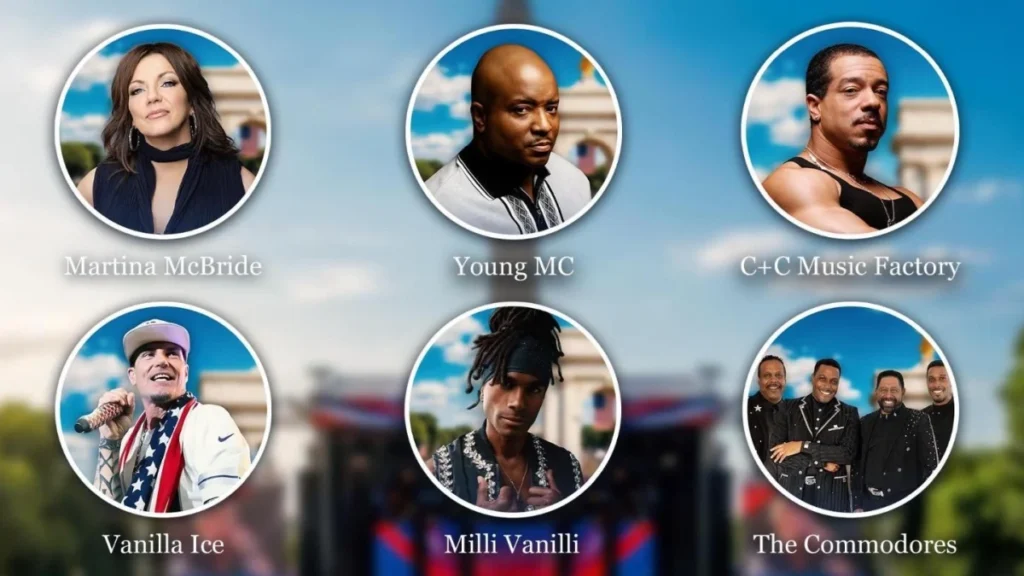

The Great American State Fair, an ambitious event spearheaded by the organization Freedom 250, which was launched by former President Donald Trump to commemorate America’s upcoming 250th anniversary, is grappling with a growing wave of artist withdrawals and internal disputes, threatening its proposed summer lineup. The latest high-profile act to sever ties is the legendary Motown group The Commodores, joining a growing list of performers who have publicly distanced themselves from the politically charged event slated for the National Mall.
The Commodores, iconic for their chart-topping hits such as "Easy," "Three Times a Lady," and "Brick House," issued a definitive statement via social media, declaring their non-participation. "Our music has always been our voice and we choose not to publicly affiliate with any single political party. We support the betterment of all Americans," the statement read, articulating a stance of political neutrality that has become increasingly common among artists navigating today’s polarized landscape. The group, which continues to tour with original member William King, while former lead singer Lionel Richie embarked on a successful solo career in 1982, emphasized their dedication to universal appeal over partisan alignment.
This cancellation follows similar declarations from other prominent 1980s and 90s artists who were initially announced for the event. Morris Day & The Time, celebrated for their distinctive funk-R&B sound and association with Prince, and Young MC, the retro rapper behind the Grammy-winning hit "Bust a Move," both released statements earlier this week echoing the sentiment of non-affiliation. Their decisions underscore a broader trend within the entertainment industry where performers, particularly those with established cross-generational appeal, are increasingly wary of lending their brand to events perceived as politically partisan.
A Lineup in Flux: The Milli Vanilli Conundrum and C+C Music Factory Fallout
The roster for The Great American State Fair has been a source of confusion and controversy since its initial announcements. The situation surrounding Milli Vanilli highlights the complexities involved in booking legacy acts. While promotional materials for the event featured the group, the singers currently touring under the Milli Vanilli name unequivocally stated they would not be performing. This denial was complicated by the fact that the accompanying promotional image was that of Fab Morvan, one half of the original duo infamous for the 1990s lip-syncing scandal. This ambiguity suggests that Morvan might be slated to perform as a solo artist, distinct from the group that currently carries the Milli Vanilli mantle. The original Milli Vanilli story, a cautionary tale of industry artifice, adds another layer of intrigue to the booking challenges faced by Freedom 250.
Perhaps the most public and contentious dispute has erupted within the ranks of C+C Music Factory, the Grammy-nominated dance-pop group known for global hits like "Gonna Make You Sweat (Everybody Dance Now)" and "Things That Make You Go Hmmm…" Freedom Williams, the rapper featured on these tracks, appeared on the event’s promotional material. However, his presumed involvement triggered significant backlash, leading Robert Clivilles, a founding member of C+C Music Factory, to issue a scathing repudiation.
Clivilles, in a series of social media posts, vehemently distanced the group from the event, its political nature, and Williams’ actions. He asserted that Williams "has done his best to misuse" the name "C&C Music Factory," clarifying that the moniker stands for Clivilles and Cole Music Factory, a tribute to his deceased partner, David Cole. Clivilles explicitly stated that Williams "should not be using this name to tour or represent what this group stands for" and that "Any political or religious show or comment Freedom Williams makes regarding any shows, views or opinion (Williams) makes as an individual." He further emphasized that Williams’ views have "absolutely nothing to do with" C&C Music Factory’s viewpoint, reiterating the group’s neutrality: "C&C Music Factory does not participate nor side with any specific political party. We stand neutral when it comes to sides. We side with Global Love & Peace." This public spat reveals not only a deep division regarding political alignment but also an underlying legal battle over intellectual property, as public records indicate the trademark for "C & C Music Factory" is currently owned by Williams’ entertainment company.
Background of Freedom 250 and The Great American State Fair
Freedom 250 was established with the stated goal of organizing celebrations across the United States for the nation’s 250th anniversary in 2026. Launched by former President Donald Trump, the initiative aims to curate events that reflect a particular vision of American heritage and patriotism. The Great American State Fair, positioned as a flagship event, is scheduled to run from June 25th to July 10th on the National Mall in Washington D.C., promising free admission to attendees. The choice of the National Mall, a symbolically potent and historically significant venue for national celebrations, protests, and major public gatherings, underscores the event’s ambition and potential visibility. Its proximity to national monuments and institutions lends an air of official gravitas, even as the event’s direct association with a political figure injects a partisan element that challenges the traditional neutrality of such public spaces.
The Semiquincentennial, or 250th anniversary, of the United States in 2026 is a significant milestone, expected to inspire a wide array of commemorative events across the country. Historically, major anniversaries like the Bicentennial in 1976 have been marked by broad, non-partisan celebrations designed to unite the nation. The politicization of the Freedom 250 initiative and its associated events, however, introduces a different dynamic, potentially fragmenting the national commemorative effort along ideological lines. This context makes the artists’ decisions to withdraw particularly noteworthy, as they navigate the complexities of national celebration versus political endorsement.
Chronology of Announcements and Withdrawals
The timeline of artist engagement and disengagement reveals a pattern of rapid repudiation following initial announcements. While the precise dates of all initial bookings remain somewhat fluid, the sequence of withdrawals has been swift and decisive:
- Initial Announcements (Undisclosed Dates): Freedom 250’s promotional materials begin to circulate, listing various artists for The Great American State Fair.
- Early Week Declarations: Morris Day & The Time and Young MC are among the first to issue statements, confirming their non-participation shortly after their names appear on event literature. Their statements, made "this week," highlighted a desire to avoid political affiliation.
- Milli Vanilli Confusion: Around the same period, the current touring iteration of Milli Vanilli publicly clarifies they are not performing, despite promotional imagery featuring Fab Morvan.
- The Commodores’ Withdrawal: As the "latest act," The Commodores release their statement, further solidifying the trend of high-profile cancellations.
- C+C Music Factory Internal Strife: The dispute between Freedom Williams and Robert Clivilles unfolds publicly, with Clivilles’ strong denouncement emerging in response to backlash over Williams’ announced participation. This internal conflict, unlike outright cancellation, adds a layer of complexity regarding who, if anyone, represents "C+C Music Factory" at the event.
This swift succession of withdrawals and public disavowals suggests that many artists, upon realizing the political implications of their potential involvement, chose to prioritize their non-partisan image.
Broader Context: Artists, Politics, and Public Perception
The challenges faced by The Great American State Fair are not isolated incidents but reflect a broader, evolving relationship between artists and political events. In an increasingly polarized society, public figures, including musicians, often find themselves under intense scrutiny regarding their political affiliations. While artists have historically participated in political campaigns and events, the current climate often demands a clearer stance, making neutrality a difficult tightrope walk.
For many legacy acts, whose fan bases span diverse demographics and political spectrums, maintaining a non-partisan stance is often seen as crucial for preserving their appeal and avoiding alienating segments of their audience. The statements from The Commodores, Young MC, and Morris Day & The Time explicitly articulate this desire to appeal to "all Americans" rather than a specific political faction. This strategy is rooted in a pragmatic understanding of brand management and the potential for backlash from fans on either side of the political divide.
Moreover, the legal dimension highlighted by the C+C Music Factory dispute—specifically concerning trademark ownership and the right to represent a group—underscores another layer of complexity. These issues can not only damage a group’s public image but also lead to costly litigation, further complicating event logistics and artist engagement. The willingness of Robert Clivilles to publicly challenge Freedom Williams’ use of the name, despite Williams’ registered trademark, points to the deep ideological and personal rifts that can emerge when artistic identity intersects with political platforms.
From the perspective of event organizers like Freedom 250, securing talent for politically affiliated events presents unique hurdles. Artists may demand higher appearance fees to compensate for potential reputational risks, or they may simply decline invitations to avoid controversy altogether. This dynamic can lead to a more limited pool of talent willing to participate, potentially impacting the perceived caliber and diversity of the lineup. The public scrutiny of event lineups, amplified by social media, means that any perceived misstep in booking can quickly become a PR crisis.
Remaining Lineup and Future Implications
Despite the significant withdrawals, promotional materials for The Great American State Fair still list several notable acts, including Vanilla Ice, Bret Michaels, Flo Rida, Martina McBride, and C+C Music Factory (presumably with Freedom Williams). These artists represent a mix of genres and fan bases, and their continued presence suggests a different approach to political engagement or a less stringent stance on political neutrality.
The ongoing controversy surrounding artist participation could have several implications for The Great American State Fair and similar politically aligned events:
- Credibility and Attendance: A constantly shifting lineup and public disputes can undermine the event’s credibility and potentially deter attendees, even with free admission. The spectacle of artists actively distancing themselves may overshadow the intended commemorative purpose.
- Future Bookings: The current challenges could make it even harder for Freedom 250 to attract future talent, as artists may view the event as a potential minefield for public relations.
- Legal Battles: The C+C Music Factory trademark dispute, if it escalates, could set precedents for how legacy group names are used in politically sensitive contexts, potentially impacting the wider music industry.
- Redefinition of "National" Events: The situation highlights the difficulty of creating universally appealing "national" celebrations in a highly polarized political environment. It forces organizers to consider whether such events can truly transcend partisan lines or if they inevitably become perceived as endorsements.
As the June 25th start date approaches, all eyes will be on the National Mall to see how The Great American State Fair navigates these turbulent waters. The series of withdrawals and internal conflicts serves as a stark reminder of the delicate balance artists must strike between their craft, their public image, and the increasingly complex world of political affiliation. The intersection of entertainment and politics continues to be a challenging terrain, where even the most well-intentioned commemorative events can become battlegrounds for ideological and artistic integrity.