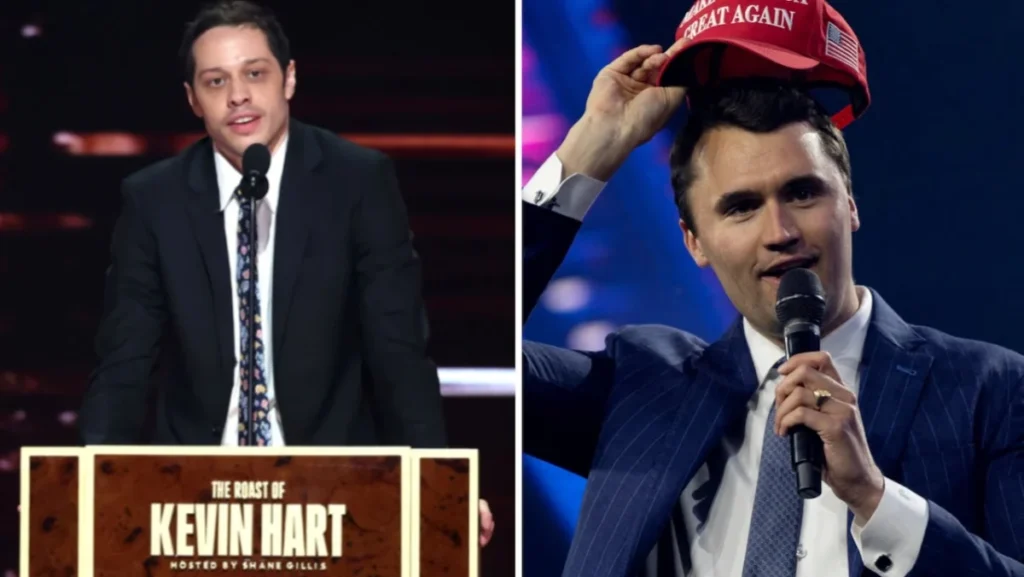

Hosts of the prominent conservative podcast, The Charlie Kirk Show, have voiced strong disapproval regarding a joke made by comedian Pete Davidson during the highly anticipated Netflix roast of Kevin Hart, which premiered on Sunday, May 10th. The controversial remark, targeting the late conservative figure Charlie Kirk, has ignited a fresh debate about the boundaries of comedic expression, particularly when it touches upon real-world tragedy and personal loss. The incident underscores the perpetual tension between artistic freedom and public sensitivity, a dynamic frequently amplified in the polarized landscape of contemporary media.
During his segment at the star-studded roast, Pete Davidson, known for his edgy and often self-deprecating humor, delivered a line directed at fellow comedian Tony Hinchcliffe. Davidson quipped, "Tony Hinchcliffe reminds me of Charlie Kirk, in that he definitely has been on camera letting a guy unload in his throat." The statement immediately drew gasps and murmurs from the audience, signaling its provocative nature. The joke directly referenced the tragic assassination of Charlie Kirk in 2025, an event that sent shockwaves through the conservative movement and the broader political spectrum.
Background: The Assassination of Charlie Kirk
Charlie Kirk, a formidable voice in American conservative politics, was the founder of Turning Point USA (TPUSA), a non-profit organization established in 2012 dedicated to identifying, educating, training, and organizing students to promote the principles of freedom, free markets, and limited government. Under Kirk’s leadership, TPUSA grew exponentially, establishing a significant presence on college campuses nationwide and becoming a powerful platform for young conservatives. Kirk himself was a prolific speaker, author, and media personality, often engaging in highly charged debates and becoming a lightning rod for both adoration and criticism. His public appearances, characterized by passionate rhetoric and unwavering defense of conservative ideals, drew large crowds and fervent supporters.
It was during one such public appearance, at Utah Valley University in 2025, that Kirk’s life was tragically cut short. A lone gunman, whose motives were later determined to be politically driven, opened fire during a live question-and-answer session, striking Kirk in the neck. The incident unfolded in a brutal and public manner, captured on various attendee recordings and live streams, creating a horrifying spectacle that quickly went viral. The immediate aftermath was chaotic, with widespread panic, emergency services rushing to the scene, and a nation grappling with the shocking loss of a prominent public figure to political violence. The assassination of Charlie Kirk was a watershed moment, prompting widespread condemnation from across the political spectrum and reigniting intense debates about political rhetoric, the security of public figures, and the increasing polarization of American society. The event left Kirk’s family, friends, and millions of followers devastated, and its memory remains a painful point for many. The assailant was apprehended shortly after the incident and subsequently convicted, but the scar left by the tragedy continues to shape discussions around political discourse and safety.
The Comedian and the Culture of Roasts
Pete Davidson’s comedic style has long been characterized by its raw honesty, vulnerability, and a willingness to push boundaries. Rising to prominence as a cast member on NBC’s Saturday Night Live, Davidson often incorporates deeply personal experiences, including his struggles with mental health and the loss of his firefighter father on 9/11, into his routines. This blend of vulnerability and dark humor has garnered him a dedicated fanbase but has also frequently placed him at the center of controversy.
The Kevin Hart roast on Netflix was part of a long-standing comedic tradition where performers gather to playfully (and often harshly) insult a central figure, as well as each other. Roasts are inherently designed to be provocative, relying on shock value and taboo-breaking humor to elicit laughter. Historically, no subject has been entirely off-limits in roast culture, with comedians often targeting personal failures, physical appearance, professional missteps, and even tragedies, albeit usually with a wink and an understanding of the context. However, the line between edgy humor and outright insensitivity is a constantly shifting one, especially in an era where social media amplifies every public statement and audiences are increasingly vocal about perceived transgressions. Davidson himself has been the subject of insensitive jokes regarding his father’s death, an experience he and his family have spoken about publicly, adding a layer of complexity to his recent joke about Kirk.
Immediate Reactions from The Charlie Kirk Show Hosts
The joke did not go unnoticed by those closest to Charlie Kirk. Andrew Kolvet, Daisy Phelps, and Blake Neff, hosts of The Charlie Kirk Show podcast, dedicated a segment of their program to addressing Davidson’s comments. Their collective sentiment was one of profound disappointment and, as Kolvet articulated, labeling the joke as "distasteful."
Andrew Kolvet, a close friend of Kirk, expressed his anguish, stating, "This is about somebody who was murdered in really the most grotesque, public way imaginable, and he happens to be our close friend." Kolvet acknowledged the inherent power and purpose of comedy, conceding that he doesn’t believe in dictating what comedians can or cannot joke about. However, he drew a firm line at this particular instance, emphasizing the deeply personal nature of the tragedy. "For this particular moment," Kolvet reiterated, "It just felt distasteful." His reaction highlighted the pain of personal loss intersecting with public spectacle, arguing that some events transcend the realm of acceptable comedic fodder due to their inherent brutality and the grief they inflict.
Daisy Phelps, another co-host, echoed Kolvet’s sentiment while adding a layer of ethical consideration. Phelps affirmed Davidson’s constitutional right to tell any joke he chooses, framing the issue not as one of legality but of morality. She questioned whether Davidson should have told that specific joke, particularly given its context. Phelps urged Davidson to hold himself to a "higher standard," drawing a poignant parallel to his own life experience. She invoked the memory of Davidson’s father, a firefighter who perished during the 9/11 attacks, and the "disgusting" jokes that have been made at Davidson’s expense about his father’s death. This comparison served to underscore the universal pain of losing a parent to tragedy and the profound impact such insensitive remarks can have. "I would have loved for him to have thought about, hey, I grew up without my dad, there are two kids out there growing up without their dad right now, the less difficult I can make this on them throughout their lives, the better," Phelps stated, appealing to empathy and shared human experience. Her comments resonated with a call for greater compassion, especially from someone who has experienced similar pain.
Blake Neff, the third co-host, offered a more nuanced perspective, acknowledging Kirk’s elevated status while still expressing disapproval. Neff referred to Kirk as an "icon" and suggested that such lofty status inevitably comes with a downside, including becoming a target for humor. "He’s going to be a subject of humor because anything great is subject to humor," Neff remarked, hinting at the idea that public figures, especially those with significant influence, often become subjects of satire and parody. However, his personal feelings about Davidson’s joke were clearly negative, as evidenced by his social media post following the podcast discussion. In a tweet, Neff wrote, "On today’s show we discussed Pete Davidson’s joke about Charlie’s death while roasting Tony Hinchcliffe. My take: I didn’t like it, and I’m glad the audience wasn’t into it, but there are other "jokes" we’ve seen that are clearly a lot more hateful in intent than Pete’s, and a…" This truncated tweet suggested a differentiation, implying that while he disliked Davidson’s joke, he might perceive other forms of humor as more malicious in their intent, indicating a spectrum of "distasteful" rather than a blanket condemnation. The mention of the audience not being "into it" also subtly highlighted that even within the context of a roast, some jokes fail to land, either due to poor taste or lack of comedic timing.
Broader Implications: Comedy, Sensitivity, and Public Discourse
The controversy surrounding Pete Davidson’s joke about Charlie Kirk’s assassination is not an isolated incident but rather a microcosm of a larger, ongoing societal debate concerning the limits of free speech, the responsibilities of public figures, and the evolving nature of humor in a politically charged environment.
One key implication is the continued discussion around "cancel culture" versus accountability. While many comedians argue for the sanctity of free expression, contending that comedy’s role is to challenge norms and provoke thought, critics often counter that this freedom comes with a responsibility, especially when jokes delve into trauma, violence, or marginalized communities. The question of where to draw the line – if one should be drawn at all – remains contentious. Is any subject fair game if the joke is "funny enough," or are there certain topics, like political assassination or mass tragedies, that should be treated with inherent reverence and sensitivity, regardless of comedic intent?
The incident also highlights the impact of political polarization on how humor is received. Jokes targeting figures from opposing political camps are often viewed through a partisan lens, with supporters of the target perceiving them as malicious attacks, while opponents might view them as justifiable satire or even cathartic. In Kirk’s case, a figure often associated with strong conservative stances, the joke by a comedian generally perceived as more aligned with liberal cultural sensibilities, inevitably fuels pre-existing ideological divides.
Furthermore, the controversy puts a spotlight on the format of roasts themselves. While designed for shock value, there is an unspoken contract between performer and audience, and sometimes, that contract is broken when a joke goes too far. The hosts’ comments about the audience’s muted reaction suggest that even within the permissive atmosphere of a roast, Davidson’s remark might have crossed a line for many viewers, irrespective of their political leanings. This raises questions for platforms like Netflix regarding content moderation and the perceived "anything goes" ethos of such productions.
Analysis and Forward Outlook
For Pete Davidson, this incident may reinforce his reputation as a comedian unafraid to tackle dark and controversial subjects, but it also risks alienating segments of his audience and the broader public. While some will defend his right to make the joke as an exercise in free speech, others will view it as a profound lapse in judgment and empathy, potentially impacting his future comedic engagements and public perception.
For The Charlie Kirk Show and Turning Point USA, the incident serves as an opportunity to reinforce Kirk’s legacy, rally their base, and frame themselves as victims of insensitive media, further solidifying their narrative in the ongoing culture wars. It allows them to highlight the human cost of political violence and the insensitivity sometimes displayed by those outside their ideological sphere.
More broadly, this event contributes to the ongoing national conversation about respect, empathy, and the appropriate boundaries of public discourse in a society grappling with deep divisions and recent traumas. It forces a re-evaluation of how we discuss sensitive topics, especially those involving violence and death, and whether the pursuit of laughter should ever supersede basic human decency and compassion. As society continues to navigate an increasingly complex media landscape, incidents like this serve as stark reminders of the delicate balance between freedom of expression and the collective responsibility to foster a more respectful and empathetic public sphere. The debate ignited by Davidson’s joke is unlikely to subside quickly, reflecting the persistent challenge of finding common ground in an era defined by both outspokenness and heightened sensitivity.