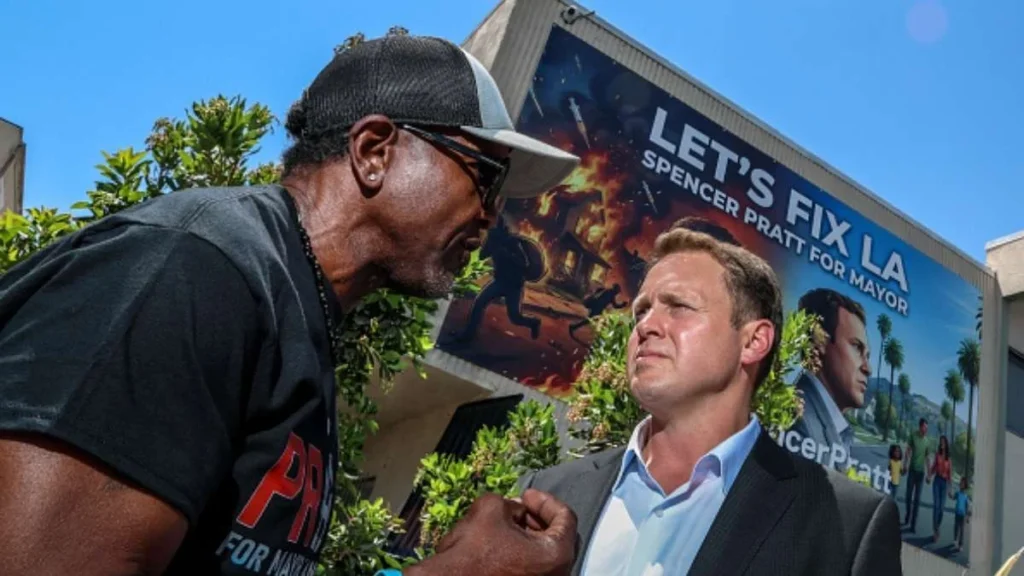

The political landscape of Los Angeles has taken an unexpected turn as reality television veteran Spencer Pratt intensifies his campaign for the mayoralty, claiming the backing of some of Hollywood’s most elite figures. In a recent and widely circulated interview with Us Weekly, Pratt asserted that his bid to lead the nation’s second-largest city has garnered the personal support of Academy Award winners Leonardo DiCaprio and Jamie Foxx. These claims come at a critical juncture in the municipal election cycle, as Pratt attempts to transition from a polarizing media personality to a viable political contender capable of challenging established incumbents and seasoned civil servants.
Pratt, 42, rose to national prominence in the mid-2000s as a primary antagonist on the MTV reality series The Hills. However, his current trajectory suggests a pivot toward civic engagement, fueled by personal tragedy and a perceived vacuum in effective local governance. While the legitimacy of his campaign was initially met with skepticism by political analysts, Pratt’s recent assertions regarding high-profile endorsements have forced a reexamination of his influence within the Los Angeles community.
Alleged Endorsements from Hollywood Heavyweights
During his discussion with Us Weekly, Pratt detailed private conversations he allegedly shared with DiCaprio and Foxx. According to Pratt, both actors reached out to express their solidarity with his platform, particularly his focus on public safety and urban management. Pratt characterized these interactions not merely as casual greetings but as substantive nods toward his vision for the city.
"I don’t name-drop, but I had two of my favorite people ever support me," Pratt stated, before identifying the two Oscar winners. He further elaborated that the conversations centered on the deteriorating state of public safety in Los Angeles, a recurring theme in his campaign rhetoric. Pratt emphasized that hearing encouragement from figures of such global stature was a "surreal" experience, yet he remained firm in the validity of his account.
Anticipating potential skepticism or formal denials from the actors’ representatives, Pratt proactively addressed the possibility of a "he-said, she-said" scenario. He claimed to have "multiple witnesses" who could verify the conversations took place, suggesting a level of preparation for the scrutiny that typically accompanies celebrity involvement in political races. As of the current reporting period, neither Leonardo DiCaprio nor Jamie Foxx has issued a public statement confirming or denying Pratt’s claims.
The Catalyst: From Reality Television to Disaster Response
The impetus for Pratt’s mayoral run appears to be rooted in the devastating California wildfires that occurred earlier this year. The fires, which ranks among the most destructive in the state’s history, resulted in the loss of thousands of homes and the displacement of tens of thousands of residents across Los Angeles and Ventura Counties. Among those affected were Pratt and his wife, Heidi Montag, whose residence was completely destroyed by the flames.
This personal loss served as a radicalizing moment for Pratt, shifting his focus from the entertainment industry to the mechanics of city management and emergency preparedness. Pratt has frequently cited his frustration with the official response to the wildfires as the primary reason for his entry into the race. He contends that the current administration failed to provide adequate warning systems, resource allocation, and post-disaster support for affected communities.
Since the disaster, Pratt has been active in visiting impacted neighborhoods, speaking with local leaders, and participating in community forums. He claims that the enthusiastic response he received from fellow wildfire victims convinced him that his message of "common sense" governance would resonate with a broader electorate beyond his traditional reality TV fan base.
A Chronology of Spencer Pratt’s Political Evolution
To understand the current state of Pratt’s mayoral bid, it is necessary to trace the timeline of his public life and recent political activities:
- 2006–2010: Pratt becomes a household name through The Hills, establishing a reputation for media manipulation and confrontational behavior.
- 2011–2023: Pratt and Montag maintain a presence in the media through various reality spin-offs, social media ventures, and a successful crystal-selling business. Pratt begins to cultivate a more eccentric, yet community-focused, online persona.
- Early 2026: Massive wildfires sweep through Southern California. The Pratt-Montag family loses their home, leading to a period of public mourning and vocal criticism of city infrastructure.
- Spring 2026: Pratt officially announces his candidacy for Mayor of Los Angeles, running on a platform of public safety, wildfire prevention, and government transparency.
- May 2026: Former President Donald Trump publicly praises Pratt’s "spirit," leading to speculation about Pratt’s partisan leanings.
- Late May 2026: Pratt clarifies his political identity as an independent "centrist" and claims the support of DiCaprio and Foxx in an interview with Us Weekly.
The Competitive Landscape: Karen Bass and Nithya Raman
Pratt faces a formidable challenge in the form of the incumbent, Mayor Karen Bass. Bass, a veteran politician with deep roots in both the U.S. Congress and the California State Assembly, has focused her first term on addressing the city’s homelessness crisis through her "Inside Safe" initiative. While Bass maintains a significant fundraising advantage and a well-established ground game, she has faced criticism from both the left and the right regarding the pace of progress on housing and the rising concerns over retail theft and public order.
Also in the race is Councilwoman Nithya Raman, representing the city’s progressive wing. Raman has consistently advocated for tenant protections, environmental justice, and a reimagining of the Los Angeles Police Department’s role in social services.
Pratt’s entry into the race introduces a "wildcard" element. By positioning himself as a political independent—or a "centrist" whose "party is common sense"—he seeks to appeal to voters who are disillusioned with the traditional Democratic establishment in Los Angeles but are wary of aligning with the formal Republican platform.
Analyzing the Impact of Celebrity in Los Angeles Politics
The intersection of celebrity and politics is a long-standing tradition in California. From George Murphy and Ronald Reagan to Arnold Schwarzenegger, the state has a history of elevating entertainers to high office. In Los Angeles specifically, the visibility of a candidate often translates into media coverage that traditional politicians struggle to match.
Pratt’s claim of support from DiCaprio and Foxx is a strategic move to bolster his credibility. Leonardo DiCaprio is well-known for his environmental activism and his influence in global climate policy, while Jamie Foxx has been a vocal advocate for social justice and community empowerment. If these endorsements are verified, it would signal that Pratt’s platform has found purchase among individuals who are typically aligned with serious policy discourse.
However, the "celebrity factor" is a double-edged sword. Critics argue that Pratt’s run is a sophisticated publicity stunt designed to revitalize his brand. The challenge for Pratt lies in proving that his policy proposals—such as modernizing the city’s fire-fighting technology and streamlining the bureaucracy of the Department of Building and Safety—are more than just talking points.
Supporting Data: The Current State of Los Angeles
The issues Pratt is highlighting are backed by significant data regarding the challenges facing the city:
- Public Safety: According to data from the Los Angeles Police Department (LAPD), while some categories of violent crime have seen fluctuations, concerns regarding "smash-and-grab" robberies and property crimes remain high among residents. A 2025 survey indicated that over 60% of Angelenos feel "less safe" than they did five years ago.
- Wildfire Risk: The Santa Monica Mountains and the surrounding hillsides remain high-risk zones. Climate data suggests that the "fire season" in California has extended by nearly 75 days over the last few decades, necessitating a radical overhaul of urban planning and emergency response.
- Voter Sentiment: Internal polling from various municipal campaigns suggests a growing appetite for "outsider" candidates. In a city where the Democratic party holds a dominant majority, the "independent centrist" label is increasingly used by candidates looking to capture the "exhausted majority" of voters who feel the current system is stagnant.
Official Responses and Implications
The offices of Mayor Karen Bass and Councilwoman Nithya Raman have largely refrained from engaging directly with Pratt’s rhetoric, choosing instead to focus on their respective legislative records. This is a standard tactical move intended to avoid giving a "fringe" candidate the legitimacy of a direct confrontation.
However, political analysts suggest that Pratt’s presence in the race could impact the primary results by peeling away a small but significant percentage of the vote, potentially forcing a runoff. His ability to command media attention ensures that his critiques of the current administration’s handling of the wildfires and public safety will remain in the public consciousness.
Pratt’s assertion that he is not aligned with the MAGA movement, despite praise from Donald Trump, is a calculated attempt to navigate the complex demographics of Los Angeles. The city voted overwhelmingly against Trump in previous general elections, and any formal association with the former president’s brand would likely be a "kiss of death" in a local mayoral race. By branding himself as a "common sense centrist," Pratt is attempting to build a bridge between disgruntled conservatives and moderate liberals who are frustrated with the status quo.
Conclusion: A Test of Political Viability
As the primary date approaches, the focus on Spencer Pratt will likely shift from his celebrity associations to the specifics of his policy platform. While the claims of support from Leonardo DiCaprio and Jamie Foxx provide a temporary boost in profile, the ultimate test of his candidacy will be his performance in debates and his ability to present a cohesive plan for the future of Los Angeles.
Whether Pratt is a serious reformer born from the ashes of a personal tragedy or a master of media spectacle remains to be seen. What is certain, however, is that his campaign has successfully tapped into a vein of local discontent, ensuring that the race for Los Angeles Mayor will be one of the most watched and unconventional contests in the city’s history. For a city built on the industry of storytelling, Pratt is currently writing a narrative that few could have predicted, but many are now forced to follow.