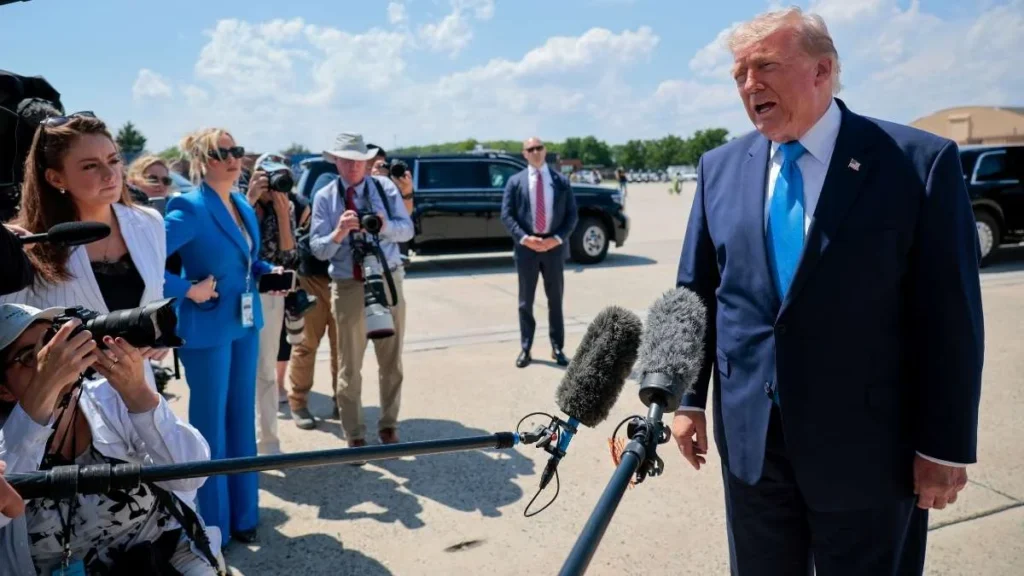

In a notable exchange with members of the press, former President Donald Trump directed pointed remarks at Fox News Senior White House Correspondent Jacqui Heinrich, specifically targeting the voting record of her fiancé, United States Representative Brian Fitzpatrick. The interaction occurred during a media availability session where Trump, known for his direct and often confrontational style with the press corps, transitioned from policy discussion to personal commentary regarding Heinrich’s domestic life. By invoking the political standing of her partner, Trump underscored a recurring theme in his political rhetoric: the prioritization of absolute loyalty among members of the Republican Party and his willingness to use personal associations as leverage in public discourse.
The incident began when Trump, addressing a group of reporters, singled out Heinrich to discuss her relationship with Fitzpatrick, a Republican congressman representing Pennsylvania’s 1st congressional district. Although Heinrich and Fitzpatrick are engaged—a fact Heinrich confirmed via social media platform X (formerly Twitter) in 2023—Trump referred to the congressman as her "husband." During the exchange, Trump expressed frustration over Fitzpatrick’s legislative history, claiming that the representative frequently votes against his preferred policies and interests. "Her husband votes against me all the time. Can you imagine? I don’t know what’s with him. You better ask him what’s with him," Trump stated, according to video footage of the session. He further added a cryptic warning, noting, "He likes voting against Trump. You know what happens with that. It doesn’t work out well."
The Political Context of Brian Fitzpatrick’s Voting Record
To understand the friction between Donald Trump and Representative Brian Fitzpatrick, one must examine the specific political landscape of Pennsylvania’s 1st congressional district. Fitzpatrick, a former FBI agent and federal prosecutor, has built a reputation as one of the most moderate and bipartisan members of the House of Representatives. His district, which encompasses Bucks County and parts of Montgomery County, is a perennial "swing" area that often splits its ticket between Democratic presidential candidates and Republican local representation.
Data from the Lugar Center and Georgetown University’s McCourt School of Public Policy has consistently ranked Fitzpatrick as the most bipartisan member of the House. This non-partisan ranking reflects his tendency to co-sponsor legislation with members of the opposing party and his willingness to break with Republican leadership on high-profile votes. During the Trump administration, Fitzpatrick was among the Republicans who occasionally voted against key initiatives, such as the full repeal of the Affordable Care Act and certain environmental policy rollbacks.
Trump’s assertion that Fitzpatrick "votes against me all the time" highlights the divide between the "Make America Great Again" (MAGA) wing of the GOP and the party’s more moderate, suburban-focused members. For Trump, legislative support is often viewed through the lens of personal allegiance, whereas for Fitzpatrick, his voting record is frequently defended as a necessity for maintaining the support of a politically diverse constituency. The former President’s comment that such opposition "doesn’t work out well" likely refers to the history of Trump-backed primary challenges against Republican incumbents who have defied him, a strategy that has seen mixed results in general elections.
Jacqui Heinrich and the Role of the White House Press Corps
Jacqui Heinrich’s role as a Senior White House Correspondent for Fox News places her at the center of the often-tense relationship between the network and Donald Trump. While Fox News has historically provided a platform for conservative viewpoints, its news division—of which Heinrich is a prominent member—is frequently the target of Trump’s ire when their reporting does not align with his narrative. Heinrich has earned a reputation for asking direct, fact-based questions to officials from both the Biden and Trump administrations, maintaining a professional distance that is standard for high-level political journalism.
The decision by a political figure to "drag" a reporter’s personal life or family members into a professional Q&A session is a tactic that media analysts suggest is intended to delegitimize the journalist’s objectivity or to intimidate them. By mentioning Fitzpatrick, Trump effectively attempted to shift the focus from the questions being asked by the reporter to the perceived political "disloyalty" of her partner. This interaction is part of a broader chronology of Trump’s interactions with female journalists, which has historically included sharp exchanges with figures such as Cecilia Vega, Weijia Jiang, and Kaitlan Collins.
Timeline of Recent Interactions and Public Statements
The relationship between Donald Trump and the press has remained a central fixture of his 2024 campaign activities. The exchange regarding Heinrich and Fitzpatrick is not an isolated event but rather part of a series of interactions where Trump uses personal anecdotes or observations to frame his political arguments.
- 2023: Jacqui Heinrich publicly confirms her engagement to Brian Fitzpatrick, a move that was met with both congratulations and scrutiny from those monitoring the intersection of media and politics.
- Recent Months: Trump has increased his focus on "RINO" (Republicans In Name Only) members of Congress, frequently citing Fitzpatrick as a representative who does not align with the current direction of the party.
- The Connecticut Trip Briefing: During a briefing ahead of a trip to Connecticut, the specific exchange regarding Heinrich’s "husband" occurred, captured by various news outlets and shared widely on social media.
In addition to his critiques, Trump has occasionally utilized humor and personal anecdotes involving his own family to engage crowds. For example, during a Congressional Picnic at the White House (referenced in historical context), Trump joked about the difficulty of following his wife, Melania Trump, on stage after she delivered a speech. "What a great job, I have to follow that? I hate it! I never like following our great First Lady, because it makes me look not so good," he remarked. This juxtaposition of lighthearted self-deprecation regarding his wife and sharp, targeted critiques of reporters’ family members illustrates the dual nature of Trump’s public persona: the entertainer and the political combatant.
Implications for Bipartisanship and Journalistic Integrity
The implications of Trump’s remarks extend beyond a simple "jab" at a reporter. First, it raises questions about the future of bipartisanship within the Republican Party. If moderate members like Fitzpatrick are publicly targeted for their voting records, it may signal a further narrowing of the "big tent" philosophy that once defined the GOP. For Fitzpatrick, the "Trump factor" is a delicate balancing act; he must satisfy a moderate home district while navigating the demands of a party leader who demands strict adherence to a specific legislative agenda.
Second, the incident highlights the ongoing challenges faced by journalists in maintaining a separation between their private lives and their professional duties. In the modern era of social media and 24-hour news, the personal lives of reporters are more accessible than ever. When a public official uses that information to undermine a reporter’s work, it creates a precedent that many in the industry find concerning. Professional organizations, such as the White House Correspondents’ Association (WHCA), have historically defended journalists against such personal attacks, emphasizing that a reporter’s family or relationships should not be used as a shield against legitimate inquiry.
Analysis of the "Trumpian" Rhetorical Strategy
Trump’s rhetoric often follows a predictable pattern: identify a perceived adversary, find a personal or professional vulnerability, and amplify it through public repetition. By framing Fitzpatrick’s votes as a personal affront ("He likes voting against Trump"), the former President shifts the debate from the merits of the legislation to a question of personal character and loyalty.
Furthermore, the mention of Melania Trump’s projects, such as her appearances and reports of her film or book rankings, serves as a counter-narrative of success and internal loyalty. Trump has frequently praised his wife’s achievements, including claims that her media appearances or related projects have reached "number 1" on platforms like Amazon Prime Video. This creates a dichotomy in his public messaging: he champions those within his inner circle while aggressively challenging those he perceives as outsiders or detractors, even if they are members of his own party or the press.
Official Responses and Public Reaction
While Representative Fitzpatrick’s office typically avoids engaging in public spats with the former President, his supporters often point to his electoral success in a difficult district as evidence that his moderate approach is the correct one for his constituents. Fitzpatrick has consistently outperformed the top of the Republican ticket in his district, suggesting that his "votes against Trump" may actually be a political asset in the Philadelphia suburbs.
For her part, Jacqui Heinrich has remained professional, continuing her coverage of the White House and the 2024 election cycle without allowing the personal comments to distract from her reporting. This adherence to journalistic standards is often the primary defense against political taunts.
As the 2024 election approaches, the tension between the Trump campaign and the media is expected to intensify. The incident involving Heinrich and Fitzpatrick serves as a precursor to the types of personal and political conflicts that are likely to characterize the upcoming political cycle. It underscores a fundamental shift in American politics where the personal and the political are inextricably linked, and where the voting record of a spouse or fiancé can become fodder for a presidential candidate’s public grievance.
Conclusion
The exchange between Donald Trump and Jacqui Heinrich is a microcosm of the current state of American political discourse. It involves a mix of personal commentary, demands for party loyalty, and the complex relationship between the executive branch and the free press. As Brian Fitzpatrick continues to navigate his role as a moderate legislator and Heinrich continues her role as a high-profile journalist, the shadow of Trump’s "loyalty tests" remains a significant factor in their professional environments. Whether these tactics will influence the legislative behavior of moderate Republicans or the reporting styles of White House correspondents remains to be seen, but the precedent of bringing a reporter’s family into the political arena is now firmly established in the current era of political campaigning.