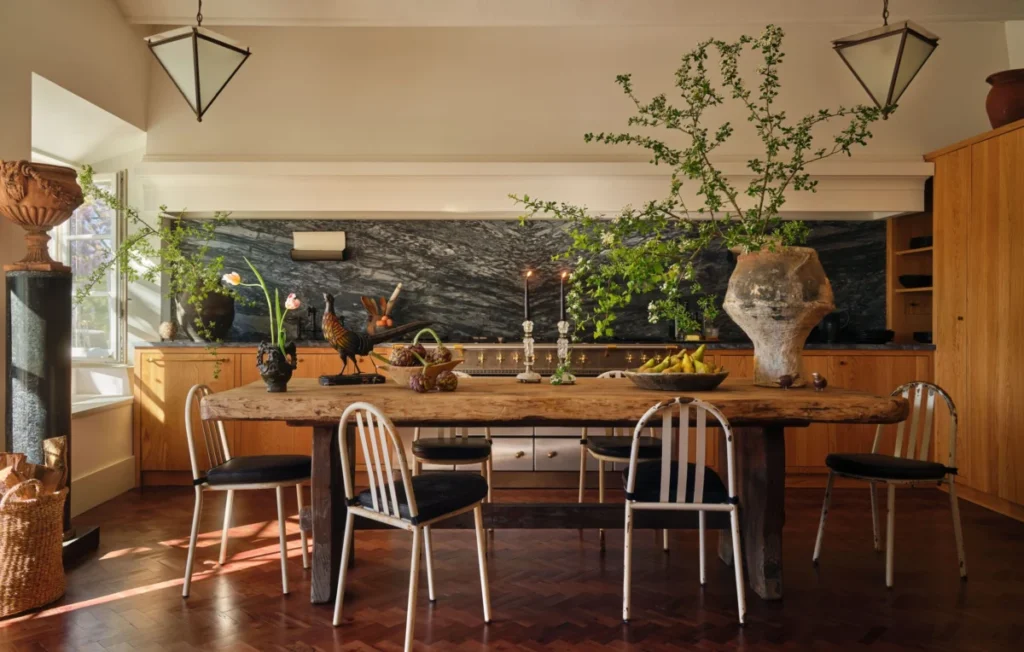

The visual landscape of high-end interior design is undergoing a tectonic shift, moving away from the clinical precision of mid-century modernism toward a more grounded, organic aesthetic. In recent months, a singular object has emerged as the definitive hallmark of this movement: the oversized clay vessel. From the sun-drenched coasts of Laguna Beach to the rustic farmhouses of rural Portugal, these towering earthen structures are no longer merely functional containers but are being utilized as architectural anchors that provide height, material depth, and a sense of historical permanence to modern living spaces.
This resurgence of interest in large-scale pottery reflects a broader cultural pivot toward "intentional imperfection." As digital environments become increasingly polished and artificial intelligence generates flawlessly symmetrical imagery, homeowners and designers are seeking out the "human touch"—objects that bear the marks of the kiln, the passage of time, and the idiosyncrasies of the artisan’s hand.
The Influence of the Architectural Digest "Cover Effect"
The prominence of large-scale ceramics has been catalyzed by a series of high-profile home tours featured in Architectural Digest. Most notably, the June issue featured the Portuguese farmhouse of renowned designers Nate Berkus and Jeremiah Brent. Located in the Alentejo region, a territory famous for its ancient pottery traditions, the home serves as a masterclass in the use of clay as a decorative medium.

In the Berkus-Brent residence, the integration of pottery is exhaustive. Aged terra-cotta pots flank the entryway, while a towering ribbed ceramic piece in olive green defines a hallway. An enormous vessel, discovered on the property itself, serves as a focal point in the entry hall, effectively bridging the gap between the home’s interior and its agricultural surroundings. This use of "found" objects suggests a design philosophy where the house is not merely decorated but is allowed to evolve from its own site-specific history.
Other celebrities and designers have followed suit. Actress Cobie Smulders utilizes a massive terra-cotta urn to punctuate an expansive oak dining table in her Canadian retreat. In a Laguna Beach kitchen designed by Studio Gutow, a pitted limestone vessel provides a rugged contrast to smooth marble surfaces. Similarly, a Maine kitchen renovation by Gregory Rockwell Interiors features a Provençal confit pot—historically used for preserving meats—as a centerpiece, signaling a shift toward utilitarian antiques as high-art decor.
The Philosophy of "Lived-In" Luxury
The appeal of these vessels lies in their ability to convey a narrative. According to Amy Kehoe, cofounder of the Los Angeles-based design firm and retail brand Nickey Kehoe, a found vessel possesses a "life" that new, mass-produced items lack. "When we’re sourcing, we’re always asking, ‘Does this piece add a layer of meaning, or just fill a shelf?’" Kehoe explains. The irregularity—the off-kilter silhouette, the patchy glaze, and the weathered patina—is precisely what makes the piece valuable in a modern context.
Todd Nickey, Kehoe’s partner, observes that the market has matured to the point where clients no longer need to be persuaded of the value of "ugly" or "imperfect" objects. In an era of "optimized" interiors, imperfection has become a form of proof—a verification that the space is inhabited by humans rather than curated by an algorithm. This sentiment is echoed by Baylor Pillow of Beep Design Co., who argues that contemporary eyes are over-saturated with "clean and pristine" environments. For Pillow, the historical context of a client’s choice—the "which old things and why"—is more important than the aesthetic perfection of the object itself.

Historical and Regional Context of Large-Scale Ceramics
To understand the current trend, one must look at the historical utility of these vessels. Large clay pots, or pithoi in ancient Greece and doli in Rome, were the primary storage units of antiquity. They held the essentials of civilization: grain, wine, and olive oil.
- The Alentejo Tradition (Portugal): The pottery found in the Berkus-Brent home is rooted in a tradition that dates back to the Roman occupation of the Iberian Peninsula. The clay in this region is known for its durability and its deep, earthy red hue. Traditionally, these pots were used to ferment wine (talha wine), a process that is currently seeing a revival in the viticulture world.
- French Confit Pots: Mentioned in the context of Maine interiors, these glazed earthenware pots were staples in 19th-century French kitchens. The bottom half was often left unglazed because it was buried in the cool ground of a cellar to keep preserved duck or goose (confit) at a stable temperature. Today, the distinct "tide mark" of the glaze is a sought-after aesthetic feature.
- Chinese Provencial Ceramics: Used in Hudson Valley farmhouses to ground modern decor, these pieces often include "ginger jars" or large water storage vats from the Shanxi or Martaban regions. Their dark, often metallic glazes provide a heavy, grounding visual weight that contrasts with light-filled, airy modern rooms.
Sourcing and Market Dynamics
The surge in demand for large-scale pottery has impacted the secondary market and the retail sector alike. While high-end designers often source unique pieces from European flea markets or specialized antiquarians, the accessibility of this look has expanded through digital platforms.
- Secondary Markets: Designers like Baylor Pillow recommend Etsy and eBay as entry points for new collectors. These platforms allow homeowners to find pieces with "previous owners and a few imperfections" at a lower price point than curated showrooms.
- The Flea Market Approach: Todd Nickey and Amy Kehoe advocate for "wandering without an agenda" at flea markets. They suggest that the most impactful pieces are often those found when not looking for something specific, emphasizing the serendipitous nature of "evolved" design.
- Retail Integration: Recognizing the trend, major retailers have moved to bridge the gap between antique one-offs and mass-market availability. Crate & Barrel, for instance, collaborated with Jeremiah Brent to produce the "Museion" collection, which features large-scale earthenware vases designed to mimic the texture and "energy" of ancient limestone.
Data and Trends in the Home Decor Industry
The "Enormous Clay Pot" trend is supported by broader economic data within the home goods sector. According to market research, the global pottery and ceramics market is projected to grow significantly through 2030, driven in part by a 15% year-over-year increase in consumer interest in "artisanal" and "handcrafted" home accents.
Search data from interior design platforms indicates a 40% increase in queries for "oversized floor vases" and "antique terracotta" over the last 24 months. Furthermore, the "vintage" segment of the home decor market is outperforming new furniture sales in several demographics, as sustainability-minded consumers opt for durable, pre-owned items over "fast furniture."

Design Implications and Styling Strategies
The integration of a massive clay pot into a home requires a nuanced understanding of scale and contrast. Stylists and designers offer several key strategies for utilizing these pieces effectively:
- Architectural Anchoring: A tall vessel can be used to "lower" a high ceiling or provide a vertical element in a room dominated by low-slung furniture. In the Berkus-Brent home, the use of pots to flank an entryway creates a sense of ceremony and transition.
- Material Contrast: The "monologue" of a room is often broken by the introduction of a contrasting texture. Placing a rough, chalky, weathered vase on a sleek, polished marble table—as seen in the Berkus-Brent kitchen—creates a visual tension that makes both materials appear more vivid.
- The Power of Branches: Large vessels are frequently styled not with delicate floral arrangements, but with "enormous branches" cut from local trees. This brings a literal element of the outdoors inside, reinforcing the biophilic design trend that emphasizes a connection to nature.
- Patience as a Design Tool: Stylist Colin King famously noted that "you don’t need a designer, you need a decade." This philosophy suggests that the best interiors are those that are not finished all at once. Nickey and Kehoe recently left a rotunda in a Los Angeles project empty for months until they found a specific 25-inch tall, early-20th-century sand-blasted glass vessel.
Conclusion: Authenticity in the Digital Age
The "enormous clay pot" is more than a passing fad; it is a symptom of a cultural desire for permanence and authenticity. In a world of fleeting digital trends and disposable goods, a 50-pound vessel of fired earth represents something unshakeable. It is an object that has "lived a life," as Amy Kehoe puts it, and its presence in a home serves as a reminder of the physical, the historical, and the human.
As interiors continue to move toward the "collected" look, the demand for these vessels is likely to persist. Whether sourced from a muddy field in Portugal, a French flea market, or a curated modern collection, the large clay pot has reclaimed its place as the foundational element of the hearth and home. It proves that sometimes, the most forward-thinking design choice is to look thousands of years into the past.