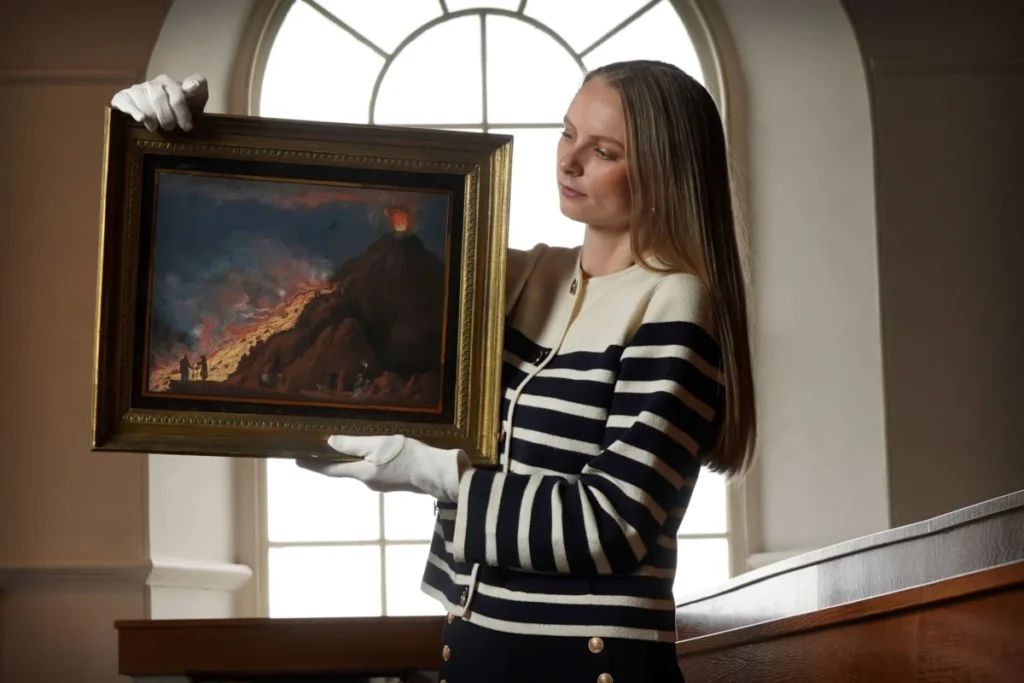

An intensely dramatic 1774 depiction of Mount Vesuvius in eruption, captured by the esteemed landscape artist Jakob Philipp Hackert, who reportedly witnessed the cataclysmic event firsthand, has achieved a remarkable sale price of £25,400, including buyer’s premium, at a recent auction in Edinburgh. The artwork, a testament to nature’s raw power and human courage in the face of disaster, went under the hammer at Lyon & Turnbull’s "Five Centuries" sale on Wednesday, drawing significant interest from international collectors eager to acquire a piece of art history imbued with such profound narrative.
The German-born artist, a pivotal figure in 18th-century European landscape painting, is said to have confronted the terrifying spectacle of the erupting Italian volcano directly. This assertion is documented in a biography penned by Hackert’s close friend and literary giant, Johann Wolfgang von Goethe. According to Goethe’s account, Hackert, demonstrating remarkable artistic resolve and bravery, embarked on a series of live sketches and meticulous studies during the very throes of the eruption. These invaluable on-the-spot observations formed the foundational reference material for the vivid and powerful paintings of Vesuvius he would later create upon his return to Rome, where he had established his residence in 1768. The sale not only underscores the enduring appeal of Hackert’s work but also highlights the timeless fascination with one of the world’s most iconic and dangerous volcanoes.
The Artist: Jakob Philipp Hackert’s Life and Legacy
Jakob Philipp Hackert (1737-1807) emerged as one of the most influential landscape painters of his era, bridging the gap between Rococo sensibilities and the nascent Romantic movement. Born in Prenzlau, Brandenburg, he received his initial artistic training from his father, Philipp Hackert, and later at the Berlin Academy of Arts. His early career saw him travel extensively, absorbing diverse influences across Europe. By 1768, he had settled in Rome, a city that would become the epicenter of his artistic output and a hub for Grand Tour travellers seeking both classical antiquity and natural wonders.
Hackert quickly gained prominence for his meticulously detailed and atmospherically rich landscapes, often featuring classical ruins, picturesque Italian vistas, and dramatic natural phenomena. His work was highly sought after by European aristocracy and wealthy travellers embarking on the Grand Tour. He distinguished himself through his commitment to verisimilitude, often undertaking extensive studies directly from nature, a practice that set him apart from many of his contemporaries. This dedication to accurate representation, combined with a profound understanding of light and composition, allowed him to imbue his scenes with both grandeur and a sense of tangible reality.
His close friendship with Johann Wolfgang von Goethe, the celebrated German poet, playwright, and statesman, proved particularly significant for posterity. Goethe, who harboured a deep appreciation for Hackert’s art and scientific curiosity, dedicated a comprehensive biography to the painter, "Philipp Hackert. Biographische Skizze" (1811). This invaluable text provides not only a detailed account of Hackert’s life and artistic philosophy but also firsthand anecdotes, including the crucial detail of Hackert’s direct observation of the 1774 Vesuvius eruption. Goethe’s biography cemented Hackert’s reputation and offered crucial insights into his working methods, particularly his commitment to sketching directly from nature, even in hazardous conditions. Hackert’s influence extended across generations of landscape artists, shaping the conventions of the genre and contributing significantly to the Romantic appreciation of the sublime in nature.
A Glimpse into the Inferno: The 1774 Vesuvius Painting
The specific painting auctioned, a 1774 depiction of Mount Vesuvius erupting, stands out for its "dramatic immediacy," as noted by Romey Clark, Associate Fine Art Specialist with Lyon & Turnbull. Clark’s insightful analysis highlights how Hackert masterfully captures the raw energy and destructive beauty of the volcanic event. The canvas explodes with activity: "Flames and molten lava burst violently from the crater while thick clouds of smoke billow upward into the night sky," creating a visceral sense of the volcano’s terrifying power.
What makes Hackert’s rendition particularly compelling is his compositional choice. Rather than presenting a distant, traditional panoramic view, Hackert positions the viewer unnervingly close to the action. This deliberate decision provides a "more concentrated and immersive vision of the eruption itself," drawing the observer into the heart of the cataclysm. This innovative perspective allows for the inclusion of small figures in the foreground – most likely Grand Tour travellers, accompanied by local guides – who are shown observing the fiery spectacle from the precarious slopes of the volcano. Their presence not only adds a human element to the scene but also serves to emphasize the scale and danger of the eruption, as well as the prevailing fascination with such natural wonders during the 18th century.
The painting’s success at auction, exceeding its pre-sale estimate of between £20,000 and £30,000, reflects its artistic merit, historical significance, and compelling narrative. The final hammer price of £25,400, inclusive of the buyer’s premium, underscores the strong demand for works that combine exceptional artistry with documented historical context.
Mount Vesuvius: A Timeless Source of Fascination and Fear
Mount Vesuvius, located near the Bay of Naples in Italy, is one of the world’s most famous and historically significant volcanoes. Its destructive power was dramatically demonstrated in 79 AD with the catastrophic eruption that buried the Roman cities of Pompeii and Herculaneum under layers of ash and pumice, preserving them for millennia. This ancient tragedy cemented Vesuvius’s reputation as a symbol of nature’s formidable and unpredictable force.

Throughout history, Vesuvius has experienced numerous eruptions, though none matched the scale of the 79 AD event until the devastating eruption of 1631, which claimed thousands of lives and significantly altered the landscape. By the 18th century, Vesuvius had entered a period of heightened activity, becoming a regular, albeit dangerous, spectacle. The eruption of 1774, which Hackert witnessed, was one in a series of smaller but still dramatic effusive and explosive events that characterized this period. These eruptions, while not always leading to widespread destruction, consistently reminded the inhabitants of Naples and the surrounding region of the volcano’s ever-present threat.
For artists, scientists, and travellers of the 18th century, Vesuvius represented a unique confluence of the sublime, the terrifying, and the scientifically intriguing. It was a living laboratory for nascent vulcanology and a muse for painters and poets seeking to capture the awe-inspiring power of the natural world. The 1774 eruption, though perhaps not as historically devastating as others, was significant enough to draw Hackert’s intrepid gaze and inspire a series of powerful artistic interpretations that continue to resonate today. The frequent activity of Vesuvius during this period made it an irresistible magnet for those on the Grand Tour, offering a thrilling and often perilous encounter with the raw forces of creation and destruction.
The Grand Tour and the Allure of the Sublime
The 1774 eruption occurred at the zenith of the Grand Tour’s popularity, a defining cultural phenomenon of 18th-century Europe. The Grand Tour was an extended journey through Europe, primarily undertaken by wealthy young British and, to a lesser extent, European aristocrats and gentry. Its primary purpose was to complete their education, broaden their cultural horizons, and acquire a veneer of sophistication by immersing themselves in classical antiquity, Renaissance art, and contemporary European court life.
Typical itineraries often included France (Paris), Italy (Rome, Florence, Venice, Naples), and sometimes Germany or Switzerland. Italy, with its unparalleled wealth of classical ruins, ancient history, and artistic masterpieces, was an indispensable part of the journey. For many, the highlight of their Italian sojourn was a visit to Naples and, crucially, an ascent of Mount Vesuvius.
The volcano held a particular allure, embodying the aesthetic concept of the "sublime" – a feeling of awe mixed with terror, generated by encountering something vast, powerful, and overwhelming, beyond human comprehension. Vesuvius offered a tangible, living example of this philosophical ideal. Travellers, often accompanied by local guides, would ascend its slopes, sometimes even venturing close to the crater to witness lava flows or minor eruptions, viewing it as a thrilling and essential experience.
The Grand Tour was also a period of intense souvenir collection. Travellers acquired everything from classical sculptures and paintings to architectural drawings and natural specimens. Views of Mount Vesuvius, whether in the form of paintings, prints, or even geological samples, were particularly popular mementos. These artworks served not only as reminders of their daring adventures but also as status symbols, demonstrating their cultured tastes and their direct encounter with one of Europe’s most iconic natural wonders. Hackert’s ability to capture the drama of Vesuvius made his paintings highly desirable among this affluent and adventurous clientele, many of whom were depicted observing the very spectacle he painted.
Auction Insights and Broader Implications
The sale of Hackert’s Vesuvius painting at Lyon & Turnbull’s "Five Centuries" sale highlights several key trends within the art market. The "Five Centuries" sale itself is a broad-ranging event, showcasing European works from the 16th to the 20th century, and the inclusion of Hackert’s piece underscores its significance within this historical panorama. The successful sale to an "international collector," as noted by Romey Clark, confirms the global appeal of important European art, especially works with strong historical provenance and compelling narratives.
Clark’s statement, "We are delighted such a fascinating, historical work has found a new home with an international collector," reflects the satisfaction of the auction house in placing a significant piece with a discerning buyer. The price achieved, while within the estimated range, demonstrates a robust market for 18th-century landscape painting, particularly by artists of Hackert’s calibre and those connected to pivotal historical and cultural movements like the Grand Tour. Factors contributing to the painting’s value include its excellent condition, its documented history (provenance), the artist’s esteemed reputation, and the enduring power of its subject matter.
The acquisition of such a painting by an international collector also has broader implications. It means that works of significant cultural and historical value continue to circulate globally, enriching private collections and potentially becoming accessible to a wider public through future exhibitions or institutional acquisitions. It reaffirms the painting’s role not just as a decorative object but as a historical document, offering a unique window into the natural world and human experience of the late 18th century.
Furthermore, Hackert’s Vesuvius paintings are more than mere artistic renditions; they are historical records. They provide invaluable insights into the appearance and activity of Vesuvius during a specific period, complementing scientific and textual accounts. For art historians, they illustrate the evolution of landscape painting and the representation of the sublime. For cultural historians, they encapsulate the spirit of the Grand Tour, the romantic fascination with nature, and the burgeoning scientific curiosity of the Enlightenment era. The sale therefore is not just about the transaction of an artwork, but the perpetuation of a rich cultural legacy, ensuring that the dramatic vision of Jakob Philipp Hackert and the fiery spectacle of Vesuvius continue to inspire and inform for centuries to come.