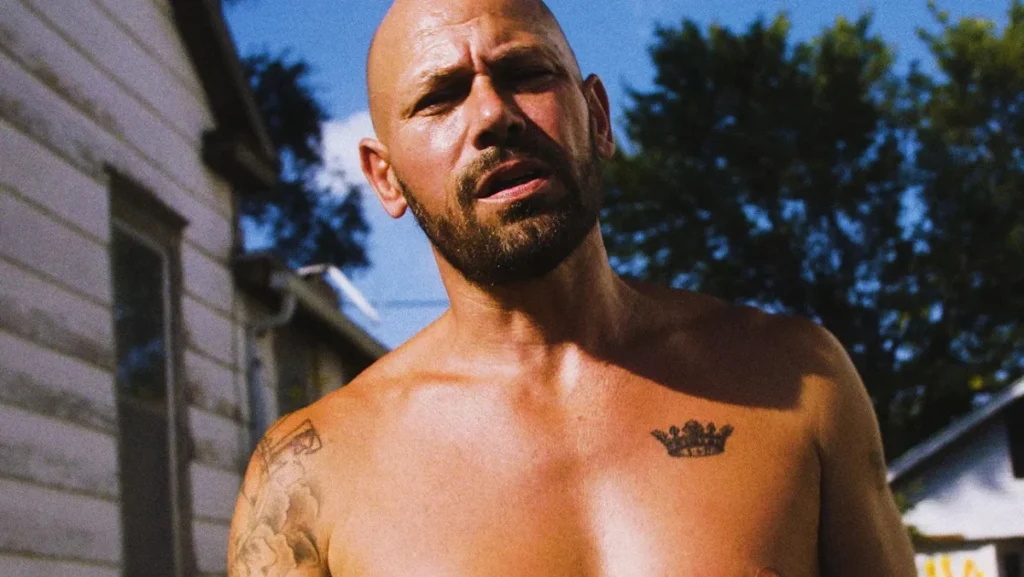

The 83rd Venice International Film Festival served as the global stage for the premiere of Robert Greene’s latest boundary-pushing documentary hybrid, Too Much Sugar. Debuting within the festival’s prestigious Orizzonti section—a competitive strand dedicated to films representing aesthetic and expressive trends in international cinema—the feature immediately drew critical attention for its unique structural premise. Rather than adhering to conventional non-fiction storytelling, Greene’s project examines the mechanics of generational healing through collaborative filmmaking, placing working-class subjects at the center of an artistic and therapeutic experiment.
The film centers on Ryan Holliger, a rural Missouri-based carpenter, fighter, and father of six children by five different partners, alongside his close friend and fellow father, known as AccRite. Driven by a shared desire to break cycles of generational trauma and distance themselves from the legacies of their own absent fathers, Holliger and AccRite embark on an ambitious undertaking. With Greene’s documentary crew documenting the process, the two men attempt to write, produce, and star in an eccentric, zany comedy alongside their respective families. This meta-narrative framework forms the backbone of Too Much Sugar, exploring whether the active creation of art can serve as a catalyst for personal accountability and familial reconciliation.
The Evolution of Robert Greene’s Collaborative Non-Fiction
To understand the methodological weight of Too Much Sugar, one must examine Robert Greene’s extensive filmography within the documentary genre. Over the past decade, Greene has carved out a distinct niche by blurring the lines between pure documentation and staged performance. His notable previous works include Actress (2014), which chronicled the personal life of Brandy Burfield; Kate Plays Christine (2016), an investigation into the psychological toll of a real-life tragedy on an actress; Bisbee ’17 (2018), a community-wide re-enactment of a 1917 labor deportation in Arizona; and Procession (2021), which followed six men who survived childhood sexual abuse by Catholic clergy as they processed their trauma by making short dramatic films about their experiences.
Procession, in particular, established a clear thematic precursor to Too Much Sugar. In that critically acclaimed feature, Greene demonstrated how narrative framing and artistic expression could function as actionable therapeutic tools for trauma survivors. Too Much Sugar applies this philosophy to a different demographic: rural American fathers grappling with toxic masculinity, socioeconomic pressures, and the psychological burdens of domestic responsibility. By collaborating directly with Holliger rather than merely observing him, Greene continues his ongoing cinematic inquiry into the ethics of representation and the transformative potential of participatory media.
Chronology and Production Background
The genesis of Too Much Sugar traces back to several years of development in rural Missouri, where Greene and his production team sought to test the viability of "therapeutic documentary cinema" on a micro-community level. The production schedule required a delicate balance between traditional documentary observation and active creative intervention.
Initial phases of the project involved Greene establishing a collaborative framework with Holliger, allowing the Missouri carpenter to dictate the terms of his on-screen narrative. Holliger’s primary objective was explicit: to produce a comedy that would demonstrate his commitment to his children and his capacity for personal growth. Throughout principal photography, the documentary captures the logistical and emotional friction of this undertaking. The production timeline charts the transition from initial concept meetings to the chaotic reality of shooting a low-budget comedy with a large, energetic cast of children, whose intelligence and resilience emerge as stabilizing forces within the narrative.
Critical Reception and Festival Context

Screened against the backdrop of the historic Lido during the Venice Film Festival, Too Much Sugar generated robust debate among international critics. While some industry commentators noted the film’s rough edges—attributable to the unpolished nature of non-professional actors and the inherent unpredictability of community-based filmmaking—others praised its raw authenticity and thematic ambition.
Critics frequently drew thematic parallels between Greene’s work and other contemporary cinematic explorations of art as rehabilitation, most notably Greg Kwedar’s prison drama Sing Sing. Much like the inmates in Kwedar’s film who find self-reflection through theatrical performance, Holliger and AccRite utilize the cinematic medium to confront their behavioral patterns. However, reviewers emphasized that Greene avoids neat, Hollywood-style resolutions. Instead, Too Much Sugar portrays personal growth as an arduous, ongoing negotiation marked by daily setbacks rather than sudden epiphanies.
Broader Socio-Economic Implications and Americana Representation
Beyond its structural innovation, Too Much Sugar offers a nuanced examination of contemporary American life outside major metropolitan centers. The film captures the economic vulnerabilities and social isolation often experienced by working-class families in rural regions. By focusing on the realities of co-parenting, financial instability, and the emotional toll of domestic labor, Greene avoids condescension or caricature.
Sociological and media analysts have increasingly pointed to the importance of authentic working-class representation in media. Projects like Too Much Sugar challenge urban-centric perspectives by humanizing individuals navigating complex familial structures. The documentary highlights the hidden emotional labor required to maintain family stability under conditions of economic stress, positioning the camera not merely as an instrument of surveillance, but as a mirror for self-evaluation.
Implications for Community-Based Media Initiatives
As documentary cinema continues to evolve in the digital age, the methodology showcased in Too Much Sugar may serve as a blueprint for future community arts programs. By demonstrating that filmmaking can act as an accessible medium for emotional literacy, Greene’s work suggests broader applications for media education in non-traditional settings.
Industry observers note that hybrid documentaries challenging the boundary between subject and filmmaker are gaining traction across major international festivals. The commercial and critical trajectory of Too Much Sugar following its Venice debut will likely influence how upcoming non-fiction filmmakers approach participatory storytelling, ethics in documentary production, and the intersection of art and mental health advocacy.
Ultimately, Greene’s latest project stands as a testament to the persistent belief that storytelling holds measurable utility. While questions surrounding the tangible impact of cinema on human behavior remain central to film criticism, Too Much Sugar posits that the act of creation itself—however messy or incomplete—remains a vital step toward breaking generational cycles and fostering empathy within local communities.