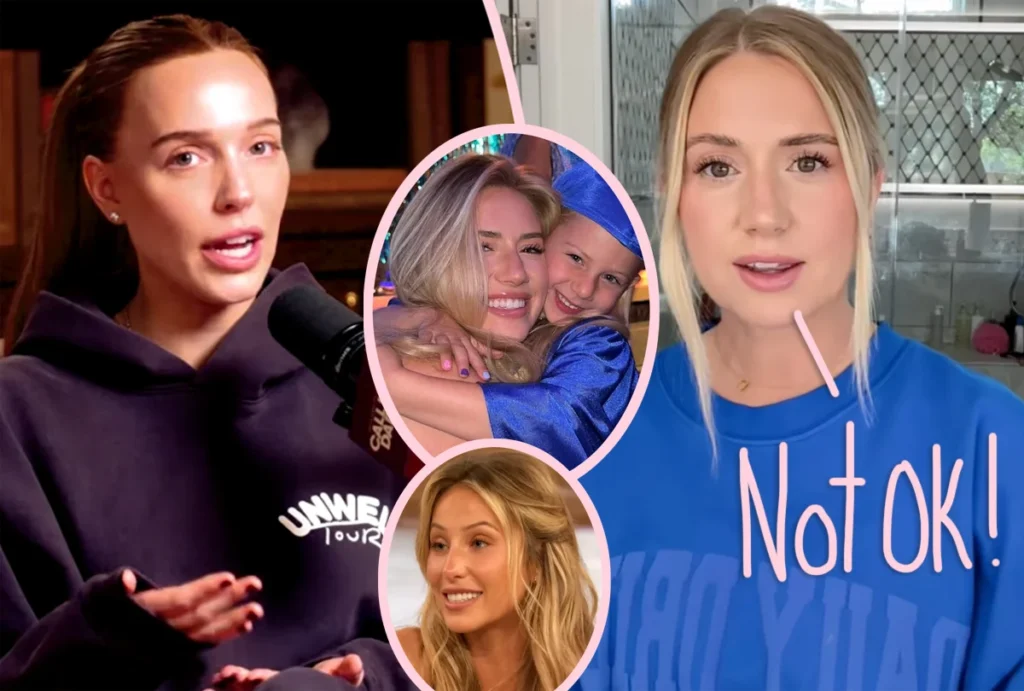

Former Bachelor contestant Lauren Luyendyk has publicly declared her unequivocal support for influencer Alix Earle in her ongoing dispute with podcast host Alex Cooper, citing deeply personal reasons stemming from Cooper’s past remarks about Luyendyk’s daughter, Alessi. This intervention by Luyendyk introduces a new dimension to a year-long, high-profile feud between Earle and Cooper, bringing to light allegations of highly inappropriate and sexualized comments made by Cooper regarding Luyendyk’s then-infant child on the popular podcast Call Her Daddy. The resurfacing of these comments has ignited a broader discussion on the ethical responsibilities of media personalities and the impact of digital content on individuals, particularly minors.
The Genesis of the Earle-Cooper Feud
The animosity between Alix Earle, a rapidly ascendant social media influencer, and Alex Cooper, the host of the hugely successful Call Her Daddy podcast, has been a subject of considerable public speculation for over a year. The conflict reportedly intensified after the dissolution of Earle’s Hot Mess podcast’s affiliation with Cooper’s Unwell Network. While neither party has offered a comprehensive public account of the events leading to their estrangement, both Earle and Cooper have made statements and taken actions that publicly confirm their mutual dislike. This ongoing tension has fueled fan theories and reports attempting to piece together the narrative, solidifying their positions as rivals within the digital media landscape. The public nature of their disagreement has led to significant engagement from their respective fan bases, with many choosing sides based on partial information and perceived grievances. The entry of a third party, particularly one with a documented history of grievances against Cooper, significantly escalates the stakes and potential fallout.
Lauren Luyendyk’s Public Declaration
On Thursday, [Date of Instagram post, if available from original source. Assuming recent based on "Thursday"], Lauren Luyendyk, known for her appearance on The Bachelor season 22, took to Instagram Stories to unequivocally endorse Alix Earle. Her statement was direct and pointed: "Team @alixearle all the way. It’s about time Alex Cooper gets called out. & yes, it’s personal." This initial declaration immediately hinted at a deeper, personal connection to the ongoing dispute, promising more than just a casual alignment with one side of an influencer spat. The following day, Luyendyk elaborated further, using TikTok as her platform to "clear the air" and provide the long-awaited context for her animosity towards Alex Cooper. Her TikTok video, which quickly garnered widespread attention, detailed a distressing period during which Cooper and her then-co-host, Sofia Franklyn, allegedly made repeated and "inappropriate" comments about Luyendyk’s daughter, Alessi, who is now six years old.
Historical Allegations: Comments on Alessi Luyendyk
Luyendyk recounted that the offensive remarks originated from a recurring segment on the Call Her Daddy podcast. According to Luyendyk, this segment, which began before Alessi’s birth and continued thereafter, involved the hosts "sexualizing" and discussing her child in a "very inappropriately and disgustingly" manner. She emphasized that while criticism directed at her and her husband, Arie Luyendyk Jr., was unwelcome but tolerable, the focus on their unborn and then infant daughter crossed an unacceptable line.
The severity of these alleged comments prompted Lauren and Arie Luyendyk to seriously consider legal action against Alex Cooper, Sofia Franklyn, and Barstool Sports, the platform that hosted Call Her Daddy at the time. However, after careful consideration, the couple ultimately decided against pursuing a lawsuit. Luyendyk explained their rationale, stating, "We decided to let it rest. We thought it would blow over. She just kept going on forever. Eventually, she stopped, and we kind of forgot about it." This decision, driven by a desire to avoid further public attention on their child and to hope the issue would dissipate, allowed the comments to recede from immediate public memory, at least for a time. Luyendyk’s recent statements indicate that the dormant anger over these past events has been re-ignited by the current controversy surrounding Alex Cooper. "Now that it’s resurfacing again, it still makes me so furious," Luyendyk stated, expressing hope that the renewed scrutiny on Cooper would prompt her to "rethink the level that she is willing to stoop to to get attention, views, whatever it is that she’s looking for because it’s not okay."
The Disturbing Content of Resurfaced Clips
Following Luyendyk’s public statements, specific audio and video clips from Call Her Daddy episodes dating back to 2019 began to recirculate on social media platforms, providing explicit examples of the comments Luyendyk referenced. These clips reveal a disturbing pattern of remarks directed at Alessi Luyendyk, who was merely a few months old at the time.
In September 2019, Alex Cooper allegedly referred to the then four-month-old Alessi as "Aless-ho" after being blocked on Instagram by Lauren Luyendyk. This came after Cooper reportedly stated that the child was "fresh off of a dk appointment." Despite acknowledging the impropriety of calling an infant a "ho," Cooper and Franklyn reportedly continued with offensive commentary. One particularly egregious segment featured Sofia Franklyn making highly sexualized and drug-related predictions about Alessi’s future, stating, "So your baby is going to have a fking gambling problem and be a crazy horse watching some girls strip and get py juice all over her and be drinking vodka sodas and doing lines of fking coke in the bathroom." Alex Cooper reportedly joined in, adding, "Baby Alessi’s like, ‘Mom, that tastes a little bit different than milk.’ Yeah, that’s cm. That’s that’s strippers c*m on your forehead."
Further incidents from December 2019 show Cooper continuing this line of commentary, describing "Baby Alessi" as "a little on the brink of prostitution lately" and claiming "she’s been doing casting couches." The co-hosts also criticized Lauren and Arie for creating an Instagram account for their daughter, accusing them of "child abusing" her. These comments, explicitly sexual and derogatory, have been met with widespread condemnation upon their resurfacing, highlighting a significant ethical lapse in content creation.
Background: The Rise and Controversies of Call Her Daddy
Call Her Daddy launched in 2018 under Barstool Sports, quickly gaining notoriety for its unfiltered discussions on sex, relationships, and pop culture. Hosted by Alex Cooper and Sofia Franklyn, the podcast’s raw and often provocative style resonated with a young audience, propelling it to the top of podcast charts. However, its success was frequently accompanied by controversy, particularly concerning its explicit content and the hosts’ willingness to push boundaries.
The podcast underwent a dramatic public split between Cooper and Franklyn in 2020, widely known as the "Daddy Gang War." This highly publicized dispute involved contract negotiations with Barstool Sports and ultimately led to Franklyn’s departure and Cooper continuing as the sole host. Cooper later signed an exclusive deal with Spotify, reportedly worth over $60 million, solidifying her status as a major player in the podcasting industry. This transition saw the podcast evolve, with Cooper interviewing celebrities and expanding its scope, while largely maintaining its candid approach.
The resurfacing of the Alessi Luyendyk comments predates the Spotify deal and stems from the podcast’s earlier, more controversial iteration under Barstool Sports. This context is crucial, as it reflects a period when the hosts were establishing their brand through shock value and boundary-pushing content, without necessarily foreseeing the long-term repercussions of such remarks, particularly those directed at a minor.
Ethical Implications and Public Accountability in Digital Media
The detailed allegations and the subsequent re-emergence of the offensive clips underscore critical ethical questions within the rapidly evolving landscape of digital media and podcasting. The line between edgy, provocative content and harmful, defamatory speech is often debated, but comments targeting an infant with sexualized and derogatory language unequivocally cross into the realm of professional misconduct and potential legal liability.
For public figures and media personalities, the responsibility to exercise discretion and judgment is paramount. While Call Her Daddy‘s brand was built on its "unfiltered" nature, the specific content regarding Alessi Luyendyk raises concerns about the potential for platforms to enable or normalize harmful rhetoric, especially when directed at vulnerable individuals. The delay in Lauren Luyendyk’s public address of the issue highlights a common dilemma faced by victims of online harassment: whether to engage directly, risking further exposure, or to hope the issue fades. Her decision to speak out now, years later, demonstrates the enduring impact of such comments and the power of social media to grant a platform for accountability, even belatedly.
The current climate, where past content can be easily unearthed and disseminated, places a greater onus on content creators to consider the long-term implications of their words. What might have been dismissed as "edgy humor" in 2019 is now being re-evaluated through the lens of heightened awareness regarding online harassment, cyberbullying, and the protection of children in the digital sphere. The public’s reaction to the resurfaced clips, largely characterized by outrage and disgust, signals a low tolerance for such content, irrespective of the passage of time or the host’s current professional standing.
Broader Impact and Future Outlook
Lauren Luyendyk’s intervention and the subsequent re-exposure of Alex Cooper’s past comments are likely to have significant implications for all parties involved. For Alex Cooper, who has largely cultivated a more polished public image since her Spotify deal, these resurfaced remarks pose a substantial challenge to her reputation and brand integrity. While she has not yet issued a public response to Luyendyk’s video or the circulating clips, the pressure for her to address the allegations directly is mounting. A failure to do so could be perceived as an admission of guilt or a disregard for the harm caused, potentially alienating parts of her audience and professional partners.
The incident also serves as a stark reminder of the permanence of digital footprints and the ongoing battle between freedom of speech and the need for accountability in online spaces. For Alix Earle, Luyendyk’s support adds a layer of moral justification to her feud with Cooper, potentially garnering her increased public sympathy. For Lauren and Arie Luyendyk, speaking out after years of silence may provide a sense of closure and an opportunity to advocate for greater responsibility in media.
The saga continues to unfold within a broader industry context where influencer culture, podcasting, and reality television intersect, often blurring the lines between personal and public life. This specific case highlights the enduring power of personal narratives to reshape public perception and demand accountability from even the most powerful figures in digital media. The demand for an apology from Alex Cooper to the Luyendyk family is now a central point of discussion, underscoring the severity of the alleged transgressions and the lasting impact on a family.