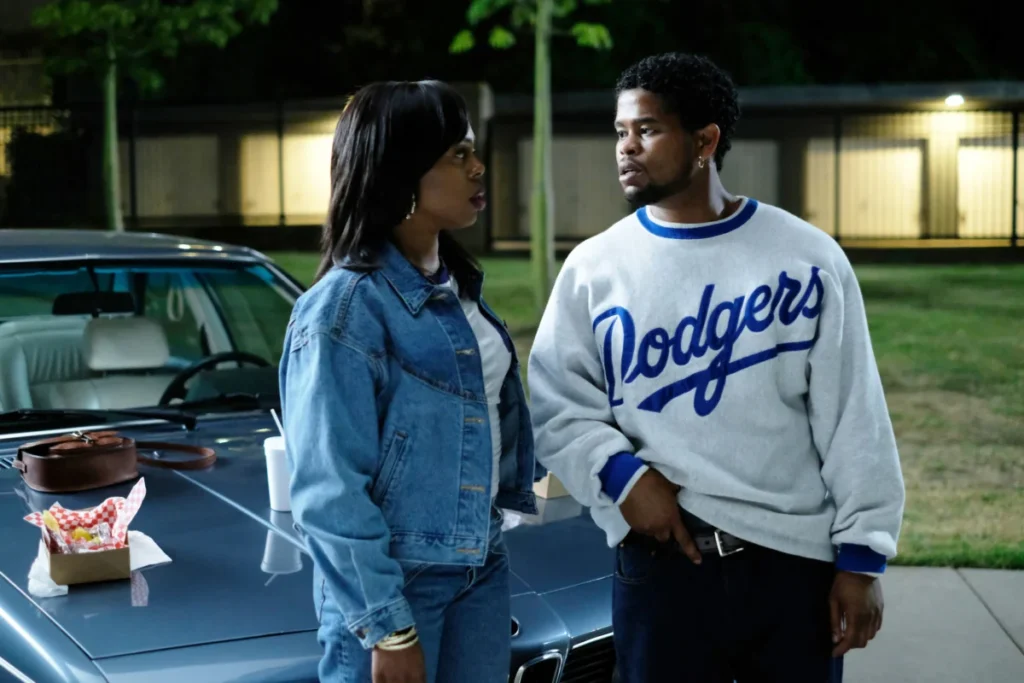

The FX network expansion of its critically acclaimed catalog has introduced television audiences to a new chapter of late-20th-century American history through The Drop: A Snowfall Saga. Serving as a spiritual and chronological successor to John Singleton’s foundational drama Snowfall, which meticulously documented the devastation of the 1980s crack cocaine epidemic in Los Angeles, this new 1990s-set series shifts its narrative lens from illicit street-level drug manufacturing to the burgeoning cultural phenomenon of West Coast hip-hop and community infrastructure.
While the original series heavily focused on the rapid ascent and tragic downfall of enterprising kingpin Franklin Saint—portrayed across six seasons by Damson Idris—The Drop charts an entirely different trajectory. Centered on returning characters Wanda (Gail Bean) and Leon (Isaiah John), the eight-episode first season explores the complex intersection of street violence, musical ambition, and social rehabilitation against the backdrop of a changing Los Angeles. Behind the creative helm of this ambitious undertaking is showrunner Malcolm Spellman, whose deep personal ties to the era and extensive background in authentic cultural storytelling have guided the series through its foundational early episodes.
Main Facts and Creative Direction of the Spinoff
The Drop: A Snowfall Saga airs weekly on FX and streams on Hulu, capturing the pulse of Los Angeles in the 1990s. The primary narrative follows Wanda as she navigates the competitive music industry and Leon as he manages a community legal center. Unlike its predecessor, which eventually adopted an unyielding, heavy tone as its characters descended into moral and societal ruin, the spinoff introduces a lighter, more vibrant atmosphere defined by Black joy, resilience, and artistic expression.
Despite rampant fan speculation and internet inquiries regarding a potential appearance by Damson Idris, showrunner Malcolm Spellman has confirmed that Franklin Saint will not make an appearance in the current season. Spellman’s approach relies on organic world-building rather than fan service or predictable cameos. Aside from Wanda, Leon, and a notable cameo by Quincy Chad as Deon, the series deliberately avoids leaning on a heavy rotation of legacy characters. According to Spellman, any original characters who eventually cross over into the narrative must emerge naturally from the writers’ room rather than being shoehorned in for mere nostalgia.
Chronology and Development of the Project
The journey to bring The Drop to television screens was neither instantaneous nor straightforward. Spellman admits that during the initial stages of development, which spanned over two years, he struggled to land a pilot because he was actively attempting to chase the precise narrative formula of Snowfall. It was only after he intentionally detached himself from the shadow of the original series that the tone, family dynamics, and emotional core of the spinoff materialized for him.
As the first season progressed through its initial eight-episode block, the narrative structure deliberately paused its primary music-industry storylines in the fifth episode. This installment shifted its focus entirely to Lamar, an ambitious musical producer portrayed by Asante Blackk, who uncovers the truth surrounding his mother’s tragic death. The episode unpacks how a historical accident tied to the music industry fueled deep-seated opposition from Lamar’s religious grandparents, who raised him and his brother James (Peyton Alex Smith) to lean on the church rather than the streets.
Background Context: The Conjoined Twins of Crack and Hip-Hop
To fully understand the narrative framework of The Drop, one must examine the socio-historical relationship between the crack cocaine epidemic and the rise of West Coast hip-hop. Spellman describes the two phenomena as conjoined twins. The introduction of crack cocaine into Black communities in the 1980s functioned as a systemic disruption that fundamentally fractured collective identity, transforming community-wide struggles against systemic oppression into isolated battles fought by individual street entrepreneurs.
In this context, hip-hop emerged not merely as a genre of entertainment, but as the raw audio journalism and primary soundtrack of an unfolding urban crisis. While Snowfall documented the macro-level economic explosion and violent fallout of the drug trade, The Drop serves as the cultural aftermath—capturing how a generation of survivors attempted to heal, express themselves, and build legitimate enterprises amid the lingering wreckage of the epidemic.
Character Architecture and Authentic Representation
The characters populating The Drop were not meticulously engineered in a corporate boardroom by analyzing demographic data or mimicking real-life music industry heavyweights. Instead, Spellman drew directly from his own adolescence, personal relationships, and eyewitness accounts of Los Angeles in the late 20th century.
Lamar represents a personal archetype for the showrunner—an eccentric, artistic individual attempting to navigate a deeply religious household and a volatile creative industry. The inclusion of strong religious motifs throughout the series reflects an authentic pillar of Black American life that television frequently reduces to a stereotype rather than portraying as a foundational community structure. Similarly, the deliberate inclusion of nuanced community debates—such as the complexities surrounding the usage and social acceptance of racially charged language—mirrors the real-world discussions that took place in local barbershops and living rooms across the city.
Official Responses and Community Reception
In the television industry, ratings and critical reviews often dictate a series’ trajectory, but Spellman places a distinct premium on grassroots validation. Rather than relying solely on traditional critical aggregation sites, the showrunner actively monitors community reaction channels and public discourse within the demographic most directly impacted by the source material.
Feedback from the target community and dedicated legacy fans of Snowfall has been overwhelmingly positive. The showrunner’s prior creative credits—ranging from Marvel’s The Falcon and the Winter Soldier to Empire and Bel-Air—have given him a sharp industry barometer for recognizing cultural momentum. In his assessment, the enthusiastic embrace from viewers who recognize their own lived experiences on screen confirms that the series has successfully established itself as a major cultural force.
Broader Impact and Industry Implications
The success of The Drop: A Snowfall Saga highlights a growing appetite for expansive, universe-building television that respects the integrity of its source material while exploring diverse thematic territory. By pivoting away from pure crime drama into the realms of artistic creation, community healing, and religious endurance, the series demonstrates that successful spinoffs do not need to endlessly recycle their predecessor’s plot points.
Furthermore, the show’s authentic centering of Black joy alongside historical trauma provides a blueprint for future prestige dramas dealing with sensitive eras in American history. As the series continues its broadcast run on FX and Hulu, it cements the enduring legacy of the Snowfall universe while establishing a distinct, vibrant identity of its own within the contemporary television landscape.