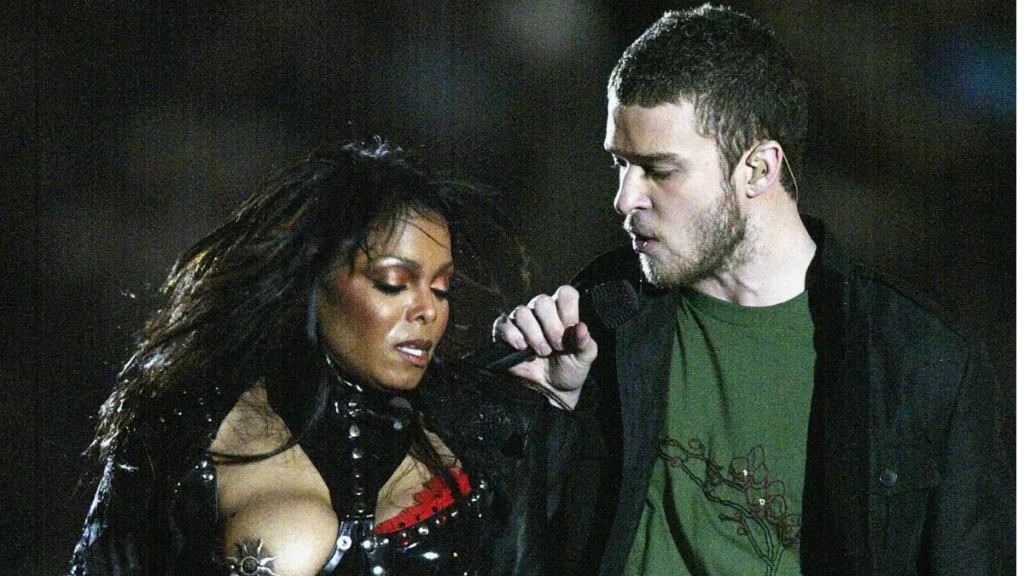

More than twenty years after television history was forever altered on a grand stage in Houston, Texas, the infamous 2004 Super Bowl halftime show is once again dominating cultural discourse. Wayne Scot Lukas, the longtime fashion designer who worked closely with pop icon Janet Jackson, has stepped forward with a stunning assertion that directly challenges the official narrative of the event. According to Lukas, the controversial costume reveal that exposed Jackson’s breast was not an impromptu wardrobe malfunction, as it has been labeled for two decades, but rather a thoroughly planned theatrical stunt that simply suffered from a critical broadcast execution error.
The remarks, delivered during a prominent media appearance, have reignited a fierce debate over one of the most scrutinized moments in the history of live broadcasting. While Lukas maintains that the creative team meticulously orchestrated the moment, the revelations have added complex new layers to an already deeply fractured historical record. Neither Janet Jackson nor Justin Timberlake has publicly validated Lukas’s recent statements, leaving pop culture historians, media analysts, and fans to sift through conflicting accounts of an evening that fundamentally altered the trajectories of two of music’s biggest superstars.
A Calculated Reveal and a Broadcast Breakdown
During a candid interview on TMZ Live, Wayne Scot Lukas provided a detailed, behind-the-scenes accounting of the wardrobe preparations leading up to Super Bowl XXXVIII. Lukas stated unequivocally that the garment engineered for Janet Jackson performed precisely as it was designed to function.
According to the designer, the original creative concept involved a different sort of dramatic unveiling centered around a decorative G-string. However, as the production timeline narrowed down to just a few days before the high-stakes performance, the artistic team purportedly pivoted. Lukas claims that the updated choreography and costume design specifically called for Justin Timberlake to peel away a portion of Jackson’s leather-and-lace ensemble, thereby exposing her breast to the live audience and the millions watching at home.
Crucially, Lukas places a significant portion of the blame for the ensuing public relations nightmare on the television production crew rather than the performers themselves. He asserted that the master control room and camera operators were supposed to execute an immediate, split-second camera cut away from the stage just as the fabric was pulled, transitioning instantly to a pre-arranged graphic or a wide shot before the network feed went completely black. Instead, millions of viewers witnessed the unedited sequence in real-time, creating a global phenomenon known colloquially as "Nipplegate."
Lukas lamented the professional fallout he experienced in the wake of the broadcast, noting that the controversy severely impacted his career trajectory in the fashion industry. Furthermore, he claimed that Timberlake never offered him a personal apology for the professional turbulence that followed. Despite this, Lukas expressed that he is no longer seeking an apology, stating that his primary desire is for Timberlake to publicly confirm what the designer asserts is the authentic version of events.
Background Context and the Historical Timeline of Super Bowl XXXVIII
To understand the weight of Lukas’s recent claims, it is essential to revisit the precise timeline of events surrounding February 1, 2004, when the New England Patriots faced off against the Carolina Panthers at Reliant Stadium in Houston.
The halftime show, produced by MTV on behalf of the National Football League, featured a medley of high-energy performances by a star-studded lineup that included Jessica Simpson, P. Diddy, Nelly, Kid Rock, Janet Jackson, and Justin Timberlake. The climax of the set featured Jackson and Timberlake performing a duet of Timberlake’s hit single "Rock Your Body." As the song reached its final lyric—"Gonna have you naked by the end of this song"—Timberlake reached across Jackson’s chest and pulled off a piece of the outer garment.
The fallout was immediate, fierce, and historically unprecedented:
- February 2004: The Federal Communications Commission (FCC) launched a massive investigation into the broadcast, receiving a record-breaking number of public complaints. CBS, the network that aired the game, faced intense political and regulatory scrutiny.
- March 2004: The Grammy Awards instituted a strict tape-delay policy for its broadcast, and MTV reportedly banned both Jackson and Timberlake from attending or performing at upcoming events (though Timberlake was later permitted to present an award).
- June 2004: The FCC issued a notice of apparent liability against CBS, eventually leading to a historic multi-million dollar fine that wound its way through federal appeals courts for years before finally being overturned in 2012.
- The Aftermath for the Artists: While Justin Timberlake’s career continued an upward trajectory virtually unscathed—bolstered by successful album releases and movie roles—Janet Jackson faced a severe industry backlash. Her subsequent radio airplay plummeted, her music videos were blacklisted by major networks, and her album sales suffered, leading many cultural critics to accuse the industry of a glaring double standard regarding gender, race, and accountability.
For years, Jackson maintained in various interviews and documentaries that the exposure was entirely accidental, a sentiment echoed by many official statements released in the immediate aftermath of the broadcast. Lukas’s recent commentary directly challenges this foundational premise, suggesting that the event was an intentional theatrical risk that went awry primarily due to technical mismanagement.
Emerging Documentation and Upcoming Media Projects
The resurfacing of the 2004 controversy is not happening in a vacuum. Industry insiders have recently pointed to an upcoming, highly anticipated four-part documenatry series for Apple TV+ that reportedly examines the life and career of Justin Timberlake, with potential deep-dives into his relationship with Britney Spears and the pivotal Super Bowl incident with Janet Jackson.
Sources close to the production have hinted that the project aims to re-examine several high-profile moments from the late 1990s and 2000s pop culture landscape, offering a retrospective analysis of how the media and the public consumed celebrity scandal during the pre-social media era. While production details remain tightly guarded, the rumored docuseries has generated significant speculation regarding whether Timberlake will use the platform to officially address the mechanics of the Super Bowl halftime show in comprehensive detail.
Lukas revealed to reporters that while producers of the Apple TV+ project have not formally reached out to him for an interview or participation, he remains hopeful that Timberlake will use the documentary to set the record straight. The designer’s willingness to speak out underscores a broader cultural shift over the past decade, wherein behind-the-scenes personnel, dancers, and creative directors are increasingly reclaiming their narratives and offering granular insights into historical pop culture events that were previously dominated by corporate PR statements and managed media cycles.
Broader Impact, Cultural Implications, and Fact-Based Analysis
The ongoing debate surrounding Wayne Scot Lukas’s claims highlights several critical implications for modern entertainment journalism, broadcast history, and the evolution of celebrity accountability.
First, the revelations emphasize the fragile nature of live television production. In an era before instant social media fact-checking and viral multi-angle video breakdowns, a single split-second delay in master control operations could alter the course of multiple careers. If Lukas’s account is accurate—that the wardrobe was explicitly designed for a reveal and that the safety net of the broadcast delay failed—it reframes the incident from a spontaneous act of indecency into a high-risk theatrical miscalculation.
Second, the discourse underscores the lingering societal reckoning regarding the disparate treatment of male and female artists during crises of public morality. Cultural historians have extensively documented how Janet Jackson bore the brunt of the professional consequences for the 2004 incident, while Justin Timberlake’s career largely flourished. Even if the reveal was planned collaboratively, as Lukas suggests, the retrospective analysis of how the media punished Jackson compared to Timberlake remains a textbook study in systemic industry bias.
Finally, the lack of official confirmation from either Jackson or Timberlake leaves the true sequence of events suspended in a grey area of competing testimonies. Without corroborating statements from the primary principals, Lukas’s version remains one piece of a complex puzzle rather than a definitive historical resolution.
As the entertainment industry continues to re-evaluate the archives of the early 2000s, the legacy of Super Bowl XXXVIII remains a defining cautionary tale about the intersection of live performance, corporate broadcasting standards, and public outrage. Whether the rumored upcoming documentary projects will provide the definitive closure that fans and industry professionals seek remains to be seen. For now, the wardrobe malfunction that stopped the nation twenty-two years ago continues to fascinate, divide, and demand a thorough accounting from those who stood behind the curtains.