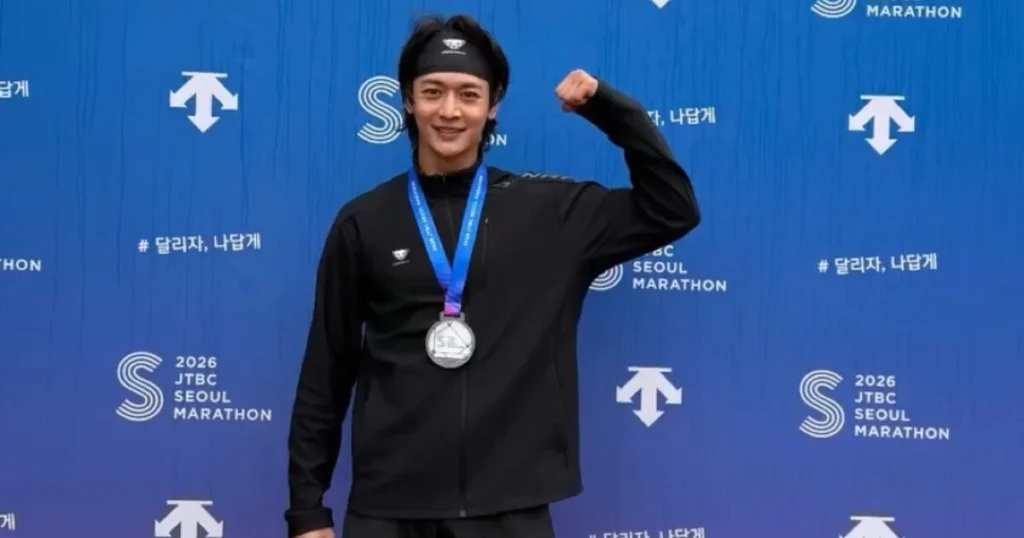

The intersection of celebrity culture, sports ethics, and public ambassadorship has once again sparked intense public debate in South Korea following a recent controversy involving Minho, a prominent member of the legendary K-pop boy group SHINee. What was initially celebrated as an impressive athletic debut at a major national sporting event has rapidly escalated into a formal inquiry by the Korean Sport & Olympic Committee. The investigation follows online revelations that the idol received physical assistance during the race, prompting questions regarding race integrity, the privileges potentially afforded to public figures, and the ongoing appropriateness of his title as a national sports ambassador.
The unfolding situation highlights the stringent standards applied to competitive running events and the heavy scrutiny faced by individuals appointed to represent public institutions. As authorities review the logistics of the race and the conduct of the participants, the incident serves as a significant case study regarding transparency, accountability, and the responsibilities attached to public promotion roles.
Chronology of Events and the Marathon Controversy
The controversy centers around the 2026 JTBC Seoul Marathon, a premier athletic event that draws thousands of professional and amateur runners to the capital city. Held on November 1, the race attracted significant media attention due to the participation of Minho, who was attempting a full 42.195-kilometer marathon for the very first time in his life.
Minho completed the grueling course, crossing the finish line with a recorded time of 3 hours, 0 minutes, and 18 seconds. Initially, this performance generated considerable excitement among fans and sports enthusiasts alike, as it meant he had narrowly missed the coveted "sub-3" milestone—finishing a full marathon in under three hours—by a mere 18 seconds. In the running community, a sub-3 finish is widely regarded as a formidable benchmark, typically achieved only by highly dedicated and conditioned amateur athletes.
However, public sentiment shifted dramatically shortly after the conclusion of the event. Video footage began to circulate widely across various online platforms and social media channels, casting doubt on the legitimacy of the performance. The footage captured a person, widely presumed to be a designated pacemaker running alongside the singer, making direct physical contact. Specifically, the individual was seen placing their hands on Minho’s back and lower waist in a manner that appeared to physically push him forward during a fatigued stage of the race.
In competitive running, receiving external physical assistance—such as being pushed, pulled, or towed—is a direct violation of standard marathon rules. While pacemakers are commonly utilized to help runners maintain a consistent target pace, their role is strictly limited to running ahead or alongside the participant to act as a windbreak and a visual guide. Physical propulsion or mechanical assistance from pacemakers or third parties is strictly prohibited, as it compromises the integrity of the individual’s independent achievement.
Public Backlash, Apology, and Voluntary Record Forfeiture
As the video footage gained traction, the online running community and the general public voiced strong criticisms. Critics argued that receiving physical pushes provided an unfair advantage, calling into question the accuracy and fairness of the official timekeeping. The debate quickly transcended a simple sports rule infraction, evolving into a discussion regarding whether celebrity status affords individuals preferential treatment or leniency in major sporting competitions.
Recognizing the severity of the backlash and the ethical implications of the incident, Minho took direct accountability. On November 3, just two days after the marathon, the artist published a personal statement on his official social media accounts. In his message, he expressed profound remorse, stating that he felt deeply ashamed of his actions and acknowledging that his conduct during the race failed to meet the ethical standards expected of participants.
Following his public apology, Minho took further decisive action on November 4 by formally returning his completion record to the event organizers. Representatives from the organizing committee confirmed that they had accepted the singer’s request to rescind the result. Consequently, the organizers decided to nullify his official completion time, removing him from the official race records to uphold the fairness and credibility of the event.
Formal Complaints and the Korean Sport & Olympic Committee Response
Despite the voluntary forfeiture of his record and his public expression of regret, the repercussions of the incident did not subside. On November 4, the Korean Sport & Olympic Committee confirmed that a formal complaint had been submitted by an unidentified party, requesting a comprehensive administrative review of the situation.
The filed complaint outlines three primary areas requiring official verification and investigation:
- The appropriateness of Minho continuing his tenure as an official public relations ambassador for the committee.
- A thorough verification of how race rules and record processing were managed by the organizing committee of the 2026 JTBC Seoul Marathon.
- An audit of the administrative basis and criteria used to assign Minho to Group B prior to the race start.
In response to the submission of the complaint, officials from the Korean Sport & Olympic Committee stated that a dedicated administrator would be assigned to oversee the case. The committee intends to conduct a detailed investigation into the allegations, examine the administrative procedures surrounding the race, and evaluate the broader implications of the controversy on Minho’s standing as a representative of the organization.
The appointment in question took place in September of the previous year, when the Korean Sport & Olympic Committee officially named Minho as a public relations ambassador. At the time of his appointment, the committee highlighted his well-known reputation as an avid sports enthusiast and celebrity athlete, noting that his involvement was intended to spearhead promotional campaigns designed to revitalize everyday sports participation and effectively communicate important sports policy messages to the general public.
Broader Implications and Analysis
The ongoing investigation highlights several critical tensions within modern sports culture, particularly when intersecting with the entertainment industry. Public figures often serve as ambassadors for state-backed sports organizations to leverage their massive fanbases and cultural influence, encouraging broader public engagement in health and fitness initiatives. However, this dynamic creates a reciprocal vulnerability: when an ambassador becomes embroiled in a controversy—even one stemming from an amateur athletic endeavor—the credibility of the institution they represent can also be called into question.
Furthermore, the public reaction to Minho’s marathon run underscores the strict egalitarian ethos of the running community. Marathons are widely viewed as a pure test of individual endurance, preparation, and mental fortitude, where every participant faces the same physical barriers regardless of social standing or celebrity status. Any perception of preferential treatment, whether in starting group assignments or in the enforcement of race rules, directly challenges the foundational principles of fairness that amateur sports rely upon.
As the Korean Sport & Olympic Committee proceeds with its review, the outcome will likely depend on a transparent assessment of both the marathon organizers’ adherence to regulations and the standard codes of conduct expected of public ambassadors. While Minho’s swift apology and surrender of his completion record have been recognized as steps toward accountability, the formal inquiry demonstrates that institutional oversight requires a rigorous examination of the broader administrative and ethical dimensions of the case.