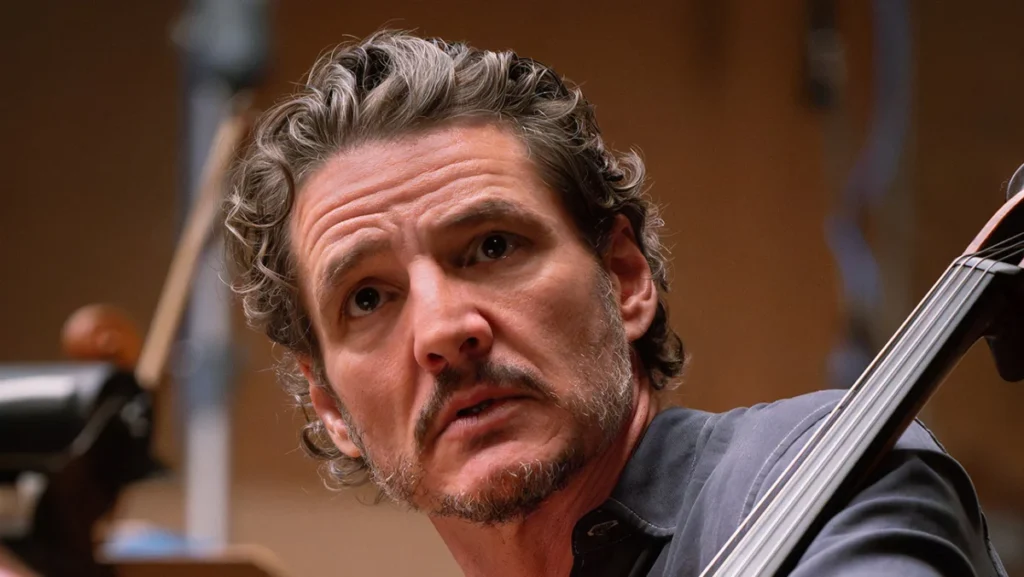

Acclaimed filmmaker and screenwriter Tony Gilroy has officially made his long-awaited return to feature-length cinema with Behemoth!, a complex and sonically driven drama that marks his first time directing a movie in 14 years. Gilroy spent the last three years deeply immersed in the television trenches of the Star Wars universe, serving as the creator, showrunner, and head writer for the critically acclaimed Disney+ series Andor. His transition back to the cinematic landscape has yielded a project that is already generating substantial industry chatter following its selection as the Centerpiece Main Slate screening at the prestigious New York Film Festival ahead of its scheduled theatrical release on Friday, December 4.
The film stars Pedro Pascal as Alex Serian, a virtuoso cellist whose professional life unfolds within the rarely glimpsed, high-pressure environment of Hollywood scoring stages. Alongside Pascal, Behemoth! features a star-studded ensemble cast that includes Olivia Wilde, Eva Victor, Alexa Swinton, Kaya Ralls, Erik Griffin, JoBeth Williams, Margarita Levieva, Hank Azaria, and Will Arnett. Shot by cinematographer Damián García—who previously collaborated with Gilroy on the visually striking world of Andor—the two-hour-and-seven-minute production is noted for its polished craftsmanship and immersive acoustic design, though it has drawn a mixed initial critical response due to its narrative pacing and structural choices.
Chronology of a Career Shift and the Road to Behemoth!
Tony Gilroy’s career has long been defined by sharp, character-driven thrillers and intelligent dramas. He earned Academy Award nominations for both best original screenplay and best director for his 2007 legal drama Michael Clayton, and he holds writing credits on major studio properties including the Bourne film franchise. However, his creative focus shifted significantly in the late 2010s and early 2020s toward prestige television. Taking over the foundational groundwork of Rogue One: A Star Wars Story, Gilroy spearheaded Andor, a gritty, mature spy thriller set within a galaxy far, far away. The series ran for two seasons, earning widespread praise for its grounded storytelling and political depth, but it kept Gilroy away from feature filmmaking for more than a decade.
Following the conclusion of his commitments to the Star Wars franchise, Gilroy turned his attention inward, developing a deeply personal project centered on the intersection of family trauma, generational pressure, and the hidden machinery of the professional music industry. Production on Behemoth! moved swiftly through the casting and principal photography phases, utilizing iconic Los Angeles recording facilities—such as the Barbra Streisand Scoring Studio at Sony—to lend authentic texture to the film’s musical sequences. Its selection as the Centerpiece film for the New York Film Festival positioned it as one of the major cinematic events of the autumn festival circuit, building anticipation among cinephiles eager to see how Gilroy would apply his methodical storytelling style to a musical drama.
Supporting Data and the Phenomenon of the Behemoth! Collective
One of the most notable technical and creative achievements of Behemoth! is its sweeping original score, which functions almost as a primary character within the narrative. Rather than relying on a single composer, the production enlisted an unprecedented assembly of nine highly respected industry veterans, collectively billed as "The Behemoth! Collective."
This powerhouse musical alliance features Michael Abels, Emily Bear, Lukas Frank, Michael Giacchino, James Newton Howard, Henry Jackman, Nami Melumad, Brandan Roberts, and Alan Silvestri. Together, they generated a staggering range of original compositions spanning dark drama, heart-pounding suspense, action cues, and soaring romance. The music extends beyond the studio sequences, woven into the film’s fabric through an eclectic mix of art rock songs, requiems, cartoon theme tunes, harp concertos, and intricate cello etudes.
Furthermore, the sonic landscape of Behemoth! is elevated significantly by advanced Dolby Atmos sound technology, allowing the film to fully immerse audiences in the physical and spatial reality of orchestral performance. Despite these high-end technical accomplishments, critics have noted a slight missed opportunity in how the score is integrated; while the film celebrates the execution of the music, it rarely pauses to illustrate the precise technical mechanics of matching specific musical cues to screen time, keeping the scoring process somewhat generalized in the background.
Character Analysis and Narrative Friction
At the center of Behemoth! is Alex Serian, played by Pedro Pascal. The character’s narrative trajectory involves a return to his hometown of Los Angeles after spending two decades performing in elite orchestras in Boston, Dallas, and Chicago. This geographic displacement is triggered by a turbulent past relationship with Carol Spedding, a wealthy and fiercely possessive arts patron played by Olivia Wilde. Spedding, whose characterization draws comparisons to classic obsessive archetypes, reacts violently when Alex attempts to distance himself, creating an explosive dynamic that mirrors her substantial philanthropic footprint, including a $6 million endowment gifted to the Chicago Symphony during Alex’s tenure.
Despite Pascal’s inherent warmth, magnetism, and deeply internalized performance, critics have pointed out that the script leaves Alex frustratingly passive within his own narrative. His sidelined demeanor is framed as a psychological defense mechanism against a lifetime spent in the shadow of a deeply narcissistic family. His late father, Peter (brought to life through video cameos by Hank Azaria), was a celebrated composer whose own musical aspirations were continually compromised by vanity. His mother, Ginnie (played by a nearly unrecognizable JoBeth Williams), was a renowned harpist whose declining health due to dementia adds a tragic layer of familial decay when Alex first returns home. Meanwhile, his brother Andy—played by Will Arnett in a performance that feels tonally distinct from the rest of the film—is the family’s designated black sheep, having abandoned classical viola in the 1990s for a brief rock career and a current podcast career dedicated to analyzing their father’s television and movie themes.
The narrative gains its emotional footing only when Alex begins to explore his paternal instincts. This shift begins when he coaches a bright young cellist named Bronte, played with natural poise by professional musician Kaya Ralls in her acting debut. The emotional stakes rise further following the death of Alex’s former love, the brilliant violinist Nadia (portrayed vividly by Eva Victor), who had previously left him to marry a wealthy businessman. At Nadia’s funeral six years later, Alex encounters her phenomenally gifted teenage daughter, Viviana, and begins a quiet investigation into whether he might be the girl’s biological father.
Broader Impact and Critical Implications
As Behemoth! prepares for its commercial release, industry analysts are viewing the film as an intriguing litmus test for Tony Gilroy’s ability to pivot away from high-octane franchise filmmaking into quiet, character-driven artistic dramas. The film’s reception highlights a persistent tension in contemporary cinema: the struggle to balance high-concept atmospheric immersion with a compelling, proactive central protagonist.
While Damián García’s cinematography and the monumental contributions of the Behemoth! Collective ensure that the film succeeds on a sensory and auditory level, the narrative’s opaque structure and sluggish pacing have sparked debate among critics. The late-film dynamic between Alex and a 15-year-old Viviana—played with tremendous maturity by Alexa Swinton, who steps into scoring duties previously held by a temperamental European diva played by Thomas Kretschmann—delivers the emotional resonance the film desperately needs. However, arriving late in the runtime, it underscores the difficulty Gilroy faced in anchoring his ambitious conceptual framework to a fully realized human core.
Ultimately, Behemoth! stands as a bold, uncompromising experiment that treats music as a living, breathing physical force. Whether mainstream audiences will embrace its deliberate pacing and subdued protagonist when it opens on December 4 remains to be seen, but its arrival firmly re-establishes Tony Gilroy as one of Hollywood’s most intellectually curious and stylistically distinct auteurs.