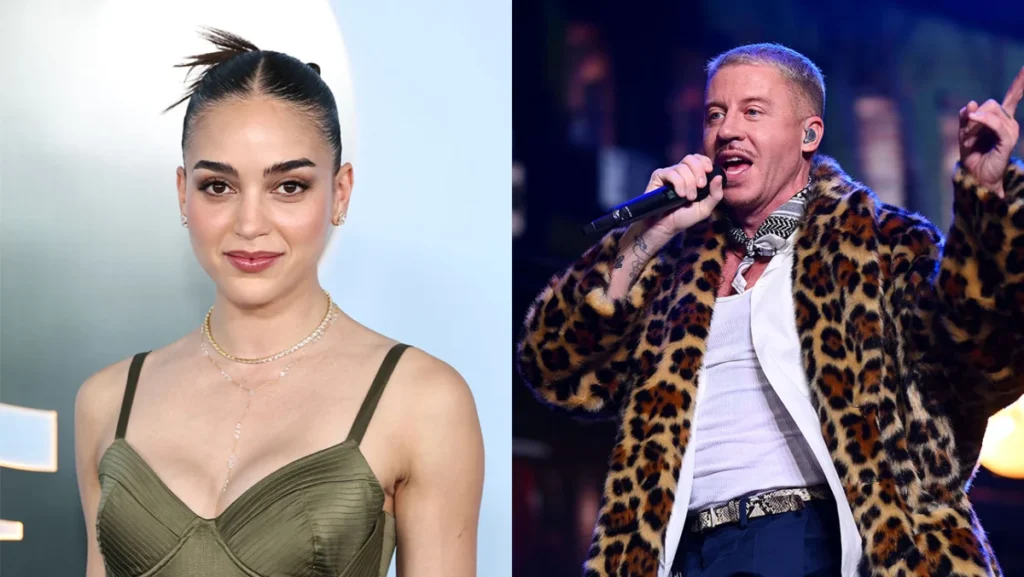

The intersection of entertainment, geopolitics, and free expression has once again ignited intense public debate following recent developments involving Grammy-winning rapper Macklemore, British pop star Ed Sheeran, and actress Melissa Barrera. Nearly three years after Barrera herself faced severe professional repercussions for expressing solidarity with Palestine, the actress has publicly praised the unified industry pushback that followed Macklemore’s removal from a major concert tour. Speaking candidly with the Associated Press, Barrera reflected on the evolving landscape of creative solidarity, contrasting her isolated experience in 2023 with the collective action witnessed in recent weeks.
The controversy underscores a growing tension within the global entertainment industry, where artists increasingly utilize major platforms to voice political stances, often triggering swift repercussions from promoters, corporate sponsors, and venue owners. As the boundaries between personal political expression and professional contracts continue to blur, industry observers note a distinct shift in how peers respond to the marginalization of vocal artists.
The Genesis of the Macklemore Controversy
The sequence of events leading to Macklemore’s removal from Ed Sheeran’s ongoing tour began in early September. Macklemore, known globally for hits like Thrift Shop and Same Love, served as a prominent supporting act on select dates of Sheeran’s international tour. During performances on September 4 and September 5 at MetLife Stadium in East Rutherford, New Jersey, the rapper openly voiced his support for Palestine, punctuating his set with the phrase "Free Palestine."
The remarks drew immediate public attention, polarizing audiences and drawing swift condemnation from various advocacy groups and organizational stakeholders. Within days of the MetLife Stadium concerts, the decision was made to drop Macklemore from the remainder of the tour lineup.
The mechanism behind the rapper’s dismissal soon became a subject of public dispute. Macklemore released a formal statement detailing the political pressure exerted behind the scenes. According to the rapper, New England Patriots owner and Gillette Stadium operator Robert Kraft reportedly coordinated with other major stadium executives, delivering an ultimatum to tour organizers: if Macklemore remained on the bill, the venues would bar the tour from playing on their properties.
Ed Sheeran subsequently addressed the mounting controversy, clarifying his own position regarding the cancellation. In a public statement, Sheeran maintained that the decision to remove Macklemore originated entirely with the tour’s promoters rather than his own creative team. Sheeran also acknowledged holding direct conversations with Kraft ahead of upcoming tour stops, highlighting the immense logistical and corporate leverage wielded by venue owners in modern touring infrastructure.
A Domino Effect of Industry Solidarity
What distinguished the Macklemore controversy from previous high-profile artist dismissals was the immediate and coordinated response from fellow performers. Rather than maintaining silence or fulfilling their contractual obligations without comment, several opening acts on Sheeran’s tour chose to pull out in solidarity with the dropped rapper.
Musician and producer Finneas, indie-pop artist Lukas Graham, and supporting act Aaron Rowe all announced their departures from the tour following Macklemore’s dismissal. The synchronized exits sent shockwaves through the touring industry, transforming what typically would have been a quiet personnel change into a high-stakes public relations crisis for tour promoters.
For Melissa Barrera, witnessing this collective pushback was a deeply emotional experience. Barrera, who was famously dropped from Spyglass Media Group’s upcoming horror sequel Scream VII in late 2023 over social media posts concerning the Israel-Hamas conflict, noted the stark contrast between the industry’s reaction then and now.
"It was so beautiful to see Finneas and the band and all the opening acts pulling out in support of Macklemore," Barrera told the Associated Press. "It made me emotional, you know. I didn’t get that when it happened to me. I didn’t have any of that happen. It was too soon. People were too scared. But it’s good to see that almost three years later, at least things have changed."
Revisiting the 2023 Scream Franchise Fallout
Barrera’s reference to her own dismissal points back to one of the most polarizing public relations flashpoints in Hollywood following the outbreak of the Israel-Hamas war in October 2023. At the time, Barrera utilized her personal Instagram account to share a series of posts commenting on the humanitarian crisis in Gaza.
In one widely circulated post on her Instagram Stories, Barrera wrote, "Gaza is currently being treated like a concentration camp. Cornering everyone together, with no where to go, no electricity no water… People have learnt nothing from our histories. And just like our histories, people are still silently watching it all happen. THIS IS GENOCIDE & ETHNIC CLEANSING."
The response from the studio was swift and uncompromising. Spyglass Media Group, the production company behind the lucrative Scream franchise, issued a formal statement terminating the actress’s contract. The studio’s spokesperson stated at the time that Spyglass maintained a "zero tolerance for antisemitism or the incitement of hate in any form, including false references to genocide, ethnic cleansing, Holocaust distortion or anything that flagrantly crosses the line into hate speech."
The firing divided the entertainment community. While studio executives and various advocacy organizations defended the disciplinary action as a necessary stand against inflammatory rhetoric, numerous artists, writers, and free-speech advocates criticized the decision as an instance of institutional censorship and blacklisting aimed at silencing criticism of military actions in Gaza.
The Broader Implications for Artist Autonomy and Power Dynamics
Reflecting on the evolution of industry responses over the past three years, Barrera argued that collective action remains the most effective deterrent against corporate censorship. She suggested that if prominent headliners exercised their leverage, the pressure exerted by venue owners and promoters could be successfully resisted.
"When someone is attacked, and there are people behind being like, ‘We’re not gonna allow this,’ and the more that happens, the less that the people in power are going to try to censor it, because eventually it’s not gonna work," Barrera stated. "I can’t help but wonder what would have happened if Ed Sheeran had been like, ‘No,’ and called the bluff. I mean, it’s possible that he still would have had his shows canceled, but I bet you that he could have rebooked those shows in other venues just as easily, and people would have rallied behind him."
Barrera expanded on her critique of power dynamics within the entertainment business, expressing a desire for top-tier artists to recognize the substantial influence they hold. She contended that many industry figures operate out of apprehension and fear of financial or reputational backlash, inadvertently enabling corporate censorship.
"I wish that the people that have power understood the power that they have," Barrera continued. "I think that the problem is that there’s a lot of people that actually have a lot of power; they think that they don’t, and they’re operating out of fear, and it’s just a shame because, you know, we just saw what happened — the support that rallied behind Macklemore — and I think that’s a big step. I think that what we’re seeing, what we’re witnessing, is going to inspire real change, and I’m very hopeful about that."
Current Outlook and Future Precedents
As the dust settles around the immediate fallout of the tour restructuring, Ed Sheeran is slated to resume his performance schedule, taking the stage in Philadelphia for his first concert since the controversy erupted. However, industry analysts suggest that the long-term ramifications of the dispute will extend far beyond individual tour dates.
The incident highlights a permanent shift in how major concert tours must navigate geopolitical sensitivities. Venue operators, corporate sponsors, and booking agencies face mounting scrutiny over decisions to cancel artists based on political speech, while performers are increasingly evaluating the ethical implications of touring under restrictive institutional guidelines.
Whether the solidarity demonstrated by Finneas, Lukas Graham, Aaron Rowe, and other industry peers will establish a new baseline for labor and creative unity remains to be seen. For artists like Melissa Barrera, however, the visible display of peer backing marks a turning point in a cultural climate that previously left dissenting voices isolated. As public discourse surrounding international conflicts continues to intersect with the global entertainment marketplace, the events surrounding Macklemore and Barrera serve as a clear indication that the cost of creative expression—and the solidarity required to protect it—will remain a central battleground for the foreseeable future.