
MGM+’s latest eight-episode crime drama, The Westies, attempts to immerse viewers in the gritty, rule-bending underworld of 1980s New York, where Irish and Italian criminal organizations clash and conspire. On a superficial level, the series, helmed by creators Chris Brancato and Michael Panes of Godfather of Harlem fame, depicts a world populated by low-level gangsters defying explicit orders, mid-tier figures dabbling in forbidden drug trades, and meticulously crafted plans frequently derailed by sudden bursts of anger or fear. However, beneath this textual layer of defiance and chaos, the series itself adheres rigidly to established genre conventions, offering a narrative experience that, while competent, struggles to carve out a distinctive identity in a saturated landscape of gangster dramas. Despite solid performances from seasoned actors J.K. Simmons and Titus Welliver, the prevailing sentiment is that The Westies is too polished to be dismissed as truly bad, yet too unoriginal to genuinely captivate.
A Glimpse into 1980s Hell’s Kitchen: The Series Premise
The series premiere, directed by Alan Taylor, opens at a precarious moment of peace between two formidable entities: the Irish American Westies, a notorious outfit operating out of Hell’s Kitchen, and the formidable Italian American Gambino crime family. After years of brutal, reciprocal violence that scarred Manhattan’s West Side, bosses Eamon Sweeney (J.K. Simmons) of the Westies and Paul Castellano (Ron Lea) of the Gambinos have brokered an uneasy truce. This détente is not born of newfound goodwill, but rather a pragmatic, business-minded understanding: both factions stand to reap significant financial rewards from the ongoing construction of the Jacob K. Javits Convention Center, a massive undertaking that requires cooperation rather than conflict. The multi-million dollar project promised lucrative opportunities in labor racketeering, material supply, and protection schemes, making continued warfare economically counterproductive.
However, the fragile peace is immediately threatened by the very men tasked with upholding it. The rank-and-file members, accustomed to generations of animosity and territorial disputes, are less than enthusiastic about the newfound alliance. The brutal enforcement required to maintain order inevitably breeds resentment and disillusionment within the ranks. This internal strife is particularly acute among the younger generation, including Jimmy Roarke (Tom Brittney), a rising figure within the Westies, and John Gotti (Hamish Allan-Headley), an ambitious and volatile capo in the Gambino family. Simultaneously, federal authorities, spearheaded by the diligent FBI agent Birdie Polk (Jessica Frances Dukes), begin to close in, aided by the reluctant, ethically compromised NYPD officer Glenn Keenan (Titus Welliver), who finds himself caught between his duty and his dark past.
Historical Underpinnings: The Real Westies and Their Domain
To fully appreciate the narrative context of The Westies, it is crucial to understand the historical backdrop of its namesake gang and the infamous neighborhood they controlled. The Westies were a notorious Irish American criminal organization that dominated Hell’s Kitchen, a working-class neighborhood on Manhattan’s West Side, from the mid-20th century through the late 1980s. Unlike the hierarchical, structured Italian Mafia, the Westies were characterized by their extreme, often gratuitous, violence and a reputation for dismembering their victims, earning them a particularly gruesome notoriety. Their preferred method of disposing of bodies, often involving hacking them into pieces and dumping them into the Hudson River or through meat grinders, cemented their fearsome legend.
Key figures in the historical Westies included Mickey Featherstone and Jimmy Coonan. Coonan, who rose to prominence in the 1970s, forged an unprecedented alliance with the Genovese crime family, one of New York’s "Five Families," allowing the Westies to operate with a degree of protection from the larger Italian syndicates in exchange for a share of their illicit profits. This alliance, and the subsequent interaction with other Mafia families like the Gambinos, forms a critical historical precursor to the series’ central conflict. By the 1980s, the Westies’ reign was characterized by widespread extortion, loan sharking, drug trafficking, and murder. Their decline was largely precipitated by the relentless efforts of federal law enforcement, particularly the application of the Racketeer Influenced and Corrupt Organizations (RICO) Act, which allowed prosecutors to target entire criminal enterprises rather than individual acts. High-profile arrests and convictions, including those of Featherstone and Coonan, eventually dismantled the gang by the early 1990s.
Hell’s Kitchen itself, once a bastion of Irish immigrant communities and synonymous with poverty, crime, and dilapidated tenements, serves as a vivid backdrop. The neighborhood’s transformation, especially through urban renewal projects like the Javits Center in the 1980s, offered both opportunities for legitimate development and fertile ground for organized crime to exploit through control over labor unions and construction contracts. The series endeavors to capture this specific era of urban decay and nascent gentrification, where the old guard of criminals fought to maintain their grip amidst shifting social and economic landscapes.
The Shadow of the Gambinos: Paul Castellano and John Gotti
The Italian American contingent in The Westies is personified by the Gambino crime family, one of the most powerful and well-known of New York’s Five Families. At the outset of the series, the Gambinos are ostensibly under the leadership of Paul Castellano, a boss known for his more business-oriented approach to organized crime, preferring white-collar rackets over the street-level violence that characterized many of his predecessors. Castellano’s reign, which began in 1976, was marked by efforts to legitimize the family’s operations, focusing on construction, trucking, and legitimate businesses, a strategic shift that aligns with the series’ plot point of capitalizing on the Javits Center construction.
However, Castellano’s relatively low-profile and business-first strategy created friction with more traditional, street-savvy capos, most notably John Gotti. Gotti, a charismatic and flamboyant figure, despised Castellano’s perceived weakness and isolation from the street. The historical context of the 1980s saw Gotti’s star rapidly ascend within the Gambino family, culminating in the infamous assassination of Paul Castellano outside Sparks Steak House in December 1985. This dramatic event paved the way for Gotti to seize control, ushering in his era as the "Dapper Don" – a media darling known for his expensive suits and public defiance of law enforcement, despite his brutal methods. The series’ inclusion of a young John Gotti provides a potent historical tension, hinting at the future power struggles that would redefine the Mafia landscape.
The broader 1980s crime landscape in New York was a complex web of ethnic gangs, drug epidemics, and increasing pressure from federal agencies. The FBI, armed with stronger legal tools like RICO, intensified its efforts to dismantle organized crime, leading to numerous high-profile indictments and convictions throughout the decade. This era marked a turning point, as the traditional power of the Mafia began to erode under the weight of sustained law enforcement pressure and internal strife.
Narrative Structure and Character Archetypes
Brancato and Panes, drawing on their experience from Godfather of Harlem, demonstrate a clear proficiency in structuring a multi-threaded narrative. The plot of The Westies unfolds with a smooth and even pace, ensuring that viewers are rarely lost, even amidst the intricate web of alliances and betrayals. The narrative beats are delivered deliberately enough for casual engagement, yet briskly enough to maintain a sense of forward momentum. The tone remains consistently straight-faced, eschewing self-indulgent philosophical musings on the "American Dream" or the "corrosive effects of revenge." Instead, the series prioritizes the visceral thrill of gangster confrontations, presenting a world where glowering tough guys pointing guns at each other is the primary form of dramatic engagement.
However, this narrative competence is undermined by a significant deficiency in character development. The most glaring issue is the reliance on well-worn clichés rather than crafting individuals with distinctive personalities or compelling inner lives. Jimmy Roarke, positioned as the series’ protagonist, embodies the archetypal "good" gangster – seemingly smarter and kinder than his violent associates, not due to any discernible personal struggle or growth, but simply because that is the role designated for a hero in this genre. His loving relationship with Bridget (Sarah Bolger) similarly lacks specific emotional depth, serving primarily to fulfill the hero’s romantic arc.
Bridget herself is given a subplot involving a secret history with the Irish Republican Army (IRA), an element that, while potentially unique within the standard gangster drama playbook, feels largely disconnected from the main narrative. This tangential detail, rather than enriching the character or plot, highlights the lack of organic integration within the overarching story. Similarly, Jimmy’s best friend, Mickey (Stanley Morgan), is a walking stereotype of the "hotheaded low-level gangster," his impulsiveness waxing and waning conveniently to introduce plot complications or inject tension into negotiations. Other supporting characters are largely interchangeable, existing primarily to populate scenes or serve as expendable cannon fodder.
The portrayal of John Gotti, despite his historical significance, also falls into the trap of generic representation. Rather than a nuanced depiction of the complex historical figure, The Westies presents a sanded-down version, familiar from countless other Italian mobster portrayals. His introduction, involving a powerful gangster feigning offense before erupting into laughter, is a scene so formulaic it borders on parody, reinforcing the show’s reliance on established tropes.
Performances Elevating the Material
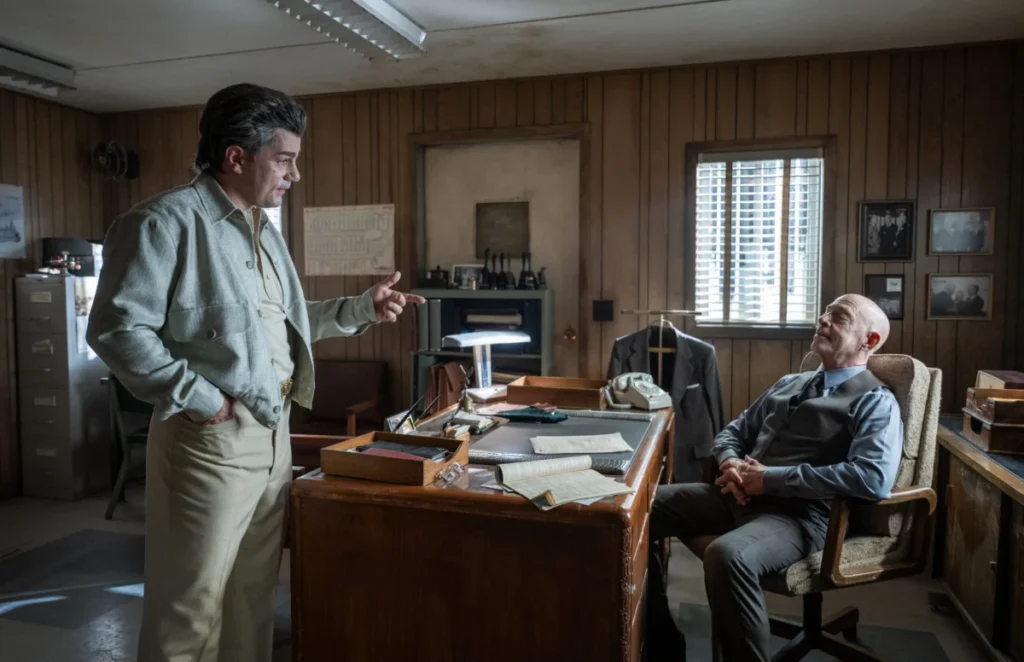
Despite the script’s limitations, a few cast members manage to infuse their characters with a semblance of interiority that transcends the written page. J.K. Simmons, as Westies boss Eamon Sweeney, delivers a performance marked by a palpable weariness and a cynical snark. While not one of his most complex roles, Simmons’ ability to convey layers of experience and underlying menace makes Sweeney feel genuinely alive, even when the dialogue offers little to work with. His portrayal provides glimpses of a man burdened by the weight of his criminal enterprise, striving for a peace he knows is inherently fragile.
Titus Welliver, as the conflicted NYPD officer Glenn Keenan, also brings a significant gravitas to his role. Welliver imbues Keenan with a profound sense of private pain, conveyed through his heavy demeanor and world-weary expressions. While the precise cause of his sorrow, once fully revealed, might not be as compelling as initially hinted, Welliver’s performance anchors the character, suggesting a deeper psychological landscape than the script fully explores. His ability to project a man perpetually on the edge, struggling with his moral compromises, stands out amidst the more one-dimensional portrayals. These performances underscore the potential of the series had the writing matched the caliber of its seasoned actors.
Aesthetics and Production Design: A Familiar Glimpse of the Past
The visual landscape of The Westies paints a commendably lived-in picture of 1980s New York. Production designer Rocco Mateo meticulously recreates the era, from the grimy streets and cramped apartments to the perpetually run-down bars that serve as gathering points for the criminal underworld. The attention to detail in portraying a city grappling with both decay and the beginnings of a new era is evident. The costumes, set dressings, and overall aesthetic contribute effectively to immersing the viewer in the period. However, much like the narrative, the visual style, while competent, offers little that hasn’t been seen in countless other gritty period dramas. It speaks to a diligent effort to replicate a familiar aesthetic rather than innovate or provide a fresh perspective. For viewers seeking a visually pleasing, albeit generic, crime drama as background entertainment, The Westies delivers a polished product.
The Metatextual Dilemma: Coloring Within the Lines
The fundamental critique of The Westies lies in its metatextual approach: an eight-hour exercise in strictly adhering to the established contours of the gangster genre. It offers no "snazzy shading" or innovative techniques to create an illusion of depth, instead opting for a safe, predictable path. The series is content to retrace the familiar tropes that have defined the genre for decades. From the internal power struggles and territorial disputes to the inevitable clashes with law enforcement and the personal tolls of a criminal life, every narrative beat feels meticulously checked off a "how to write a gangster drama" list.
This adherence to convention stands in stark contrast to the seminal works of the gangster genre. Films by Francis Ford Coppola (The Godfather), Martin Scorsese (Goodfellas, Casino), and television series like David Chase’s The Sopranos transcended mere crime narratives. These masterpieces offered not only vivid stylistic flair and gripping plots but also deeply complex characters, ambitious thematic explorations, and profound psychological insights into the nature of power, family, morality, and the American experience. They dared to innovate, to challenge audience expectations, and to leave an indelible mark on popular culture by pushing the boundaries of storytelling. The Westies, by comparison, largely settles for replication, providing the expected bag of body parts and revenge plots without the accompanying layers of complexity, memorable quirks, or zingy one-liners that define truly great genre entries.
MGM+’s Strategy and the Saturated Streaming Landscape
The release of The Westies on MGM+ positions it within a crowded streaming market, where platforms are constantly vying for subscriber attention with original content. For MGM+, a rebranded service seeking to establish its identity beyond its premium cable roots, a crime drama based on real-life notorious gangs is a logical choice, appealing to a demographic known to gravitate towards such narratives. However, in an era where streaming services churn out an unprecedented volume of content, the challenge lies not just in producing shows, but in creating ones that resonate and stand out.
The Westies arrives in a post-Sopranos, post-Boardwalk Empire, post-Peaky Blinders world, where audiences have developed sophisticated palates for nuanced anti-heroes, intricate moral dilemmas, and historically rich settings. The series’ inability to offer a fresh perspective or truly compelling characters in such a competitive environment raises questions about its long-term impact. While it might serve as agreeable background viewing, its lack of distinctiveness makes it difficult for it to become a must-watch or to contribute significantly to the evolution of the genre. It reflects the broader industry trend where quantity sometimes overshadows quality, leading to a proliferation of content that is perfectly watchable but ultimately forgettable.
Conclusion: Competent Yet Uninspired
In summary, The Westies is a competently produced gangster drama that capably navigates its complex plot lines and presents a visually authentic 1980s New York. Its creators, Chris Brancato and Michael Panes, deliver a smooth, briskly paced narrative, and actors like J.K. Simmons and Titus Welliver manage to inject some much-needed depth into their otherwise archetypal characters. However, the series ultimately suffers from a pervasive lack of originality, relying heavily on genre clichés and failing to develop its characters beyond their stereotypical roles. It offers no complex emotions to process, no grander themes to parse, and no memorable quirks to linger in the viewer’s mind. While it avoids being unbearable, its imaginative shortcomings prevent it from being truly interesting or impactful. In a landscape rich with groundbreaking crime dramas, The Westies settles for retracing familiar ground, proving that while it’s certainly not the worst option for a generic crime fix, viewers could undoubtedly find more engaging and innovative alternatives.