
The interior design industry is currently witnessing a curious phenomenon: the persistent resurgence of a design element that was declared a fading trend several years ago. The "squiggle" or undulating line, characterized by its playful, wave-like form, has re-emerged as a staple in high-end residential projects across the globe. Most notably, the Méandre chair and counter stools by Design Frères have become a recurring feature in prominent architectural tours, signaling a shift in how modern designers approach the balance between historic structure and contemporary whimsy.
While trend forecasters in 2021 suggested that the "wiggle" aesthetic had reached its saturation point, recent data from luxury furniture platforms and editorial features in publications like Architectural Digest suggest otherwise. From a 14th-century château in the French countryside to a pre-war Art Deco apartment in Brooklyn, the undulating silhouette is being used not merely as a decorative flourish, but as a strategic tool to soften the rigid geometries of traditional architecture.
The Historical Lineage of the Undulating Form
To understand the current obsession with the Méandre chair, one must look back to the mid-20th century French decorative arts movement. The design is heavily influenced by the work of Jean Royère, a seminal figure in 1940s and 50s design known for his biomorphic shapes and whimsical approach to luxury. Royère’s "Liane" and "Ours Polaire" collections famously rejected the harsh, industrial lines of early Modernism in favor of organic, flowing forms that suggested movement and comfort.

The Méandre collection by Design Frères serves as a modern homage to this era. Crafted typically from wrought iron or steel, these pieces utilize the "meander" line—a decorative border constructed from a continuous line, shaped into a repeated motif. In the context of the Méandre chair, this translates to a backrest or frame that appears to ripple like water. This connection to historical craftsmanship allows the piece to feel grounded in tradition while maintaining a sense of avant-garde playfulness.
Case Studies in Modern Application
The versatility of the undulating silhouette is best demonstrated through its application in diverse architectural settings. Designers are increasingly utilizing these pieces to bridge the gap between different eras and styles.
The Dordogne Château: Bridging Centuries
In a recent renovation of a 14th-century château in Dordogne, France, designers Brandon Quattrone and Isadora Lim integrated Méandre counter stools into a kitchen that dates back to 1350. The stools were paired with a Shaker-style island and cabinetry by Plain English. This juxtaposition serves a specific functional purpose: the playful, wavy lines of the iron stools provide a visual counterpoint to the sharp, right angles of the historic stone walls and the minimalist cabinetry. By introducing a "wiggle" into such a storied environment, the designers effectively lowered the formality of the space, making a medieval structure feel approachable and lived-in.
The Brooklyn Art Deco Apartment: Softening Geometry
Justin DiPiero, an interior designer whose 1939 Art Deco apartment in Brooklyn has garnered significant attention, utilized the Méandre chair to resolve a common design challenge: the over-abundance of angular furniture. DiPiero’s space features a European oak console and a mid-century "surfboard" coffee table—pieces defined by their long, straight lines and sharp edges. By placing a Méandre chair with its curved metal backrest in the room, DiPiero introduced a "whimsical silhouette" that cushions the visual impact of the more structured pieces. He further emphasized this softness by pairing the chair with a plush, boucle lounge chair, creating a "curved cushioning" effect that anchors the living room.

The Berkeley Craftsman: Adding Dimension to Corners
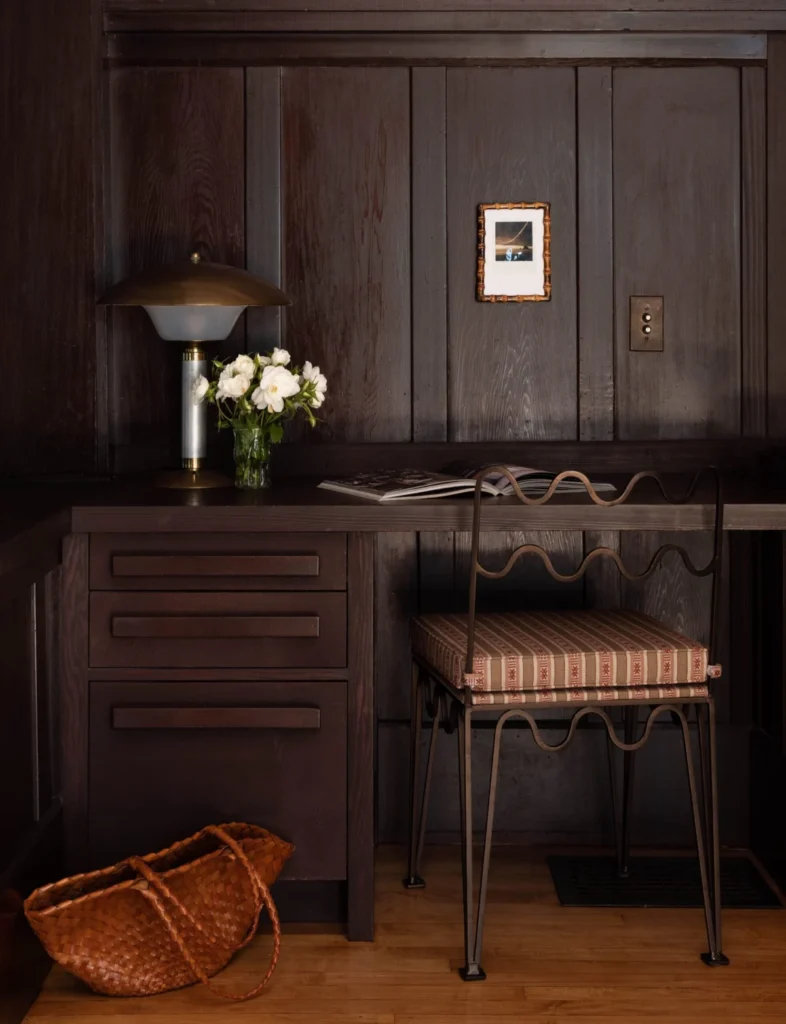
In a Berkeley craftsman home designed by Heidi Caillier, the Méandre chair was used to inject personality into a dark corner of the downstairs area. Caillier, known for her ability to mix textures and patterns, customized the seat with a Namay Samay textile. In this instance, the chair functions as a piece of "functional art." The undulating backrest creates shadows and depth against the dark wood paneling of the craftsman architecture, proving that the squiggle trend can be adapted to feel moody and sophisticated rather than just bright and "poppy."
The Psychology of the Curve in Post-Pandemic Design
The persistence of the squiggle can also be analyzed through the lens of design psychology and the "biophilia" movement. Studies in neuro-aesthetics suggest that the human brain is naturally predisposed to favor curved lines over sharp angles. Curves are often associated with safety, nature, and the human form, whereas sharp angles can trigger a subtle "fight or flight" response associated with thorns or jagged rocks.
In the post-pandemic era, there has been a documented shift toward "emotional interiors." Homeowners are moving away from the clinical perfection of ultra-minimalism toward spaces that feel "friendly" and "inviting." The undulating line provides a sense of movement and "give" that rigid furniture lacks. This explains why the Méandre chair, despite its iron construction, is often described by designers as "softening" a room. It invites the eye to wander rather than stop abruptly at a corner.
Market Trends and the Longevity of Design Frères
Design Frères, the maker of the Méandre line, has seen its products become staples in the "new vintage" market. On high-end platforms like 1stDibs, sets of Méandre counter stools can command prices upwards of $8,250. This high valuation indicates that the design is no longer viewed as a fleeting TikTok "aesthetic" but as a collectible piece of furniture with long-term investment value.

The "squiggle" trend of 2020 and 2021 was largely defined by inexpensive, mass-produced items—wavy mirrors, colorful candles, and plastic decor. However, the pieces currently surfacing in designer homes represent the "prestige" version of this trend. They are characterized by:
- Material Integrity: Handcrafted wrought iron and high-quality upholstery.
- Historical Reference: Clear nods to 1940s French Art Deco and mid-century biomorphism.
- Customization: The ability to be reupholstered in artisanal textiles (as seen in Heidi Caillier’s work).
Supporting Data: The Ripple Effect in the Furniture Industry
The success of the Méandre chair has spurred a wider movement within the industry, with other luxury brands and designers launching their own interpretations of the undulating form. Notable examples include:
- Sarah Sherman Samuel’s Ripple Accent Chair: A more upholstered, voluminous take on the squiggle that has become a best-seller for Lulu and Georgia.
- Design Frères ‘Arcade’ Collection: A sister collection to the Méandre, featuring wrought iron frames with shearling seats, emphasizing the "hard-meets-soft" aesthetic.
- Vintage Resurgence: An increased demand for Gilbert Poillerat and Jean Royère originals, which frequently reach six-figure sums at auction houses like Sotheby’s and Christie’s.
According to market analysis from the luxury interior sector, searches for "curved furniture" and "organic shapes" have increased by 45% year-over-year since 2022. This suggests that while the specific term "squiggle" might eventually fall out of fashion, the underlying preference for non-linear forms is a permanent shift in consumer taste.
Chronology of the Squiggle’s "Second Life"
- 1940s–1950s: Jean Royère and Gilbert Poillerat popularize the undulating line in French high-society interiors.
- 2019: Design Frères introduces the Méandre collection, modernizing the iron-work techniques of the 1940s.
- 2020: The "Wiggle" trend goes viral on social media during the pandemic as people seek "happy" and "playful" home decor.
- Late 2021: Trend forecasters declare the squiggle "dead" due to market oversaturation of cheap imitations.
- 2023–2024: The Méandre chair begins appearing in high-profile Architectural Digest tours, signaling its transition from a "trend" to a "designer favorite."
Implications for Future Interior Design
The enduring popularity of these undulating pieces suggests a broader maturation of the interior design market. It indicates that designers are moving away from "total look" rooms—where every piece belongs to the same era—toward a more curated, eclectic approach. A Méandre chair can sit comfortably next to a 14th-century fireplace or a 2024 smart-home console because its primary function is to act as a visual "lubricant," easing the transitions between different textures and shapes.

Furthermore, the trend highlights the importance of the "hand" in design. In an age of AI and mass production, the slight irregularities of a wrought-iron curve suggest a human touch. Designers are using these squiggles to ensure that homes feel "lived-in rather than meticulously designed," as noted by industry observers.
In conclusion, the story of the Méandre chair and the wider squiggle movement is a testament to the cyclical nature of design. By reaching back to the whimsical roots of French decorative arts and applying them to the functional needs of modern living, designers have ensured that the undulating line has staying power. Far from being a dead trend, the squiggle has evolved into a sophisticated design tool, used by the world’s leading architects to create homes that are as friendly as they are fashionable. For those looking to invest in this look, the market remains robust, with vintage and handcrafted iterations offering the best blend of historical resonance and contemporary appeal.