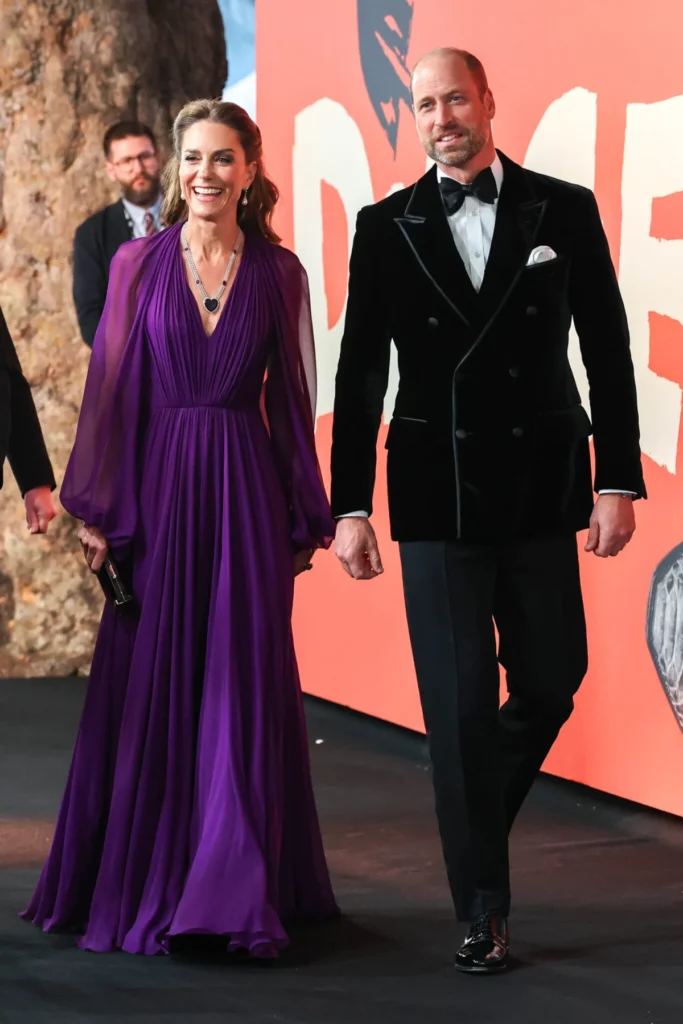

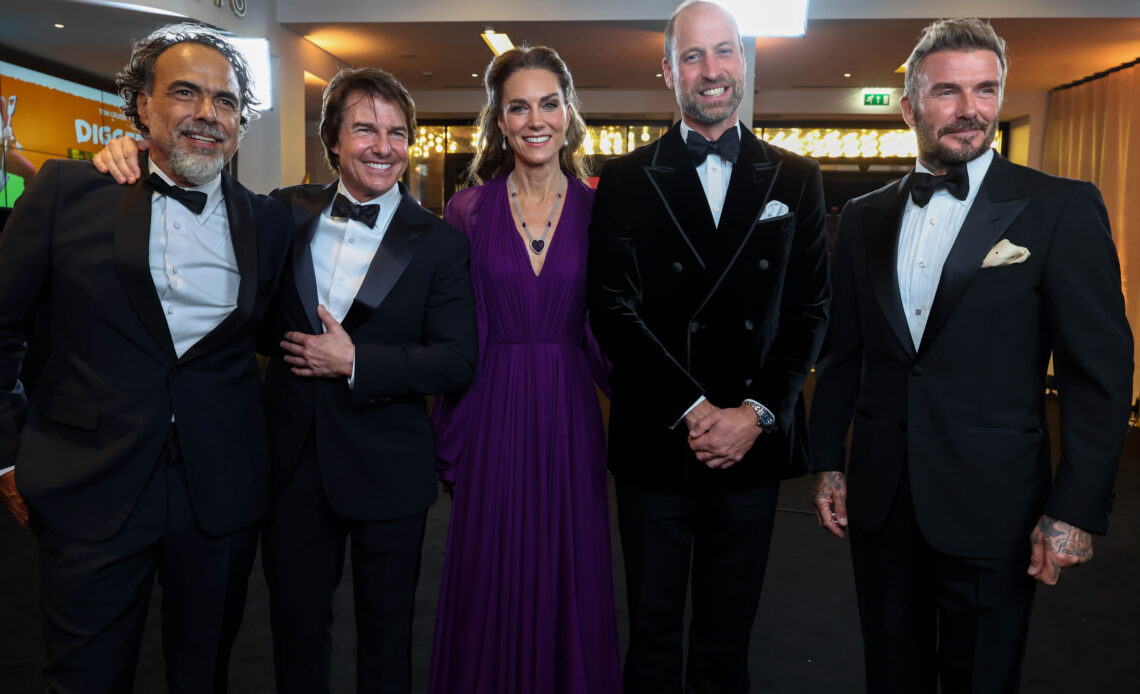
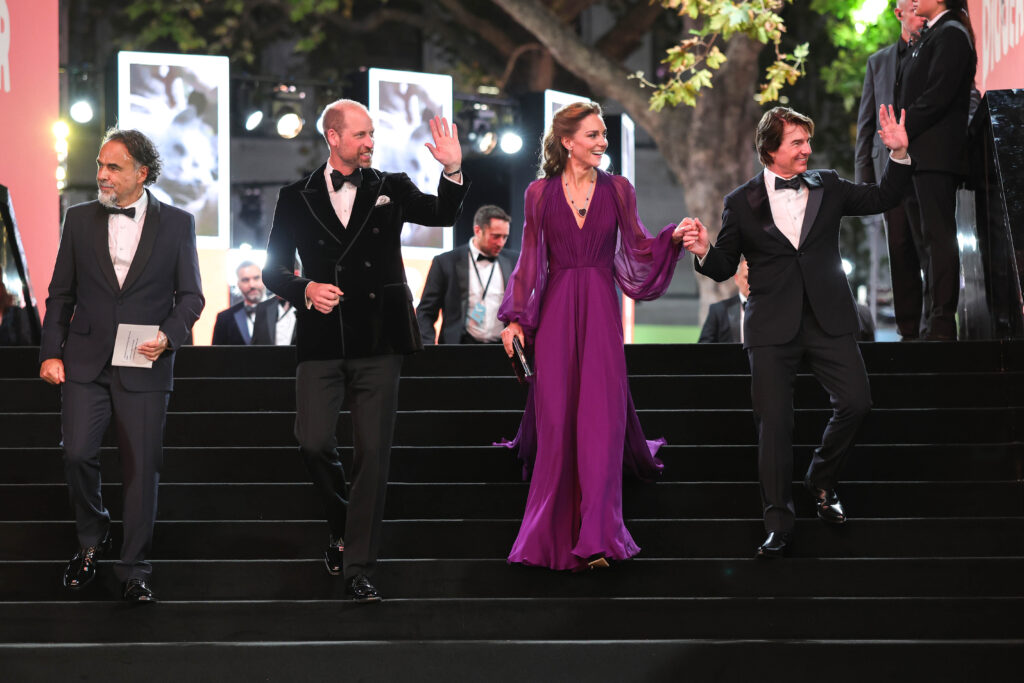
The central red carpet at London’s historic Leicester Square transformed into a dazzling intersection of Hollywood glamour and British royal heritage this week, as the Prince and Princess of Wales attended the star-studded world premiere of the new feature film Digger. Among the international cinema icons and industry luminaries in attendance, including Hollywood actor Tom Cruise, it was Catherine, Princess of Wales, who captured the global spotlight by unveiling a magnificent piece of royal jewelry that has remained largely hidden behind palace walls for over a decade.
Stepping out in support of the Film and TV Charity—an organization dedicated to supporting the mental health, financial wellbeing, and professional development of those working behind the scenes in the UK film and television industries—the Princess combined philanthropic commitment with a striking sartorial statement. For the high-profile gala evening, she selected a full-length Jenny Packham gown rendered in a deep, saturated shade of purple. Featuring flowing sleeves and a sophisticated deep V-neckline, the contemporary silhouette provided a striking backdrop for an extraordinary historical necklace crafted from diamonds, pearls, and amethysts.
The appearance of the rare sautoir necklace not only highlighted the Princess’s evolving fashion repertoire but also reactivated a fascinating lineage of royal provenance. The piece links the future queen directly to three former queens of the United Kingdom, offering a masterclass in how contemporary royals use historical artifacts to project continuity, legacy, and institutional stability.
A Century-Old Gift: Origins and Provenance
The remarkable diamond, pearl, and amethyst sautoir dates back precisely to 1923, commissioned and presented during an era of significant transition for the British monarchy. The piece was originally given as a wedding gift by Queen Alexandra, the dowager queen and widow of King Edward VII, to Lady Elizabeth Bowes-Lyon upon her marriage to Prince Albert, Duke of York—the second son of King George V, who would later unexpectedly ascend the throne as King George VI.
Queen Alexandra, renowned throughout her life as a formidable style icon, possessed a discerning eye for jewelry and fashion. Born Princess Alexandra of Denmark, she had arrived in Great Britain in 1863 to marry the Prince of Wales, quickly establishing herself as a trendsetter whose sartorial choices were meticulously documented by the press and emulated by the public. Her early exposure to fashion began during her upbringing in Copenhagen, where she and her siblings frequently fashioned their own garments. Decades later, as a dowager queen, Alexandra recognized a kindred spirit in the young Lady Elizabeth Bowes-Lyon.
Lady Elizabeth, celebrated for her forward-thinking approach to fashion, had caused a gentle stir among traditionalists by selecting a remarkably modern wedding dress for her 1923 nuptials at Westminster Abbey. Eschewing the heavily rigid, traditional royal aesthetic dominated by stiff lace, orange blossoms, and myrtle, Elizabeth chose a medieval-inspired, low-waisted drop-dress designed by Madame Handley Seymour. Recognizing this shared appreciation for modernity and elegance, Queen Alexandra gifted the bride the striking amethyst and diamond sautoir—a design that felt remarkably fresh and avant-garde for the roaring 1920s.
The Journey Through Generations of Queens
A sautoir is a long necklace or scarf-like chain, often featuring tassels or prominent pendants, which gained immense popularity during the Edwardian and Art Deco periods. The piece presented to the future Queen Elizabeth combined the romanticism of a heart-shaped amethyst center stone with the timeless luster of pearls and the icy brilliance of diamonds.
Following its creation and initial presentation in 1923, the necklace entered the extensive vaults of the British royal family. The bride who received it would eventually become Queen Elizabeth The Queen Mother, guiding the nation alongside her husband through the turbulent years of the Second World War. Yet, despite its significant sentimental value, the sautoir gradually slipped out of public rotation, rarely seen at official state functions or public engagements.
For decades, the jewel remained dormant in the royal collection until it experienced a rare public outing in 2012. That year, Camilla, Duchess of Cornwall (now Queen Camilla), selected the historic necklace to wear to the world premiere of the James Bond film Skyfall at the Royal Albert Hall in London. The appearance demonstrated the versatility of the piece, pairing a 20th-century royal heirloom with the red carpet demands of a 21st-century blockbuster premiere.
Now, fourteen years after its last major public sighting, the Princess of Wales has brought the sautoir back into the light. By wearing the necklace, Kate has forged a direct visual and historical bridge connecting her to three remarkable consorts in modern British history: Queen Alexandra, who commissioned and gifted the piece; Queen Elizabeth The Queen Mother, who first wore it; and Queen Camilla, who revived it in the modern era.
The Red Carpet Event: Supporting the Film and TV Charity
Beyond the considerable fascination generated by the royal jewelry, the primary purpose of the Prince and Princess of Wales’s appearance at Leicester Square was to champion the vital work of the Film and TV Charity. Founded in 1924, the charity has spent a century providing crucial support to the thousands of creative professionals who constitute the backbone of the British screen industries.
In recent years, the organization has intensified its efforts to address systemic issues within the sector, including long working hours, lack of job security, and mental health challenges amplified by the post-pandemic economic landscape. By lending their patronage and high-profile presence to the premiere of Digger, Prince William and Princess Catherine sought to draw widespread public attention to the challenges faced by behind-the-scenes workers, from grips and gaffers to costume designers and script supervisors.
Industry insiders and charity representatives noted that royal patronage provides an invaluable platform for fundraising and awareness. "Having the Prince and Princess of Wales here tonight shines an undeniable light on the tireless, often unseen work of our creative community," remarked a senior spokesperson for the Film and TV Charity. "Their continued advocacy validates the struggles of our workforce and helps secure the resources needed to expand our mental health and financial support services."
Strategic Sartorial Diplomacy
Fashion historians and royal commentators have frequently analyzed the deliberate sartorial choices made by senior members of the British royal family, often describing them as a form of non-verbal communication or "diplomacy." By selecting a deep purple Jenny Packham gown—a color historically associated with royalty, nobility, and power due to the historical scarcity and expense of purple dyes in antiquity—the Princess of Wales struck a balance between regal authority and modern approachability.
Pairing the contemporary British designer gown with a century-old royal heirloom further illustrates a growing trend among younger royals: sustainability and heritage through the recycling of historic assets. Rather than commissioning entirely new parures of jewelry for a high-profile entertainment gala, Kate chose to delve into the royal archives, honoring the legacy of past royal women while celebrating British craftsmanship across generations.
Furthermore, the choice of a film premiere as the venue for such a major jewelry debut highlights the monarchy’s strategic engagement with the creative arts and modern entertainment industries. As the United Kingdom seeks to reinforce its position as a global cultural hub, the active participation of the Prince and Princess of Wales in premier cinematic events underscores the soft-power influence wielded by the institution.
Broader Implications and Future Outlook
As the Princess of Wales continues to step into increasingly prominent roles within the royal hierarchy, her careful curation of historical artifacts signals a deep respect for the institution’s traditions combined with a distinctly modern sensibility. Every element of her public presentation—from championing UK-based designers like Jenny Packham to honoring former queens through thoughtfully chosen jewelry—is analyzed for its symbolic weight.
The resurrection of Queen Alexandra’s amethyst and diamond sautoir serves as a potent reminder of the vast, living museum that is the British royal collection. These pieces are not merely static exhibits locked behind glass; rather, they are active participants in the ongoing narrative of the monarchy, worn by successive generations to project continuity, elegance, and historical depth.
As the cameras flashed in Leicester Square, capturing the interaction between Hollywood stars and British royalty, the glittering heart-shaped amethyst at the center of the Princess’s necklace stood as a testament to a century of royal history. For a future queen consort, wearing a jewel passed down through a lineage of influential royal women is more than a fashion statement—it is a quiet, confident nod to the past as she prepares to shape the future of the crown.