
When Guillaume Excoffier first arrived in Beirut in the early 2010s, he was not merely a visitor; he was a design professional seeking a deeper connection to the architectural narratives of the Levant. The French interior designer and former gallery owner found himself captivated by the city’s dense, layered history, specifically the period between the 1950s and the mid-1970s. This era, characterized by rapid economic growth and a burgeoning middle class, left the city with a unique structural footprint: a collection of modernist landmarks ranging from Brutalist office monoliths to residential blocks inspired by the principles of Le Corbusier.

The Architectural Legacy of Post-War Beirut
The mid-century transformation of Beirut was part of a broader regional trend where international architectural experiments were adapted to suit the specific needs of the Mediterranean climate. Architects working in the region during this time faced a complex mandate: to integrate modern prefabrication techniques and new materials with the traditional requirements of Middle Eastern life.
The resulting structures featured ingenious climate-control solutions, including deep breezeways, sun-shielding screens, and structural innovations designed to navigate the city’s notoriously steep topography. Furthermore, many architects successfully reinterpreted the Ottoman-era triple-arched dwelling, merging traditional Lebanese vernacular with the clean, functional lines of global modernism.

However, the history of these structures is inextricably linked to the region’s political instability. Major architectural projects, such as Oscar Niemeyer’s iconic design for the Tripoli International Fair, commissioned in 1963, serve as poignant reminders of interrupted ambition. Construction on the site was halted due to the outbreak of the Lebanese Civil War, leaving a masterwork in a state of suspended animation—a physical manifestation of the stops and starts that have defined urban development in the country for decades.
A Personal Archive: Documenting a Modernist Vision
Excoffier’s fascination with this architectural landscape culminated in the publication of Modernist Beirut, a book co-authored with photographer Matthieu Salvaing and released by Éditions Norma. The project serves as a visual and historical catalog of a period that many residents viewed as a precursor to a brighter, more cosmopolitan future.

The book does not merely celebrate the aesthetics of the buildings; it analyzes them as a social record. By documenting the spatial logic of these structures, Excoffier highlights how the architecture reflected the optimism of a society in transition. For Excoffier, the project eventually transcended professional research. In 2023, he sought to immerse himself in this legacy by securing a residence in the Ashrafieh district, a neighborhood known for its historic and cultural significance.
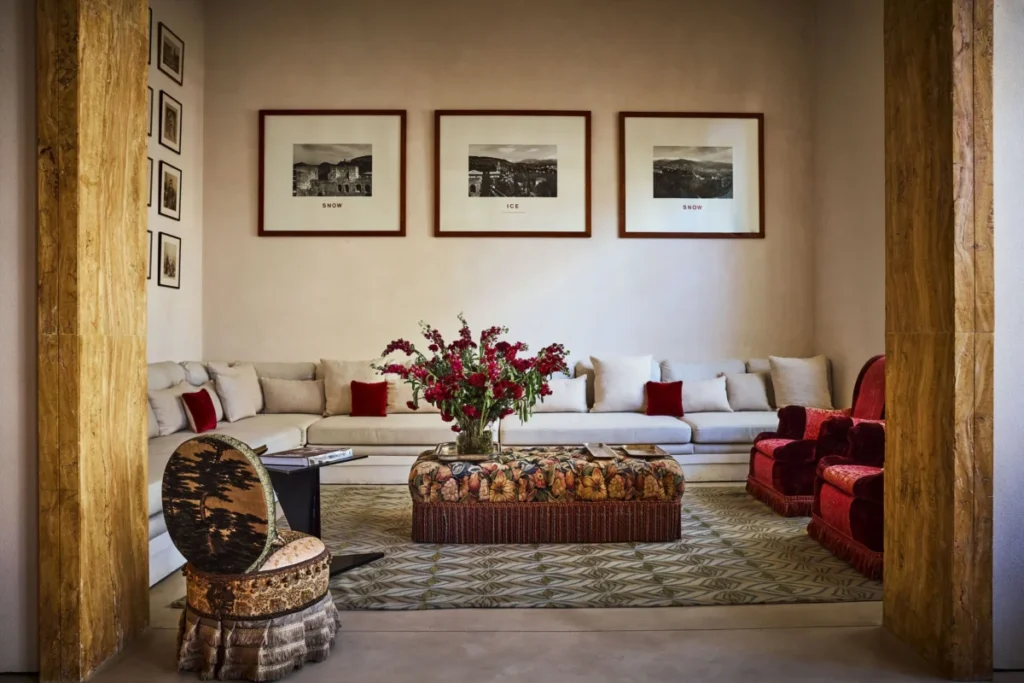
The apartment, located in a 1952 building, offered the raw material he desired: 13-foot-tall ceilings and a generous, airy volume that echoed the loft-like atmosphere of mid-century industrial spaces. Upon acquiring the property, he stripped away decades of disjointed renovations, opting for concrete floors and period-accurate window frames to return the space to its structural essence, effectively creating a blank canvas for his own collection of artifacts.

The Intersection of Eras: A Curation Strategy
Excoffier’s approach to interior design is rooted in the belief that historical objects can engage in a meaningful dialogue across centuries. In his own home, this manifests as a juxtaposition of 19th-century antiques and 20th-century avant-garde pieces.
Drawing inspiration from high-profile auctions—including the notable dispersal of Mica Ertegun’s collection—Excoffier has developed an affinity for Biedermeier furniture. This 19th-century Central European style, characterized by its rejection of excessive ornamentation in favor of clean, architectural lines, is often considered a spiritual precursor to modernism. In his dining room, a circa 1810 Biedermeier cabinet stands in conversation with a postmodern cabinet by Aldo Rossi. The comparison is intentional: both pieces share a pyramid-top geometry, demonstrating how design logic can transcend the limitations of time and cultural origin.

The living area is equally eclectic, housing Philippe Starck’s tubular Dr. Sonderbar chairs, Josef Hoffmann’s Purkersdorf seats, and André Dubreuil’s Spine sculpture. This intentional mix challenges the notion that a space must adhere to a single design movement to feel cohesive. Excoffier argues that the density of these objects reflects the social reality of Beirut itself. "Beirut is not about minimalism," he observes. "It is a city of layers, gatherings, and complex interactions."
Local Craftsmanship and Global Context
While Excoffier’s collection includes internationally recognized design icons, he has made a conscious effort to integrate the work of local Lebanese craftspeople into his home. This synthesis serves to ground his high-design artifacts in the local context of the city.

The sectional sofa, the dining table, and the bookshelves—constructed from local plaster-finished bricks—were all fabricated within a short distance of his apartment. Even the playful, oversized ice cream cones that decorate the bedroom were sourced from a local shop. These objects serve as a testament to the city’s continued vitality; for Excoffier, they are not merely decorative but are symbolic of the city’s ability to repurpose and reinterpret external influences.
This hybrid approach to design—marrying the global with the hyper-local—has become a hallmark of his practice. By sourcing utilitarian pieces locally and pairing them with significant art, such as the Richard Artschwager lithographs that define his kitchen wall, he creates a space that feels both intellectually rigorous and authentically lived-in.

Broader Implications for Urban Preservation
The preservation of Beirut’s modernist architecture remains a critical issue for urban planners and historians. As the city continues to navigate the pressures of modern development and the ongoing effects of global conflict, many of these mid-century structures face the threat of demolition or insensitive renovation.
Experts note that the loss of these buildings would represent a significant gap in the historical narrative of the Middle East. These structures were not just dwellings; they were laboratories for the modernization of urban life in the region. The efforts of individuals like Excoffier to document and inhabit these spaces contribute to a growing movement aimed at recognizing and protecting this unique heritage.

Furthermore, the economic implications of preserving these sites are becoming increasingly clear. Cities that successfully integrate their architectural history with contemporary use often see a revitalization of their urban centers. By treating these modernist buildings as viable assets rather than obsolete relics, stakeholders in Beirut could potentially foster a more resilient and culturally rich urban future.
Conclusion: A Reflective Practice
Excoffier’s transition from a Paris-based gallery owner to a designer working between Paris, Beirut, and Dubai marks a shift in his professional trajectory. His career, which began with a deep appreciation for the art world and led to the founding of the gallery Guillaume, has now focused on the intimate act of creating environments that bridge history and modernity.

His home in Ashrafieh is more than a residence; it is a laboratory for testing the limits of what a living space can be. It asks whether a room can simultaneously hold the weight of 19th-century tradition and the sharp, sometimes ironic, sensibilities of the 1980s. Through his work, Excoffier provides a template for how contemporary dwellers might engage with the past—not by hiding it behind modern veneers, but by letting it stand in honest, sometimes provocative, conversation with the present. As he continues to scour global markets for everything from rare Jean Royère pieces to everyday objects, he remains committed to the search, finding beauty in the juxtaposition of the monumental and the mundane.