
The exhibition draws heavily from the extensive personal collection of Dung Ngo, a prominent editor and collector whose fascination with the "architecture of the table" has culminated in both this museum presentation and an accompanying monograph published by August Editions. By examining the evolution of the knife, fork, and spoon over the last 125 years, the Denver Art Museum provides a window into the shifting social mores, industrial breakthroughs, and artistic movements that have defined the modern era.
The Evolution of Domestic Design Since 1900
The chronological scope of the exhibition begins in 1900, a period marked by the transition from the ornate, often excessive silver services of the Victorian era toward the streamlined functionalism of the 20th century. In the early 1900s, flatware was a primary indicator of social class and etiquette, with specialized utensils for everything from sardines to strawberries. As the century progressed, however, the influence of movements such as the Bauhaus and Mid-Century Modernism began to strip away superfluous ornamentation in favor of ergonomic efficiency and mass-production capabilities.

The exhibition highlights how material innovation dictated design possibilities. The introduction of stainless steel in the early 20th century revolutionized the industry, offering a durable, rust-resistant, and more affordable alternative to sterling silver. This shift democratized high-quality design, allowing renowned architects and industrial designers to bring avant-garde sensibilities to the average household. By the mid-20th century, flatware had become a playground for legendary designers such as Arne Jacobsen, Gio Ponti, and Tapio Wirkkala, whose works are represented in the collection as benchmarks of "good design."
As the timeline moves into the late 20th and early 21st centuries, the exhibition captures the postmodern turn, where designers began to reintroduce playfulness, irony, and historical allusion into their work. This era saw a move away from the "form follows function" dogma, setting the stage for the contemporary experimental works that anchor the final section of the show.
KFS 3.0: The Digital Frontier of Flatware
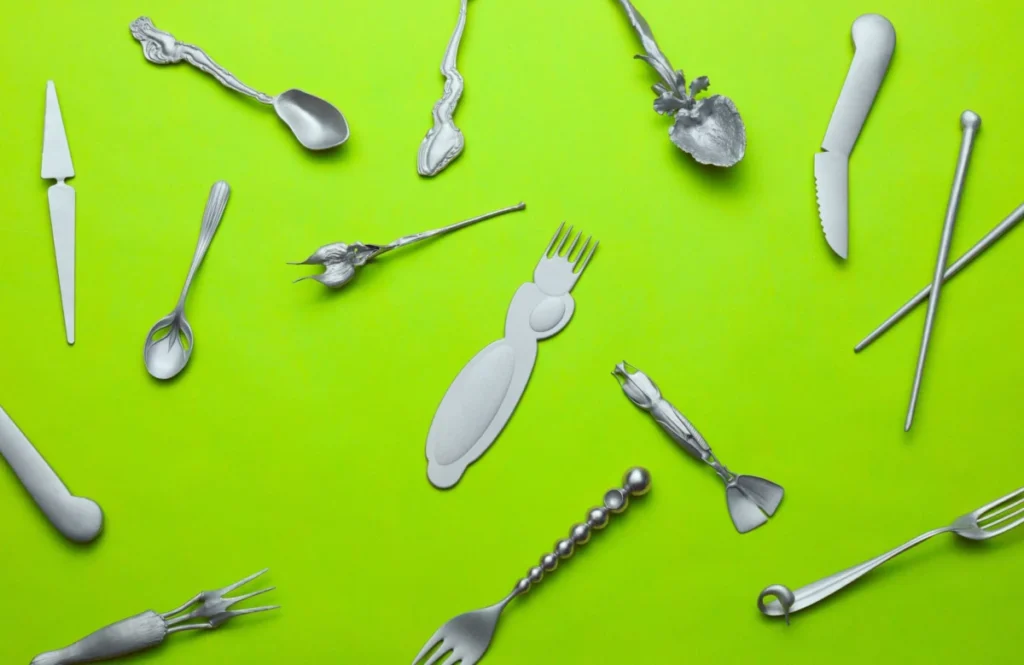
A central highlight of the exhibition is the "KFS 3.0" series, a collection of 12 3D-printed stainless-steel sets, 11 of which were specifically commissioned for this project. Conceived by Dung Ngo, this series represents a radical departure from traditional manufacturing methods like forging or casting. By utilizing additive manufacturing, the participating designers were able to explore complex geometries and intricate textures that would be nearly impossible to achieve through conventional means.

These contemporary commissions, which are also available for purchase through the Marta gallery, serve as a provocative commentary on the current state of design. As Ngo notes, the goal was not necessarily to create the most ergonomic tools, but to use flatware as a medium for artistic expression. The results are "out-there" designs that reflect the anxieties, technological capabilities, and aesthetic preoccupations of the 2020s.
Among the notable commissions is Anima by Jolie Ngo, which utilizes the precision of 3D printing to create forms that feel organic yet digital. Similarly, the firm Charlap Hyman & Herrero produced Liquid Flatware, a set that takes the familiar silhouettes of baroque silverware and subjects them to a surrealistic digital "melt," resulting in objects that look as though they are caught between solid and fluid states. These pieces challenge the viewer to reconsider the tactile relationship between the hand, the tool, and the food.
Global Rituals and Cultural Synthesis
One of the most significant contributions of the exhibition is its effort to decenter the Western-centric narrative of flatware. While the "knife, fork, and spoon" triad is the standard in much of the world, the exhibition acknowledges that eating rituals are diverse and deeply rooted in specific cultural histories.

Designer Nifemi Marcus-Bello, based in Lagos, Nigeria, contributed a set titled FKS_2026 that includes a bowl traditionally used for rinsing one’s fingers. In many Nigerian and broader African culinary traditions, eating by hand is a communal and ritualistic act. By including a finger-rinsing vessel within a "flatware" exhibition, Marcus-Bello and curator Darrin Alfred expand the definition of what constitutes a "tool for eating," recognizing that the ritual of the meal begins before the first bite is taken.
Similarly, Minjae Kim’s contributions bridge the gap between hand-sculpted craftsmanship and digital fabrication. Kim first hand-modeled his utensils in clay, capturing the idiosyncratic imprints of the human touch before they were translated into the digital realm for 3D printing. This hybrid approach reflects a growing desire among contemporary designers to retain a sense of the "handmade" in an increasingly automated world.
Materiality and the Art of the Table
The exhibition also delves into the botanical and organic inspirations that have long influenced domestic tools. Marcin Rusak’s Ghost Orchid set renders detailed, delicate botanical forms in hardened stainless steel, turning a fork into a literal branch of nature. This work serves as a reminder of the historical link between silverware and the natural world, echoing the floral motifs of 18th-century rococo design but updated with a haunting, contemporary precision.

Other featured works, such as David Wiseman’s Lattice and Johnston Marklee’s ROCK. PAPER. SCISSORS., explore the intersection of architecture and domesticity. Johnston Marklee, an architectural firm known for its minimalist and structural approach, brought a sense of geometric rigor to their flatware design, treating the spoon and knife as micro-structures.
The inclusion of Greg Lynn’s 2007 Flatware for Alessi provides a critical link between the early experiments in "blob architecture" and the current 3D-printing revolution. Lynn, a pioneer in using computer-aided design to create biomorphic forms, showed nearly two decades ago how digital tools could reshape the most intimate of household objects.
Curatorial Analysis and Broader Implications
The Denver Art Museum’s decision to host such an extensive long-term exhibition on flatware underscores a broader trend in the museum world: the elevation of "everyday" objects to the status of high art. Curator Darrin Alfred posits that because we use these tools daily without conscious thought, they are uniquely positioned to reflect the subtle changes in our civilization.

From a socio-economic perspective, the exhibition tracks the shift from silver as a store of familial wealth to stainless steel as a symbol of industrial progress, and finally to 3D-printed metal as a signifier of the "bespoke digital" era. The KFS 3.0 project, in particular, suggests a future where manufacturing is localized and "on-demand," allowing for a level of customization and artistic experimentation previously reserved for the ultra-wealthy.
Furthermore, the exhibition arrives at a time when the "rituals of the table" are being redefined by global migration and a heightened awareness of cultural diversity. By placing Nigerian finger-bowls alongside Alessi spoons and 3D-printed botanical forks, the museum fosters a dialogue about how we nourish ourselves and how those methods define our identity.
Exhibition Logistics and Legacy
"Knife Fork Spoon: Everyday Tools, Extraordinary Design" is not merely a static display but a multi-platform project. The accompanying book by August Editions serves as a permanent record of Dung Ngo’s collection and the new commissions, providing scholarly context for the 150 objects on display. The collaboration with Marta gallery ensures that the contemporary designs move beyond the museum walls and into the homes of collectors, fulfilling the objects’ original purpose as functional (if experimental) tools.

The exhibition is scheduled to remain on view through May 2028, reflecting the museum’s commitment to providing deep, accessible design education to the public. As visitors move through the gallery, they are encouraged to look closely at the objects they usually take for granted. In doing so, they discover that a simple spoon is not just a tool for sustenance, but a masterpiece of engineering, a record of historical change, and a canvas for the imagination.
By the end of the survey, it becomes clear that the evolution of flatware is the evolution of humanity itself—our discovery of materials, our refinement of social graces, and our constant desire to marry the utilitarian with the beautiful. The Denver Art Museum has succeeded in turning the kitchen drawer into a gallery of innovation, proving that extraordinary design is often right in the palm of our hand.