
It has been a rigorous and demanding three-year journey for Jarno Zaffelli, the Italian visionary behind the global track design firm Dromo. With a quarter-century of experience and a portfolio spanning more than 200 motorsport venues across the globe, Zaffelli is accustomed to the complexities of high-stakes engineering. However, this weekend marks a career milestone as the "Madring"—the highly anticipated, purpose-built Formula 1 street circuit in the heart of Spain’s capital—officially welcomes the world’s elite racing drivers.
The project represents a significant departure from traditional purpose-built racing facilities. By integrating the sprawling infrastructure of the IFEMA convention center with the urban arteries of the Valdebebas neighborhood, near the Madrid-Barajas airport, Zaffelli has attempted to solve the "street circuit paradox": the historical tendency for temporary city tracks to produce processions rather than competitive races due to narrow widths and a lack of overtaking opportunities.

A Three-Year Chronology of Construction
The genesis of the Madring project traces back to the rapid post-pandemic surge in Formula 1’s global viewership, catalyzed by the success of the Netflix docuseries Drive to Survive. As the sport transitioned into a lifestyle brand, the demand for "destination races" in major metropolitan centers skyrocketed. Following the successful introduction of street-based events in Miami, Las Vegas, and Jeddah, the mandate for the Madrid project was clear: build a track that offers the urban spectacle of a city center race while retaining the technical integrity of a permanent circuit.
Construction commenced in April 2025, triggering a 17-month phase of intense civil engineering. The project required the movement of approximately one million square meters of earth to reshape the local topography. Unlike many street circuits that simply pave over existing public roads, the Madring was conceived as a hybrid. The final 5.4-kilometer configuration utilizes 1.5 kilometers of existing public infrastructure, with the remainder of the track purpose-built to meet the stringent FIA Grade 1 safety standards required for Formula 1 competition.
Engineering the "La Monumental" Turn
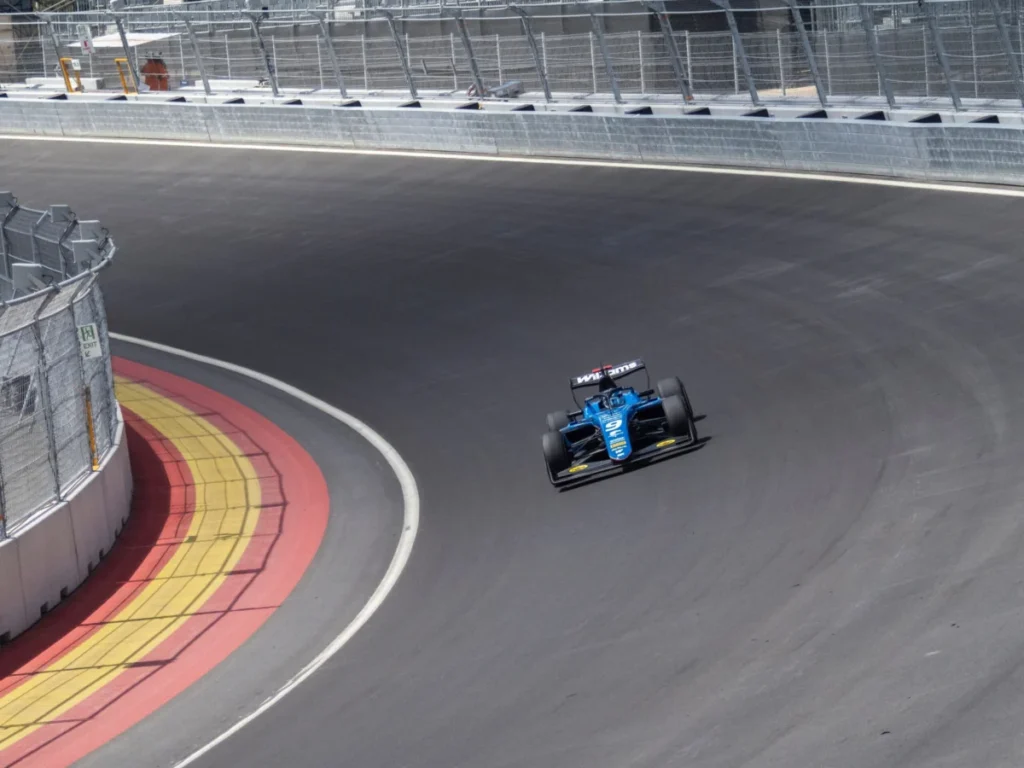
The standout feature of the layout is undoubtedly Turn 12, colloquially dubbed "La Monumental." In an era where modern F1 tracks are often criticized for their lack of elevation, Zaffelli’s design introduces a radical 24% slope gradient. Peaking at a 10-meter height differential, this banked corner stands as the second steepest on the current Formula 1 calendar.

"We wanted to create something truly dramatic and inherently difficult," Zaffelli stated in an interview with Architectural Digest. "A banked corner on its own can feel artificial or static. The achievement here lies in the preceding corners, which feature ten meters of elevation change. The goal was to manipulate the driver’s perception, forcing them to push their limits while experiencing high-speed forces that feel even more intense than the telemetry data suggests."
The structural integrity of this turn was a primary focus for the design team. Beyond the physics of the banking, the circuit was designed to foster an "arena" effect. Zaffelli prioritized the placement of grandstands and hospitality suites in immediate proximity to the track, particularly around the high-G sections of the course. This creates a stadium-like atmosphere where the vibrations of the engines—reaching speeds in excess of 300 kilometers per hour—can be physically felt by the spectators.
Navigating the Bureaucratic Labyrinth
One of the most significant challenges in building a street circuit is the administrative burden. Zaffelli noted that his team had to synchronize efforts with over 50 distinct entities, ranging from local municipal transportation departments and environmental agencies to the stringent security protocols of the Madrid-Barajas airport.

Early in the development phase, the design team made a strategic decision to scale back the use of public roads by more than 50% compared to initial concepts. This was done not only to mitigate disruption to local residents in the Valdebebas area but to reduce the legal and administrative hurdles associated with long-term road closures. By integrating the IFEMA convention center as the central hub for the paddock, pit garages, and media facilities, Zaffelli ensured that the most complex logistical operations remained within a self-contained, managed zone.
Skepticism and Performance Data
Despite the ambitious design, the circuit has faced scrutiny from seasoned motorsport experts. Robert Barnard, a veteran designer noted for his work on the Adelaide Street Circuit, has expressed concern regarding the track’s sightlines. "The danger with these sharp, narrow corners is the loss of visibility," Barnard explained. "If a driver cannot see through the apex, they are inherently less likely to commit to a high-speed maneuver. Without confidence in the track ahead, you risk a stagnant race."
These concerns were amplified following a recent Formula 3 test session, which resulted in 19 red flags. While critics argue this indicates a dangerous or overly difficult track, proponents suggest the data is misleading. Formula 3, serving as a junior feeder series, involves younger, less experienced drivers who are more prone to incident during the learning phase of a new circuit.

Longtime analyst David Hobbs remains optimistic, drawing parallels to his own experience covering inaugural races. "Formula 3 is inherently more volatile than Formula 1," Hobbs noted. "The true test will be how the engineers adjust the ride height and suspension stiffness to handle the extreme G-forces. The energy of an inaugural race in a major capital city usually transcends the technical debates."
The Broader Impact on the F1 Calendar
The Madrid Grand Prix represents a pivotal moment for the sport’s European footprint. As Formula 1 faces pressure to balance its traditional heritage circuits with the commercial requirements of modern, urban-based events, the success of the Madring will likely serve as a blueprint for future infrastructure projects.
From an economic perspective, the event is expected to draw hundreds of thousands of fans, significantly impacting local tourism and the hospitality sector. The integration of the IFEMA center provides a sustainable model for hosting large-scale events, as the venue does not require the construction of temporary facilities that are discarded after the race weekend.

As the grid prepares for the 2026 Spanish Grand Prix this weekend, September 11–13, all eyes will be on the track surface. For Jarno Zaffelli, the weekend is the culmination of years of theoretical modeling and structural labor. His objective remains clear: to prove that the "street circuit" label does not have to be synonymous with "dull racing."
"My hope is that the audience walks away with the realization that we have achieved something unique," Zaffelli said. "If the fans can feel the cars in the pits of their stomachs and the drivers find the track both demanding and rewarding, then we have succeeded in redefining what a city-center circuit can be."
Whether the Madring becomes a classic fixture or a controversial addition to the calendar remains to be seen. However, the sheer engineering ambition behind the project ensures that it will be one of the most talked-about events in the 2026 racing season. As the lights go out, the intersection of urban planning and high-performance racing will finally be put to the ultimate test.