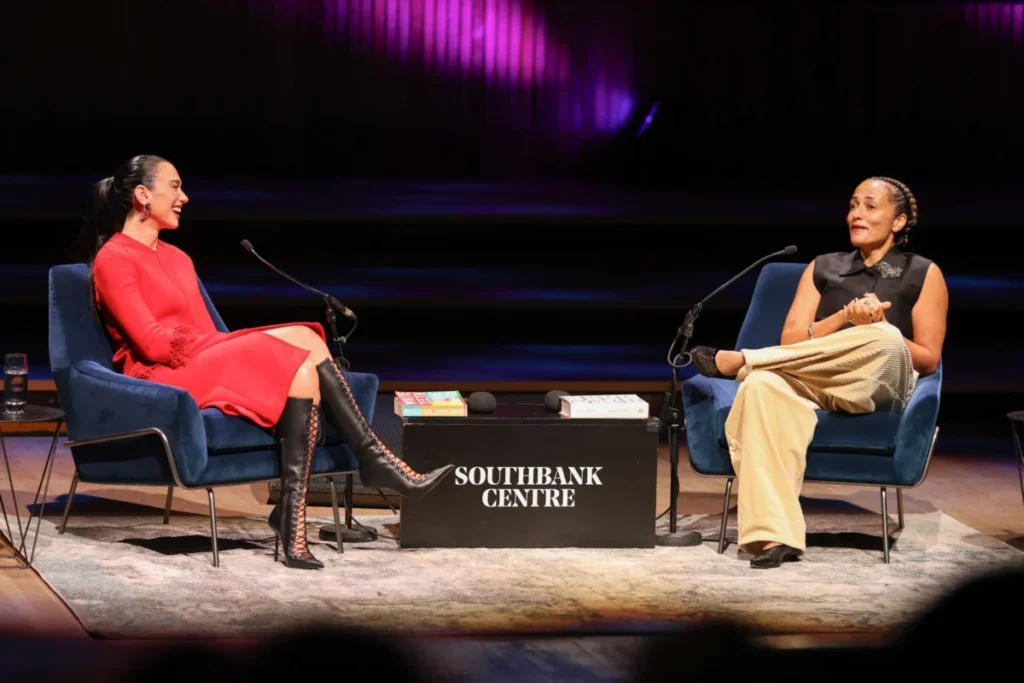

Literary luminary Zadie Smith delivered a sobering assessment of contemporary British life during a high-profile appearance at the Southbank Centre this past Saturday. Participating in a discussion hosted by pop superstar Dua Lipa as part of the London Literature Festival—an event marking the iconic arts venue’s 75th anniversary—Smith offered a poignant critique of how economic structural decay has fundamentally altered the social fabric of the capital.
The conversation, which centered on the legacy of Smith’s breakout 2000 novel, White Teeth, moved rapidly from literary analysis to an examination of the "existential" anxieties now defining life in modern London. Smith, who was born and raised in the city, noted that the camaraderie once afforded by a robust welfare state has been replaced by a pervasive sense of alienation. "It has become very, very natural to look to your left and think: ‘Who the f*** are you?’" she remarked, characterizing this shift as an outcome of economic and structural decline.

The Welfare State as a Social Anchor
To understand Smith’s perspective, one must look at the specific socioeconomic context of her debut novel. White Teeth chronicles the lives of the Iqbal and Jones families in north-west London between 1975 and the end of the millennium. During this era, as Smith reminded the audience, residents benefited from an "incredible, historic welfare system" that provided universal access to free education, subsidized housing, and the National Health Service (NHS).
Smith argued that this safety net provided a baseline of dignity that mediated social tensions. While the characters in her novel navigated the frictions of multiculturalism, these disputes were not existential threats to their survival. "When the person next to you is in the same classroom, when you’re living in basically decent housing, when you hurt yourself and then you can go to hospital and be treated just like the rich kid down the road—then the differences become interesting, sometimes annoying, but not existential," she explained.
However, the author posited that the steady erosion of these public institutions has transformed neighborly differences into sources of profound insecurity. "Now they’re existential, that’s a different matter," she stated. "When you can’t get a job, when there’s no housing, when your schools are falling apart, when the hospitals are falling apart, now it feels existential."

A Changing Landscape: Immigration and Politics
The discussion took a geopolitical turn when Dua Lipa, 31, pressed the novelist on the current climate of division in the United Kingdom. Lipa highlighted how immigration remains a central fault line in contemporary discourse, citing the impact of Brexit, the rise of the Reform UK party, and the ongoing political protests surrounding small-boat arrivals.
Smith’s response avoided partisan talking points, instead framing the issue through the lens of social expectation. She suggested that the current hostility is less about a sudden explosion of irreconcilable cultural differences and more about a widespread realization that the "equal experience" once promised by the welfare state is no longer guaranteed. "It’s not that there is such an extraordinary traumatic difference between these faiths—it’s that people have no expectation of an equal experience with their neighbour," she observed.
The author referenced the North African concept of "Sankofa," which encourages individuals to look back into history to retrieve what is valuable for the future. For Smith, this means distinguishing between the regressive aspects of the 1980s and 90s—such as pervasive racial prejudice and antiquated attitudes toward LGBTQ+ rights—and the functional social democracy that allowed for social mobility. She urged a reconsideration of the universalist values that once underpinned the British state, questioning whether a society that "cared about" such foundations could recreate them today.

The Weight of Early Stardom
Beyond the sociopolitical commentary, the event offered a rare glimpse into Smith’s personal development following the meteoric success of White Teeth. Published when Smith was just 24, the novel transformed her into a household name, a transition she described as overwhelming and, at times, alienating.
"My reaction was kind of defensive, I felt like people envied me and I didn’t want them to envy me," she recalled. This defensiveness manifested as a deliberate withdrawal from the spotlight. She famously declined high-profile invitations, such as serving as a judge at the Cannes Film Festival, a decision she now views with a measure of self-deprecating humor. "Now I’m 51 and I think oh that might have been fun to be a judge at Cannes, you didn’t have to be such a bluestocking," she laughed.
Smith also drew parallels between her own experience of public scrutiny and that of other iconic British women from her generation, including Amy Winehouse and Lily Allen. She noted that while a writer’s experience of fame is different from that of a pop star, the era was defined by a tabloid culture that was often "unpleasant" for young women.

She recounted an illustrative anecdote regarding the intellectual climate of the late 1990s. When asked by a journalist to name her favorite writers, she cited Toni Morrison. The journalist’s reaction—a dismissive laugh—left a lasting impression. Smith reflected on how "comically woke" it was considered at the time to reference a Nobel laureate if she happened to be an African American woman. "Those kind of attitudes were pretty exhausting," she admitted, adding that the cultural expectation of the time was that a young author should prioritize celebrity over substance, often pressuring them to appear on reality television programs like Big Brother.
Implications for the Future of London
The analysis provided by Smith resonates with broader trends in British urban sociology. Data from the Office for National Statistics (ONS) and various housing think tanks have repeatedly highlighted the widening gap between housing supply and demand in London, as well as the increasing pressure on public services. As the cost-of-living crisis continues to impact the capital, Smith’s observation that neighbors no longer share a common "economic experience" aligns with findings from researchers who track rising inequality in urban centers.
By contrasting her own upbringing in the state education system—which she credits with giving her the ability to "talk to anyone"—with the present reality, Smith highlights the loss of the "social glue" that once defined London’s identity. The implication is clear: the polarization observed in modern politics is not merely a product of culture wars, but a direct result of a structural decay that forces citizens to view one another as competitors for dwindling resources.

As the London Literature Festival concludes its milestone 75th-anniversary programming, Smith’s reflections serve as both a historical record and a cautionary tale. She does not advocate for a return to the past in its entirety, but rather for a re-engagement with the project of social democracy. Whether such a project can be revitalized remains the central question for the next generation of Londoners. For now, Smith’s voice remains a critical bridge between the literary traditions of the past and the uncertain, fragmented reality of the present.