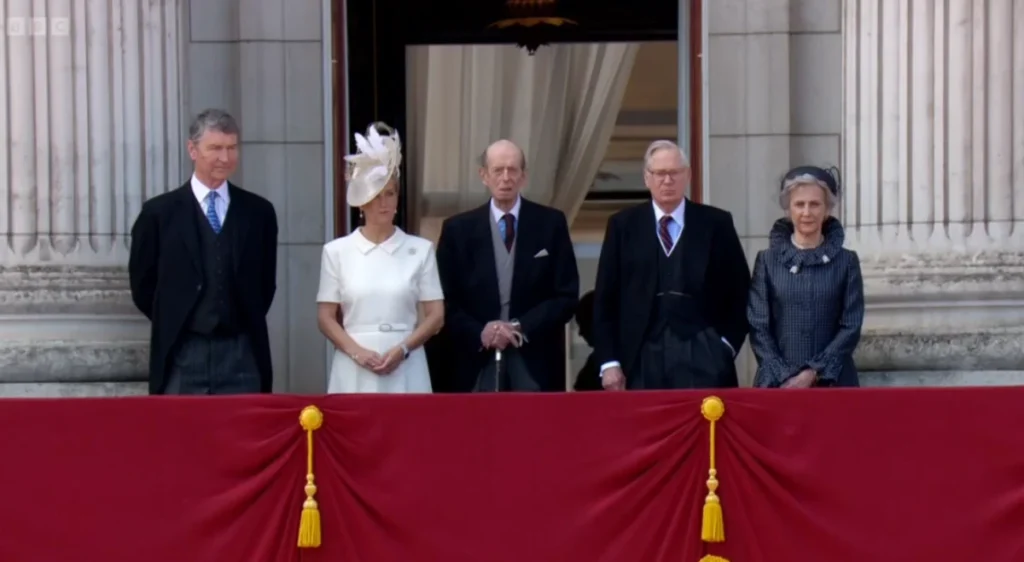

The venerable Duke of Kent, Prince Edward, a steadfast presence within the British Royal Family for decades, occupied a significant position alongside senior royals on the iconic balcony of Buckingham Palace. His presence marked a poignant moment as the family gathered to welcome His Majesty King Charles III back from the grand spectacle of Trooping the Colour, the Sovereign’s official birthday parade. At 90 years old, the Duke’s participation underscored his enduring connection to this cherished national tradition and his continued dedication to royal duties.
The Duke watched from his vantage point as King Charles III and Queen Camilla returned to the Palace after their ceremonial journey to Horse Guards Parade. This annual military event, steeped in history and tradition, serves to celebrate the monarch’s official birthday, a tradition that dates back centuries. The King, who has been undergoing treatment for an unspecified form of cancer, led the procession, a visible testament to his resilience and commitment to his constitutional role. His participation, alongside other senior members of the Royal Family, was keenly observed by the public and commentators alike, particularly in light of his ongoing health challenges.
Sharing the balcony with the Duke of Kent were other prominent members of the Royal Family, including the Duchess of Edinburgh, Sophie, who has increasingly taken on more visible public roles. Sir Tim Laurence, husband of Princess Anne, and the Duke and Duchess of Gloucester, Prince Richard and Birgitte, also joined the royal contingent, forming a tableau of continuity and service. This collective appearance on the Buckingham Palace balcony is a quintessential symbol of the monarchy, offering a public display of unity and shared duty.
Earlier in the day, the nation had witnessed the grandeur of the King’s Birthday Parade, with thousands of enthusiastic spectators lining the historic Mall, a ceremonial road leading to Buckingham Palace. The route was awash with the colours of the Household Division and the Royal Horse Artillery, as well as the vibrant hues of the Union Jack flags waved by the assembled crowds. The atmosphere was electric, a blend of national pride and patriotic celebration, a hallmark of British state occasions.
The procession itself was a meticulously choreographed display of military precision and royal pageantry. King Charles and Queen Camilla travelled in a magnificent State Carriage, drawn by the majestic Windsor Grey horses, a breed renowned for their calm temperament and impressive stature, perfectly suited for such ceremonial duties. The carriage’s ornate design and the gleaming harnesses of the horses added to the visual splendour.
Meanwhile, the operational heart of the parade saw members of the Royal Family actively participating in the military procession. The Prince of Wales, Prince William, who holds the Colonelcy-in-Chief of the Welsh Guards, the Princess Royal, Princess Anne, and the Duke of Edinburgh, Prince Edward (son of the Duke of Kent), all rode on horseback. Their uniformed presence on horseback, as is customary, underscored their direct involvement in the military aspect of the ceremony. This tradition of royals participating in the parade dates back to King George II in 1748, who established the event to combine the annual summer inspection of the Guards with a public celebration of his birthday.
The younger generation of the Royal Family also played a visible role. The Princess of Wales, Catherine, who has also been undergoing preventative chemotherapy, travelled in a carriage alongside her three children: Prince George, Princess Charlotte, and Prince Louis. The young royals, visibly excited, waved enthusiastically to the cheering crowds as their carriage made its way through the heart of London. Their presence, particularly after the Princess’s own health journey, was a source of considerable public interest and a comforting sight for many.
The Duke of Kent’s presence on the balcony carried a particular weight of historical significance, owing to his extensive and deeply personal connection with Trooping the Colour. For many decades, Prince Edward was not merely an observer but a central figure in the ceremony. He regularly rode in the parade, a testament to his military background and his commitment to the ceremonial duties associated with the Crown. His participation in the parade, and his subsequent presence on the balcony, often alongside his cousin, Queen Elizabeth II, marked some of the most significant moments of her long and historic reign.
In the later years of Queen Elizabeth II’s reign, the Duke of Kent became a familiar and reassuring sight, accompanying the late monarch on the dais at Horse Guards Parade as she took the salute. This role evolved over time, reflecting the changing needs and capabilities of the monarch and senior royals. The Duke’s unwavering support provided a sense of continuity and stability during these important public engagements.
His dedication was particularly evident in 2021. In the wake of the passing of his brother, Prince Philip, the Duke of Edinburgh, and amidst the stringent public health restrictions imposed due to the COVID-19 pandemic, Prince Edward stood beside Queen Elizabeth II for a significantly scaled-down Trooping the Colour. This ceremony, held in the Quadrangle of Windsor Castle, was a departure from the usual grand parade through London, but the Duke’s presence alongside the Queen was a powerful symbol of enduring loyalty and shared experience during a challenging period.
A year later, in 2022, the Duke of Kent was once again a steadfast companion to Queen Elizabeth II during her final Trooping the Colour. This event also marked the beginning of the Platinum Jubilee celebrations, a momentous occasion celebrating Her Majesty’s 70 years on the throne. The Duke’s consistent presence during these key milestones underscored his deep-rooted sense of duty and his profound connection to the British monarchy.
Historical Context of Trooping the Colour
Trooping the Colour is more than just a birthday parade; it is a centuries-old tradition that showcases the British Army’s finest regiments. The ceremony’s origins can be traced back to the 17th century, when flags, or "colours," were carried, or "trooped," down the ranks of soldiers so that they could recognize their unit’s flag in the heat of battle. This practice was essential for maintaining order and identification on the battlefield.
Over time, this military exercise evolved into a grand ceremonial parade. Today, it is a public celebration of the Sovereign’s official birthday, regardless of the actual date of birth. The event involves over 1,400 parading soldiers, 200 horses, and 400 musicians, all coming together in a magnificent display of military precision and synchronicity. The Royal Gun Salutes, fired in Hyde Park and the Tower of London, add to the ceremonial atmosphere. The procession typically moves from Buckingham Palace down The Mall to Horse Guards Parade, where the Sovereign inspects the troops.
The Royal Family’s Evolving Roles
The presence of various members of the Royal Family on the balcony and in the procession reflects an ongoing evolution in their public roles. As senior royals age or face personal challenges, younger members are stepping forward to undertake more prominent duties. King Charles III, having recently ascended to the throne, is establishing his own style of leadership. Queen Camilla has become an increasingly central figure, supporting the King in his duties.
The Prince and Princess of Wales, as the future King and Queen, are taking on increasingly significant responsibilities. The Princess of Wales’s return to public duties, even in a limited capacity, has been met with widespread support and relief. The Duchess of Edinburgh has also carved out a distinct role, focusing on areas such as supporting the arts and mental health initiatives. The Duke of Kent, in his advanced years, continues to embody a legacy of service, representing continuity and historical perspective.
Public Reaction and Analysis
The public’s reaction to Trooping the Colour is consistently one of strong engagement and patriotic sentiment. The event provides a tangible link to national history and tradition, something many find reassuring in an ever-changing world. The visible presence of the King, especially given his health, was a key talking point, with many expressing relief and admiration for his commitment. The appearance of the younger royals, particularly the Princess of Wales and her children, also resonated deeply, offering a glimpse into the future of the monarchy.
From an analytical perspective, Trooping the Colour serves multiple purposes. It is a powerful tool for military recruitment and public relations, showcasing the discipline and capability of the British Armed Forces. It reinforces the symbolic connection between the Sovereign and the military. Furthermore, it provides a crucial platform for the Royal Family to engage with the public, demonstrating their presence, accessibility, and dedication to service. The careful choreography of appearances, from the balcony to the procession, is a strategic element of royal public relations, aimed at fostering a sense of national unity and continuity.
The Duke of Kent’s enduring presence, particularly his participation in events like Trooping the Colour, highlights the importance of historical continuity within the monarchy. While younger generations are stepping into more prominent roles, the older generation’s continued involvement provides a bridge to the past, offering a sense of stability and tradition. His decades of service, often performed with quiet dignity, underscore the often-unseen but vital contribution of senior royals in maintaining the monarchy’s relevance and public trust. His continued presence on the balcony, even as his active participation in the parade has naturally diminished with age, is a testament to his unwavering commitment to the Crown and the nation.
Additional reporting by Lydia Starbuck.