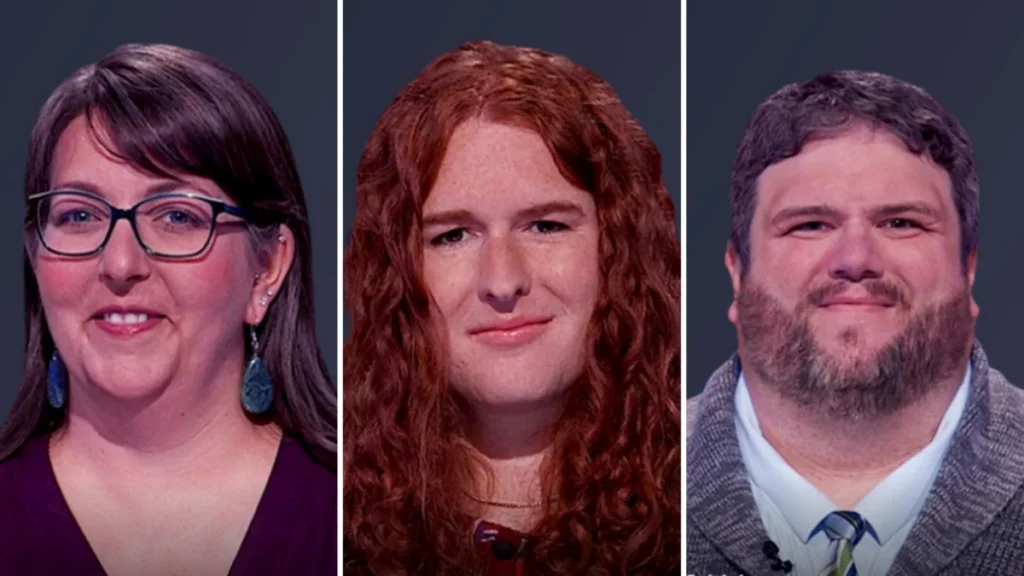

The two-day winning streak of Stefanie Landeweer, a chemistry professor hailing from Lexington Park, Maryland, came to a definitive end on the October 30 episode of the long-running quiz show Jeopardy!. Landeweer, who entered the competition with an accumulated total of $30,000, faced a rigorous challenge from two formidable opponents: Sam Neal, a knowledge management analyst from Shawnee, Kansas, and Erica Doornek, a federal employee from Glasgow, Montana. The match, characterized by high-stakes wagering and a pivotal moment during the Final Jeopardy round, ultimately saw the transition of the champion’s podium to Doornek.
A Game of Momentum and Strategic Risk
The gameplay on October 30 was defined by Landeweer’s aggressive pursuit of the Daily Doubles. Throughout the Jeopardy! and Double Jeopardy! rounds, Landeweer successfully navigated the board to locate all three Daily Doubles. This strategy is often employed by seasoned contestants to build a commanding lead and neutralize the board for their opponents. However, the inherent risk of such a strategy materialized when Landeweer provided an incorrect response on the third Daily Double. This error proved to be a critical turning point, allowing Erica Doornek to capitalize on the opening and secure the lead heading into the final stage of the game.
Historically, Landeweer had displayed resilience, having entered previous Final Jeopardy rounds without a lead and still emerging victorious. Yet, the October 30 contest presented a different set of mathematical variables. As the contestants approached the final question, the scores were tightly clustered, setting the stage for a dramatic conclusion. Erica Doornek commanded the lead with $15,000, while Landeweer trailed in second place with $11,600. Sam Neal rounded out the field with $2,400.
The Final Jeopardy Challenge
The category for the final segment was "Art & Artists." The provided clue read: "Commenting on a work by this artist, MoMA noted ‘his initial experiments with the effects of gravity & momentum on falling paint.’" The reference was a direct allusion to the iconic "drip" technique popularized by American Abstract Expressionist Jackson Pollock.
For the contestants, the pressure was exacerbated by the mechanical reality of the Final Jeopardy process. Landeweer, in a moment of extreme tension, initially wrote down "Who is Salvador Dali?" before realizing the error. With only seconds remaining on the clock, she managed to cross out the incorrect name and write "Pollock." While her response was ultimately accurate, the decision to wager $4,000—bringing her final total to $15,600—proved insufficient to overcome Doornek’s lead.
Doornek, demonstrating both accuracy and strategic betting, wagered $8,500 on the correct answer. This brought her final total to $23,500, effectively locking out both Landeweer and Neal and securing her status as the new Jeopardy! champion. Neal also answered correctly, wagering $2,399 to finish with $4,799.
Analytical Perspective on the Clue
The difficulty level of the clue became a subject of immediate discussion among the show’s dedicated viewer base on platforms such as Reddit. Many regular observers of the program categorized the "Art & Artists" clue as relatively accessible. Common sentiment suggested that the mention of "falling paint" and the specific reference to the Museum of Modern Art (MoMA) made the answer identifiable for those with a foundational knowledge of 20th-century American art.
Some fans characterized the question as a "400-level" clue, implying that in the hierarchy of Jeopardy! difficulty, this specific inquiry would typically appear as a lower-value question early in the game rather than a high-stakes final challenge. This observation highlights the variability of the show’s difficulty, where even a "simple" clue can shift the outcome of a game depending on the contestants’ specific areas of expertise and the psychological pressure of the final round.
The Evolution of Jeopardy! Wagering
The outcome of this particular game serves as a case study in the importance of wagering strategy, a component of Jeopardy! that often receives as much scrutiny as the trivia itself. In professional quiz competition, players are taught to calculate their wagers based on the potential scores of their competitors.
In this scenario, Doornek’s wager of $8,500 was a calculated move to cover Landeweer’s potential score. By maintaining a lead of $3,400 going into the final round, Doornek was in a position where, even if she had missed the question, her strategy would have been contingent on the wagers of her opponents. By correctly answering and wagering aggressively, she ensured that she would remain out of reach regardless of how Landeweer adjusted her own bet.
Landeweer’s decision to risk $4,000 was likely an attempt to reach a score that would be competitive should Doornek have wagered conservatively or missed the question. However, in the fast-paced environment of the studio, the mental agility required to cross out an incorrect answer and write the correct one in the final moments of the allotted time is a feat that few viewers have the opportunity to experience firsthand.
Broader Implications and Future Outlook
With this victory, Erica Doornek transitions from a challenger to the defending champion. As per the show’s protocol, she is slated to return for the next episode, which aired the following Monday, to defend her title against two new contestants. For Landeweer, the conclusion of her run marks a transition back to her academic career as a chemistry professor. Her two-game total of $30,000 reflects a successful, albeit abbreviated, tenure on the program.
The episode serves as a reminder of the volatility inherent in Jeopardy!. Despite one’s level of preparation, the combination of buzzer timing, the specific distribution of Daily Doubles, and the psychological weight of the Final Jeopardy wager can fundamentally alter the trajectory of any game. As Jeopardy! continues to maintain its status as a staple of American evening television, episodes like this reinforce why the program remains a subject of intense public engagement and analysis.
For fans who missed the broadcast, the show continues to air on weekdays in local syndication, with episodes available for streaming the following day on platforms such as Hulu and Peacock. The discourse surrounding the October 30 game—specifically the reaction to the "Art & Artists" clue—demonstrates the continued vitality of the Jeopardy! community, which remains deeply invested in the nuances of the game’s mechanics and the performance of its participants.
Chronology of the October 30 Match
- Initial Rounds: Landeweer dominates the board early by locating and claiming all three Daily Doubles, positioning herself as the front-runner.
- Mid-Game Shift: Landeweer misses the third Daily Double, allowing Erica Doornek to seize the lead.
- Final Jeopardy Round: The scores heading into the final clue were Doornek ($15,000), Landeweer ($11,600), and Neal ($2,400).
- The Clue: Contestants were asked to identify the artist whose "initial experiments with the effects of gravity & momentum on falling paint" were documented by MoMA.
- Resolution: Landeweer corrects her initial answer of "Salvador Dali" to "Pollock" in the final seconds. All three contestants answer correctly.
- Final Tally: Doornek wagers $8,500 to finish at $23,500; Landeweer wagers $4,000 to finish at $15,600; Neal wagers $2,399 to finish at $4,799.
- Outcome: Erica Doornek is declared the new Jeopardy! champion.
As Doornek prepares for her next appearance, the episode stands as a testament to the unpredictable nature of the competition. While the "Art & Artists" category may have been perceived as accessible, the tactical execution required to secure a victory remains a complex challenge, one that Doornek navigated with precision to secure her place in the show’s ongoing history.